“Even though the boy isn’t me, the painting somehow ended up feeling like a portrait of my own childhood.”
Between Recognition and Doubt
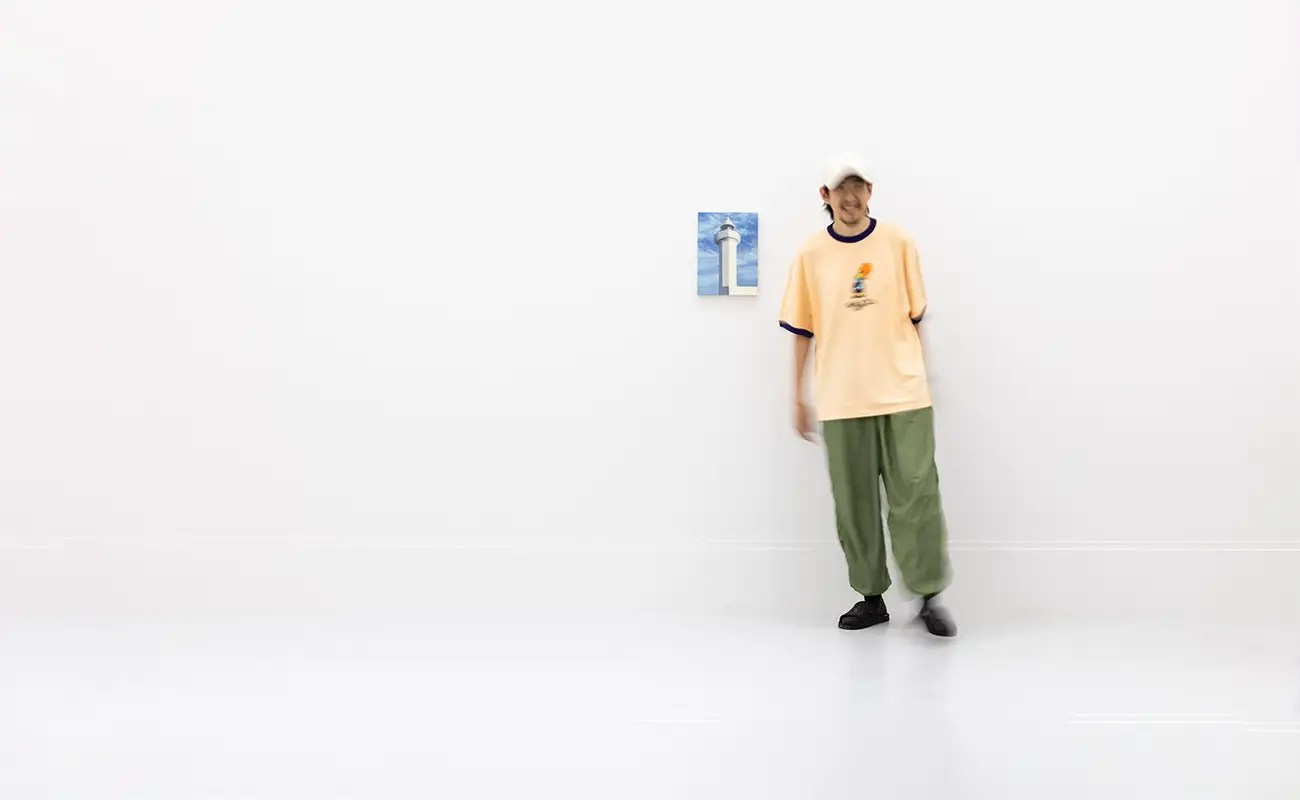
Hidetaka Suzuki paints images that appear accessible before quietly becoming difficult to place. Born in Hokkaido, Japan, in 1986 and now based in Tokyo, Suzuki has developed a practice centered on the unstable relationship between reality and fiction. His paintings often begin with recognizable subjects, yet recognition does not provide the viewer with a secure explanation. Objects and figures are removed from the circumstances that originally gave them meaning, allowing familiar imagery to become ambiguous. Working primarily in oil on canvas, Suzuki is interested in what happens when an image crosses from one context into another, particularly when painting interrupts the rapid circulation of photographs and digital pictures. His restrained compositions heighten this uncertainty by withholding unnecessary information rather than supplying a narrative. A pepper, a lemon, a person, or an anonymous visual fragment can consequently become an invitation to question how meaning is produced. What seems obvious at first can gradually reveal the instability beneath seeing itself.
That concern with perception has accompanied Suzuki from an early fascination with drawing. Manga first encouraged him to make images and imagine art as a profession, while paintings by Claude Monet, encountered during childhood, also left an important impression. Suzuki later pursued formal training at Musashino Art University, where he studied oil painting and completed his BFA in 2012 followed by his MFA in 2014. These different points of reference suggest a visual education shaped by both popular imagery and the history of painting, although his mature practice resists reducing itself to either influence. Instead, he has concentrated on a deceptively simple question: how confidently can we distinguish the authentic from the artificial? Suzuki is fascinated by the way a fake can imitate reality and reality can resemble something constructed. More importantly, he notices how easily that exchange can escape attention. Painting gives him a way to isolate such moments and make their uncertainty visible long enough for viewers to reconsider them.
The environment of Suzuki’s childhood contributes another, less immediately visible layer to this perspective. Growing up in Hokkaido, one of Japan’s colder regions, he remembers freezing temperatures as a force that influenced both his character and his way of looking at the world. Rather than presenting climate as a literal subject that must appear in every painting, Suzuki describes the experience as something formative, embedded in his sensibility. His stated inspiration is similarly understated: the small discomforts of everyday life. These slight disturbances are important because they interrupt habitual perception without necessarily announcing themselves as dramatic events. A seemingly ordinary image can contain just enough strangeness to make its status uncertain. That tension connects naturally with Suzuki’s interest in reality and fabrication. His paintings do not depend on spectacular scenarios to create unease. They locate uncertainty within images that may initially appear straightforward, asking viewers to remain with what they see rather than immediately accepting the first interpretation that recognition provides.

Hidetaka Suzuki: Painting Against the Speed of Images
Contemporary visual culture supplies Suzuki with an enormous and continually changing archive. His source material can come from photographs he has taken himself, pictures encountered online, other people’s photographs, and, more recently, AI generated imagery. These sources carry different relationships to authorship and lived experience, yet Suzuki does not organize them into rigid hierarchies. Instead, he brings them together through painting, where their original distinctions can become less stable. Images connected directly to his own life may coexist conceptually with material that has no personal connection to him. This combination has become increasingly important to his practice in Tokyo, where he describes his recent paintings as blending images discovered in daily experience with images detached from his biography. Such movement between personal and impersonal material supports his larger investigation into the relationship between the body and the image. The resulting paintings ask whether an image needs to belong to someone’s experience before it can generate memory, identification, or emotional recognition in another person.
Suzuki’s process begins with searching, selecting, and printing. He has explained that much of his studio time is spent locating motifs beyond himself, particularly through the internet. This outward search is deliberate because he wants otherness to participate in the making of his work. Once an image has been chosen, the physical act of turning it into a painting can happen comparatively quickly. He paints directly rather than preparing drafts, and he says his process consistently starts by making a print. The apparent simplicity of this sequence conceals a demanding cycle of judgment. Suzuki identifies the continuing trial and error inherent in painting as one of the greatest challenges of being an artist. His method therefore combines prolonged visual selection with direct execution, allowing the source image to pass through another medium and another set of decisions. What matters is not merely reproducing what was found. Painting changes the speed, material presence, and conditions through which that image can be encountered.
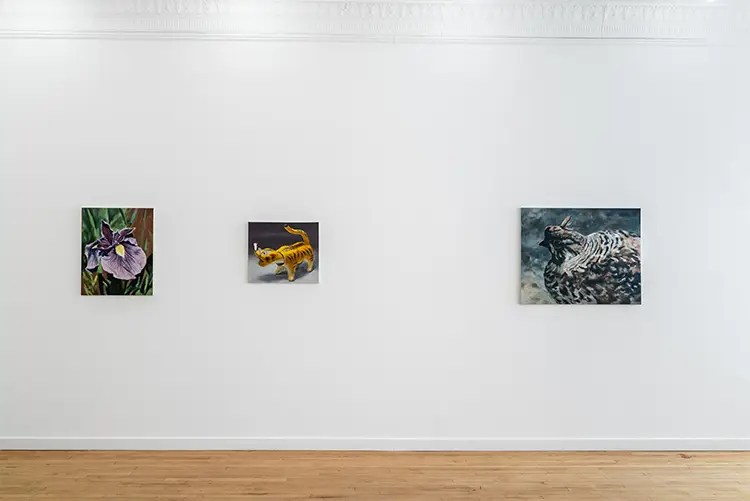
This slowing of images is fundamental to Suzuki’s artistic approach. He has described painting as a means of extending the existence of pictures that would otherwise be rapidly consumed and displaced by the immense stream of visual information surrounding contemporary life. Within that constant circulation, certain images seem worthy of interruption. Painting allows him to stop them, reconsider them, and acknowledge the human activity that may exist behind their surfaces, even if the original images eventually disappear. Oil painting is especially consequential in this context because it demands a different form of attention from the quick viewing habits associated with online imagery. Suzuki’s technically controlled surfaces and purposefully sparse compositions create a productive contrast between labor and apparently simple subject matter. Works such as Red Basket, featuring red peppers, and Bomb, centered on a half cut lemon, demonstrate how ordinary motifs can acquire unexpected intensity when isolated and sustained through paint. Rather than explaining why viewers should care about these objects, Suzuki creates conditions in which uncertainty itself becomes meaningful.
A Stranger Who Resembles a Memory
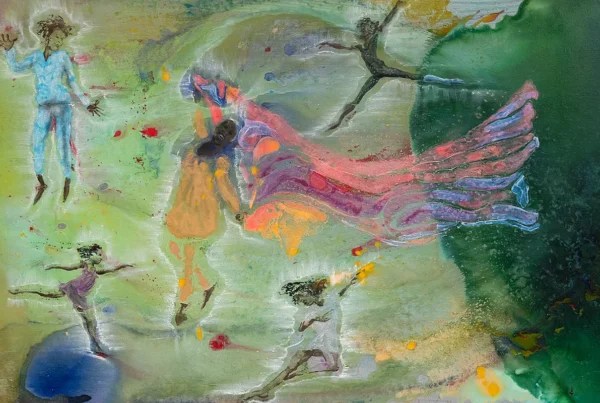
One work from Suzuki’s Paragraphia series makes the complicated relationship between image, identity, and memory especially personal. The painting depicts a boy wearing a yellow down jacket, yet the child is not Suzuki. The broader concept of Paragraphia involved creating paintings from family photographs belonging to other people, a method that intentionally placed private images from unfamiliar lives inside his artistic process. Such photographs ordinarily carry intimate histories for the families who possess them. Once removed from that setting and translated into painting, however, their meanings become open to another kind of encounter. Suzuki’s decision to work with these photographs extends his interest in otherness while complicating assumptions about portraiture. A painted person can be recognizable as an individual without being known to the viewer or even personally connected to the painter. The image therefore occupies a curious position between somebody’s documented past and a new visual object whose emotional associations are no longer controlled by its original circumstances.
The boy in the yellow jacket became particularly significant because Suzuki experienced an unexpected sense of recognition while painting him. Although the child was someone else, the finished work somehow began to feel like a portrait of Suzuki’s own childhood. That emotional shift brought the Paragraphia series to what he regarded as its natural endpoint. The significance of the painting lies precisely in this contradiction. An image borrowed from another family’s history became capable of reflecting something intimate about the artist who repainted it. The work turns Suzuki’s larger interest in reality and fiction toward the unstable character of personal memory. A portrait does not necessarily need to depict its maker in order to function as a form of self recognition, just as a photograph does not remain limited to the meaning assigned by the people who originally possessed it. Through oil painting, the unknown boy becomes both himself and an unexpected mirror, demonstrating how images can migrate between identities without resolving the distance between them.
That experience also connects with Suzuki’s renewed interest in portraiture. He painted portraits in the past and now wants to return to them, but his proposed direction preserves the ambiguity that defines his broader practice. His idea is to paint “someone who is nobody,” a phrase that turns the conventions of portraiture inside out. Portrait painting traditionally encourages questions about identity, biography, likeness, and presence. Suzuki’s concept instead proposes a figure whose identity resists those expectations. The idea follows naturally from Paragraphia, where strangers could unexpectedly carry personal resonance, and from his broader use of online and AI generated imagery, where the relationship between an image and a physically encountered subject can become increasingly complicated. In Suzuki’s hands, portraiture can therefore become less concerned with confirming who a person is than with examining why an image feels human, familiar, or credible. The face or figure becomes another site where reality and fabrication approach one another closely enough to unsettle certainty.

Hidetaka Suzuki: What Remains When Context Disappears
Suzuki’s paintings have reached audiences well beyond Tokyo, giving his questions about visual culture an increasingly international context. His solo exhibitions include Breathing at ACKERMAN CLARKE in Chicago in 2026 and Flourishing In Quietude at Hunsand Space in Hangzhou in 2025. In 2024, he presented Stereoscope at AISHO in Hong Kong, Two values at pokettales in Seoul, and Solaris at PTT Space in Taipei. Earlier solo presentations took place at biscuit gallery in Tokyo, Edel Assanti in London, and ACKERMAN CLARKE in Chicago. Recognition began earlier in his development as well. Suzuki received the Golden Acrylics prize at GEISAI#13 in 2009 and the Shell Art Award in 2013. In 2021, ArtConnect selected him for Artists to Watch ’21, while Foundwork included him in its Guest Curators Program through a selection by Emilia Yin. These milestones trace the growing visibility of a practice rooted in persistent questions rather than fixed answers.
Across these exhibitions and stages of development, Suzuki has maintained a productive tension between technical precision and conceptual uncertainty. Oil painting has long been associated with illusion, representation, and the persuasive rendering of physical appearances, qualities that make it especially suited to his investigation of images whose truthfulness remains uncertain. His compositions can be radically economical, giving isolated subjects a degree of attention they might never receive in their original contexts. Removing contextual clues does more than make an object visually prominent. It deprives the viewer of an easy explanation and permits several interpretations to exist simultaneously. That strategy is central to Suzuki’s interest in the moment when reality begins to resemble fiction and fiction acquires the credibility of reality. His paintings do not dictate which side should be trusted. Instead, they expose how heavily perception depends on framing, familiarity, memory, and expectation. The longer an image remains before us, the less secure its first meaning may become.
Suzuki is currently extending his interest in relationships between images, people, and perspectives through an exhibition being developed with two other artists around the theme of “exchange.” The project is consistent with a practice that repeatedly allows material from outside the self to enter the creative process. Whether he is searching the internet for motifs, translating AI generated imagery into oil paint, working from another family’s photograph, or considering a portrait of someone who is nobody, Suzuki keeps testing what happens when images cross boundaries. Exchange, in this sense, can be understood through the concerns already present in his work: between source and painting, reality and fabrication, stranger and self, rapid consumption and sustained attention. His continuing trial and error keeps those relationships open rather than settling them into a signature formula. For Suzuki, painting remains a place where an image can be detached, slowed, reconsidered, and allowed to become something less certain than it first appeared.