Beauty at the Edge of Disgust
Gregory Jacobsen has spent more than two decades making the body impossible to ignore. Across paintings, objects, music and performance, he returns to flesh as something desired, decorated, exposed, damaged and comic. His figures may resemble portraits, anatomical fragments, animals or invented hybrids, yet they rarely settle into a single identity. Swollen forms, open mouths, exposed organs, stray hairs and cosmetic surfaces push attraction and repulsion into the same frame. Rather than separating beauty from disgust, Jacobsen treats them as simultaneous conditions, allowing a face or body to appear glamorous, humiliating, vulnerable and absurd at once.
Born in New Jersey in 1976, Jacobsen grew up in Middlesex before moving to Chicago to study at the School of the Art Institute of Chicago, where he completed his BFA in 1998. His memories of New Jersey are sharply physical: radioactive soil stored near his neighborhood, factory fires during the 1980s and pollution entering local waterways. Music, record sleeves, magazines and books provided an early route into visual culture, and making imagery for music appealed to him before museums became a major reference point. Chicago later introduced him to the Chicago Imagists, a tradition he has said was unfamiliar to him before his arrival.
That collision of popular culture, local art history and bodily unease helps explain the paintings without reducing them to a single lineage. Jacobsen has described the punk aesthetic of the mid-1970s as dirty, glamorous, experimental and androgynous, while underground comix offered another model for visual aggression and comic distortion. Jim Nutt became important after Jacobsen settled in Chicago. Medieval painting, especially Hieronymus Bosch, supplied a different strangeness through figures enduring extraordinary events with vacant or helpless expressions. Paul McCarthy also offered a precedent for holding comedy, beauty and provocation together. These references meet in pictures that can suggest religious panels, underground graphics and theatrical sets at once.

Gregory Jacobsen: The Body as Comic Theatre
The body is not simply Jacobsen’s subject; it is the structure through which identity becomes unstable. He has described his comic and grotesque figures as stand-ins for himself, bodies through which perception and physical form can be altered. Details usually removed from idealized representation become focal points: pores, folds, hair, mouths, secretions and organs receive intense attention. Anxiety contributes to this fixation, but so does a formal fascination with shape. Jacobsen makes bodily imperfection the visual event, forcing the viewer to notice how quickly decoration can become damage and glamour can tip into embarrassment.
Many figures occupy shallow, artificial spaces that intensify this sense of performance. Jacobsen has linked the staging of earlier paintings to puppets, puppet theatres and Punch and Judy shows. He prefers enough pictorial depth to establish a scene without allowing the image to become fully illusionistic. Faces are built through a similar process of disruption. He may begin with ordinary features, then enlarge a mouth, damage a nose or distort the face until it carries the emotional pressure he wants. Smiles are especially charged because they can make suffering look rehearsed, leaving the viewer uncertain whether a figure is ecstatic, terrified, humiliated or simply posing.
Color makes that ambiguity harder to resolve. Saturated pinks, oranges, greens, blues and cosmetic tones can make flesh appear edible, diseased, decorative or synthetic. Recent oil paintings use glazing, careful modelling and finely handled detail even when the image contains damaged skin, bodily fluids or exposed anatomy. Portrait formats sharpen the contradiction because they borrow the familiar authority of headshots or school photographs while replacing a stable face with something swollen, perforated or physically impossible. The viewer recognizes the social structure of portraiture, but the body inside it refuses composure.

Making, Naming and Transforming Flesh
Jacobsen’s paintings develop through exploration rather than a fixed plan. He rarely determines the full composition in advance and instead rearranges forms as the image evolves. Drawings can supply starting points, but he avoids simply transferring a finished sketch into paint. His use of language follows a comparable method. Titles and lyrics have emerged from cut-up procedures using words collected from pulp fiction, encyclopedias and cookbooks, then edited for rhythm and effect. Alliteration and collisions between clinical, appetizing, sexual and humiliating vocabulary give the titles a physical quality of their own.
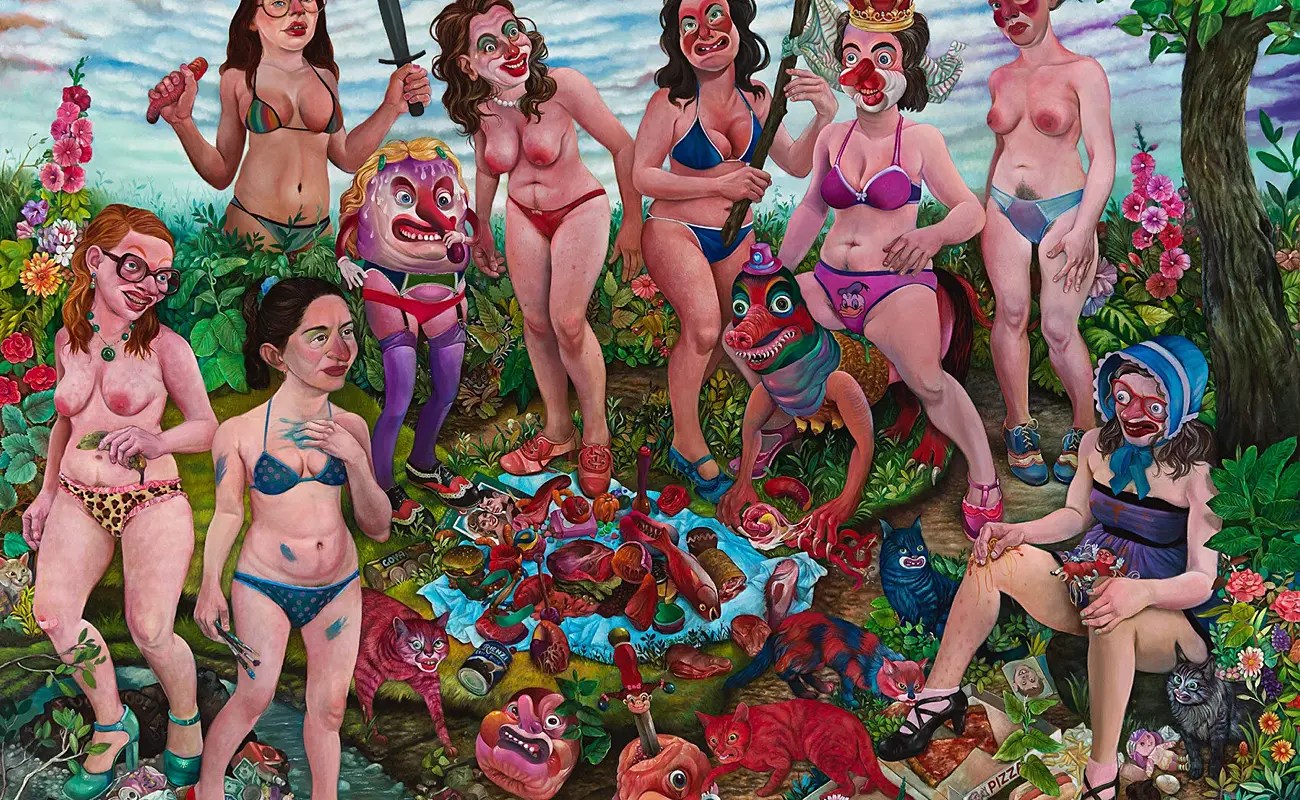
The materials of the work have shifted considerably over time. Early and mid-2000s paintings often used acrylic on panel, including works associated with Glamorous Piles & Puffy Saddlebags and Palpitating Remains. By the end of that decade, oil became increasingly prominent and later emerged as the principal medium across panel, linen and canvas. The change expanded Jacobsen’s ability to build translucent layers, model volume and produce polished surfaces without abandoning compressed compositions and graphic clarity. He has also moved images into three dimensions through painted and epoxy-coated papier mâché masks. The Day’s Bounty, a nine-by-eleven-foot oil painting, shows how his bodily theatre can also expand to enveloping scale.
Portraiture has become an especially productive framework. In the Glamour Cats series, Jacobsen applies the conventions of 1980s Glamour Shots and yearbook photography to animals. Individual hairs are carefully rendered while cosmetics, heightened expressions and controlled backgrounds impose a human language of presentation. The cats can appear dignified, anxious, ecstatic or ridiculous, shifting his concerns away from exposed anatomy without abandoning vanity and embarrassment. Later paintings bring portrait structures back into contact with the visceral piles that have occupied his work for years. Human faces, animals, organs and invented beings become variations on one problem: every body tries to present an image of itself while remaining unruly material.

Gregory Jacobsen: From Painting to Performance
Music and performance extend Jacobsen’s bodily theatre beyond the painted surface. He founded Lovely Little Girls in the early 2000s, first as a chaotic performance project and later as an elaborate Chicago art-rock ensemble. Costumes, prosthetics, unusual vocal performance, grotesque humor and theatrical staging became central to its identity. Jacobsen has described painting and performance as mutually influential, with ideas moving from one form into another. The cut-up language used for painting titles also became a method for writing song lyrics, reinforcing the connection between verbal collision and visual distortion.
His early attraction to album imagery has continued through cover work for musicians and groups including Tropical Fuck Storm, Controlled Bleeding, To Live & Shave in L.A. and Daniel Knox. These projects clarify how consistently Jacobsen treats sound, image, language and performance as connected outlets. The same concerns recur across them: bodily excess, unstable identity, comic discomfort and the desire to control how one appears. A painted smile, a costumed performer and a glamour portrait can all function as forms of display in which presentation becomes exaggerated enough to reveal vulnerability beneath it.
Jacobsen has maintained a long relationship with Zg Gallery in Chicago, with solo exhibitions extending back to the early 2000s. His paintings have appeared in institutional exhibitions including Risqué at the Long Beach Museum of Art and Altars of Madness at Casino Luxembourg and Le Confort Moderne. The Fondation Antoine de Galbert collection includes his work, while the Museum of Modern Art Library holds his artist book Still Damp and related printed material. Jacobsen has spoken about moving beyond images that operate only through provocation, and his grotesque figures repeatedly return vanity, shame, desire, vulnerability and deterioration to the self. The body in his work never settles into a clean category: it remains funny, decorative, frightening and strangely glamorous at the same time.