“It reflects how our experiences remain within us and become part of who we are.”

K2B
Black Matters
Matter After Memory
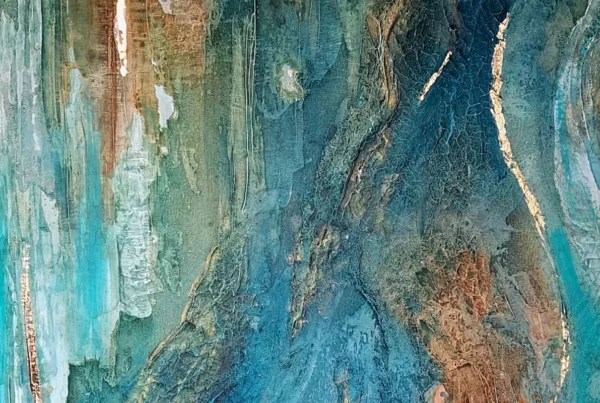
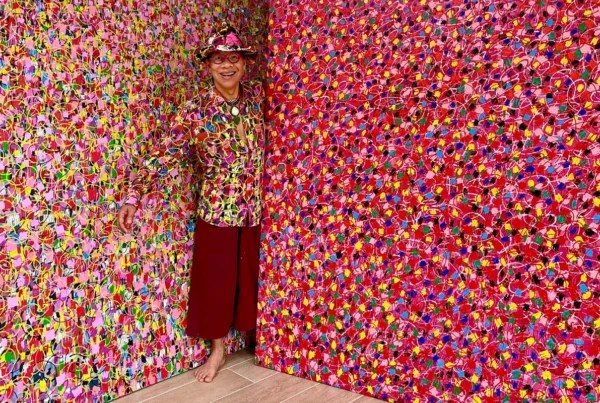
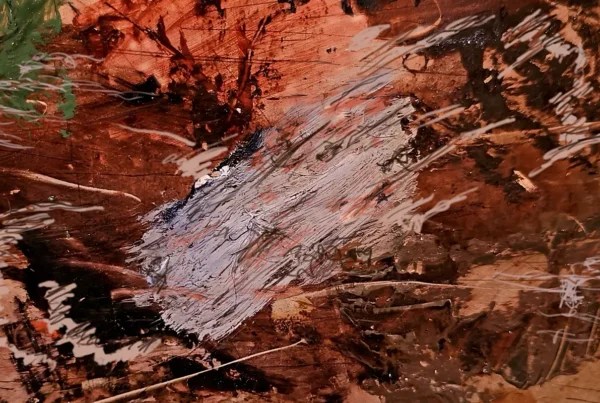
K2B, the artistic name of Swedish artist Karin Brudnicki, works between Stockholm and Italy with a practice shaped by movement, memory, and the physical character of materials. Her work spans conceptual and abstract painting, paper relief, and sculpture, often beginning with ordinary substances that already carry signs of use or exposure. Recycled paper, found wood, plastic, metal, and fragments gathered from beaches become more than raw material. They provide a way to think about what people retain, what environments leave behind, and how an object can change without losing every trace of its previous state.
Her sensitivity to such traces reaches back to a childhood spent close to nature in a small Swedish town. Forests and natural surroundings trained her attention on surfaces, textures, gradual changes, and details that might otherwise pass unnoticed. Later, moving to a large city brought a different rhythm and visual environment, while periods spent abroad, including in Albania, widened her awareness of how culture and place influence perception. Living between Sweden and Italy continues that experience of contrast, giving her practice an ongoing relationship with different landscapes, habits, and ways of seeing.
Personal relationships also inform this attention to identity and belonging. Brudnicki describes her family as central to her life, and her adopted daughter has deepened her thinking about human connection, origins, and the ways identity is formed. These concerns do not appear in her work as literal narratives. Instead, they emerge through material choices and through surfaces that suggest change, interruption, survival, and renewal. Nature, memory, transformation, presence, and absence recur because they connect the artist’s lived experience with the physical behavior of the objects she chooses to use.

Communication I
Communication II
K2B: Learning to Read What Materials Carry
Brudnicki began making art in her teenage years, initially through oil painting. Education and a long professional career later reduced the time available for studio work, but the desire to create remained. A decisive shift came around three years ago when she encountered artworks made from paper and discarded fragments during a museum visit. Their directness impressed her, particularly the idea that a modest, everyday material could be altered enough to acquire a new visual and emotional function. That experience changed the direction of her practice and brought recycled matter to the center of her work.
At roughly the same time, walks along beaches in Italy began to supply another kind of studio vocabulary. Wood, plastic, metal, and other objects found along the shoreline caught her attention not simply as debris but as material with shape, history, and potential. Their weathered or irregular condition became part of what interested her. In some works, she preserves signs of prior use, allowing dents, worn edges, tears, and uneven surfaces to contribute to the final composition. In others, she actively shapes and transforms the materials to create new surfaces and expressions. Transformation, in this sense, can preserve traces of the past while also giving the material an entirely new presence.
Her artistic references reinforce this material approach. Brudnicki cites Alberto Burri, Anselm Kiefer, Antoni Tàpies, and the Arte Povera movement as important influences. What attracts her is the capacity to give physical substances conceptual weight, and to let imperfection, everyday matter, and irregularity function as part of the work rather than as defects to conceal. Her own practice develops from that affinity while remaining grounded in her personal questions about change and belonging. The result is a visual language in which material itself carries part of the meaning.

What Remains
Gold, Fragments, and What Remains
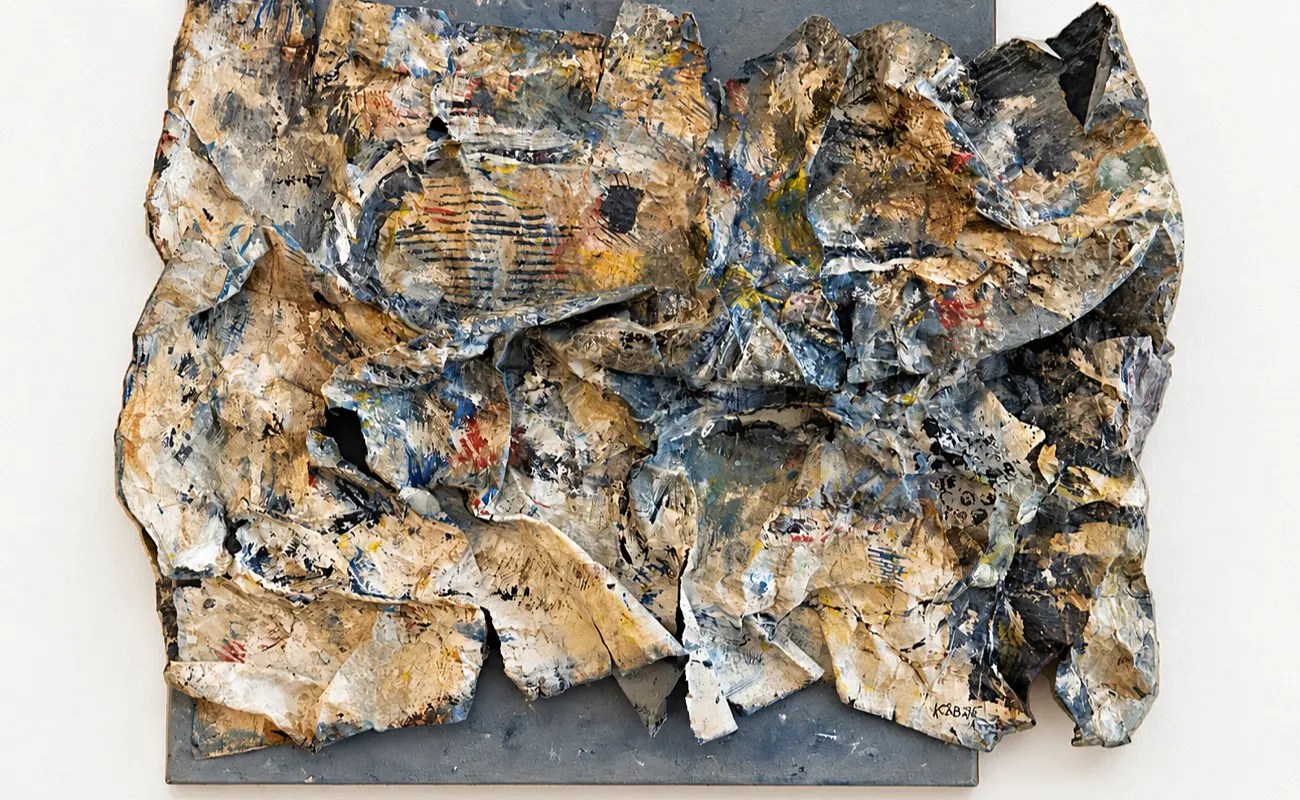
One work brings these concerns into especially clear focus. What Remains is made from paper glued onto canvas, building a surface from layers, marks, and irregularities. The relief quality of the paper makes the work dependent on light and shadow, while its accumulated texture suggests that alteration is never completely clean or final. Parts appear to have been changed, covered, or reformed, yet evidence of what came before continues to register. For Brudnicki, that persistence reflects the way experience becomes absorbed into a person over time.
Touches of gold introduce another emotional register. She associates the gold with light, hope, and the possibility of something new. Against the uneven paper surface, it does not erase traces of the past; it coexists with them. That relationship is important to the work. Some traces fade, while others remain active and may acquire a different meaning with time. The piece therefore holds memory and possibility together, suggesting that what survives from the past can become the starting point for another stage rather than a fixed reminder of what has been lost.
The tactile character of What Remains also reflects Brudnicki’s interest in the boundary between what is immediately visible and what must be sensed through attention. The viewer encounters a physical surface, but the work points beyond appearance toward experiences that cannot be fully represented. This combination of memory, transformation, and potential makes the piece especially important within her current practice. It condenses several of her central ideas into a single object while showing why paper has become such a productive medium for her: it can hold evidence, accept intervention, and change form without losing its material identity.

Within the Silences
Inner Balance
K2B: Building a Language From Transformation
In the studio, Brudnicki often begins with an idea or a feeling and may sketch or establish a basic structure before moving into a more intuitive process. Planning gives the work an initial direction, but materials are allowed to influence what happens next. She tests fragments, surfaces, and forms against one another, observing how their weight, texture, and shape alter the composition. Paper remains especially important because it can be folded, layered, torn, shaped, compressed, and rebuilt, giving her a medium that responds easily to both deliberate construction and unexpected change.
Her collecting process extends beyond the studio. Materials are gathered in nature, along shorelines, and through everyday surroundings, so the act of finding becomes part of the work’s development. A fragment enters the studio with a previous life already visible in it, and Brudnicki decides whether to preserve, rearrange, combine, or transform those traces. This method links the conceptual questions in her work to a practical way of making. Memory and identity are not added afterward as themes; they are already present in the material logic of objects that have moved through other places and uses.
The next stage of her practice is focused on creating more cohesive series, developing her sculptures, and learning further techniques such as papier-mâché. She also wants to strengthen her own visual language and continue presenting work internationally. Her recent and planned exhibition activity reflects that direction, including shows in Stockholm, Bordighera, Florence, and Barcelona, as well as representation by World of Crete at Art3f in Paris in January 2027. Brudnicki is also one of 25 artists featured in the newly published book The Art Influencers of Our Time by World Artists Org. The publication, now available on Amazon, includes her artwork What Remains, a portrait photograph, and an accompanying text about her artistic practice written by the curatorial team. She is also participating in the book The Form of the Invisible: Art as Revolution and Cure for the World, which will be presented in Rome on 3 December 2026. Across these projects, the central question remains consistent: how can a material that has already been altered, used, or discarded become the site of another possibility?