“I paint aggressively.”
Painting as an Act of Excavation
Don Mirakl approaches painting as a physical encounter in which construction and destruction become inseparable. Born Ondra Mikl in Brno in 1988, the Czech artist, graphic artist, musician, and secondary school teacher has developed a visual language shaped by experimental processes, automatic drawing, action painting, digital art, and materially dense mixed media. His works resist the polished surface. Paint is accumulated, disturbed, scratched, covered, and exposed again, allowing earlier decisions to remain visible beneath subsequent interventions. Portraiture and ambiguous human forms recur throughout his practice, alongside the visionary series Child of Eternity, The Blue Period, and The Bubblegum Period. Rather than presenting the figure as a stable likeness, Mirakl often reduces it to an uncertain presence within a scarred pictorial field. This tension between recognition and disappearance gives his work much of its psychological force, inviting viewers to search through layers rather than receive an image immediately.
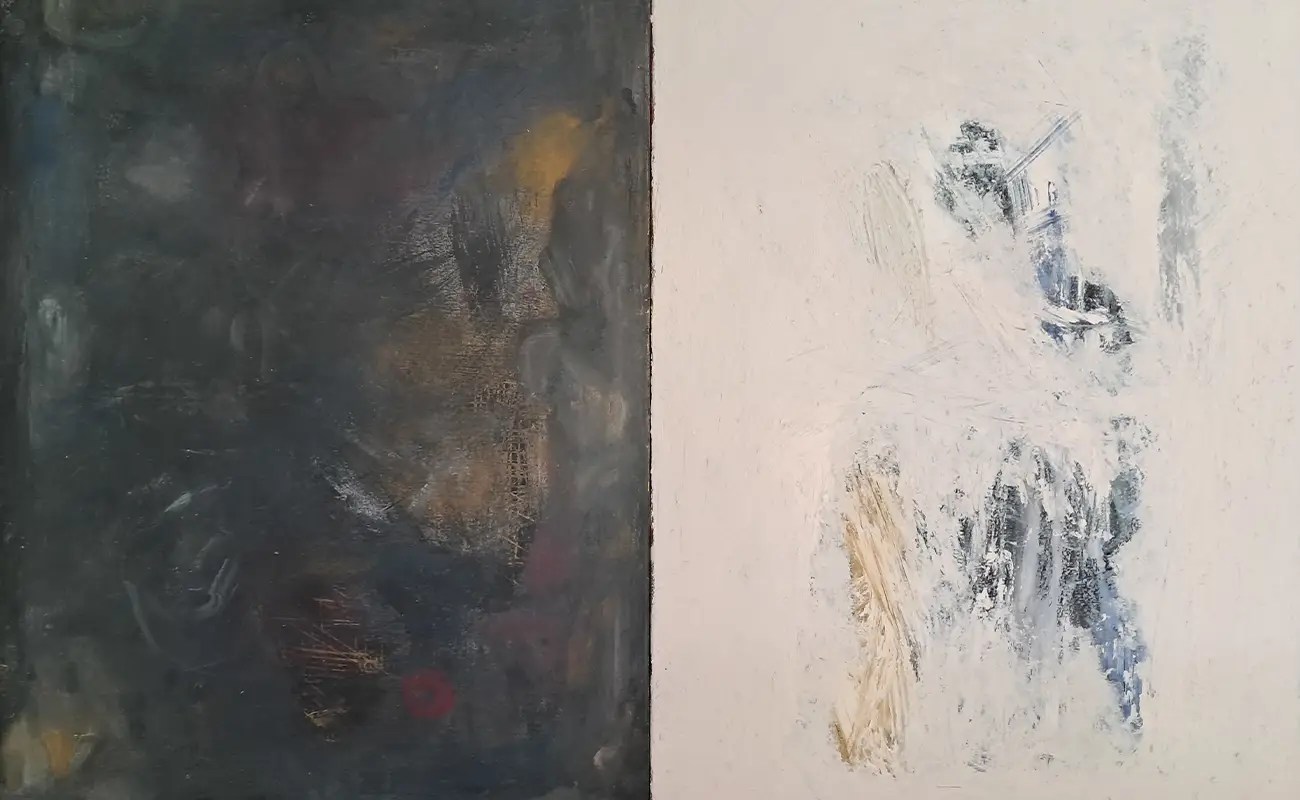
The physical character of Mirakl’s process is fundamental to understanding these paintings. He combines acrylic, oil, charcoal, ink, oil pastel, collage, torn paper, printed fragments, and handwritten text, building surfaces that can withstand forceful intervention. Heavy canvas and thick cardboard provide the durability required for his aggressive working methods. Brushes and palette knives move quickly across the support before scraper tools and sharp objects cut back into fresh material. Scratching and gouging reveal colors that had already disappeared beneath newer applications, making subtraction just as consequential as addition. Old book pages and fragments of language may be inserted between layers, only to become partially obscured by paint. The resulting surfaces preserve evidence of revision, interruption, and resistance. Instead of concealing the history of their making, Mirakl allows that history to remain exposed through scars, irregular edges, buried typography, broken lines, and passages where one visual decision continues to haunt another.
Color reinforces this sense of emotional excavation. Mirakl frequently restricts himself to black, chalk-like white, grey, brown, and other earthy or smoky tones, creating an atmosphere that can feel austere, weathered, and psychologically compressed. Yet restrained fields are sometimes interrupted by concealed flashes of teal, azure, turquoise, violet, or blue. These colors are rarely allowed to dominate. They emerge from beneath darker material, appearing almost as remnants that have survived an act of covering. Within The Blue Period, this approach gives color a psychological rather than simply descriptive purpose. Blue becomes an interruption, a concentrated visual event within surfaces otherwise governed by erosion and restraint. The contrast reflects a broader rhythm within Mirakl’s work, where density meets emptiness, violent gestures encounter fragile marks, and monochromatic passages coexist with sudden chromatic intensity. His paintings consequently communicate through both what they reveal and what they refuse to make fully accessible.

Don Mirakl: Figures Without Fixed Identities
Human presence occupies an unusual position in Mirakl’s visual vocabulary. Although portraits form a major part of his output, his figures often move away from conventional portraiture toward abstraction and psychological suggestion. He describes them as blurry, non-specific, abstract, and androgynous, frequently removing the eyes that would ordinarily establish direct emotional contact between subject and viewer. This absence changes the function of the face. Rather than communicating identity through recognizable features, the figure becomes an uncertain sign embedded within the material structure of the painting. Rough charcoal lines may suggest a body without defining it, while layers of paint obscure forms that might otherwise appear complete. Handwritten words and fragments of printed text further complicate the image, introducing language without necessarily resolving its meaning. Mirakl therefore positions the human form between visibility and erasure, allowing it to appear present yet inaccessible, familiar yet resistant to conventional interpretation.
This ambiguity is especially relevant to Child of Eternity and the related visionary dimension of Mirakl’s practice. The figures in these works can operate less as descriptions of individual people than as psychological presences. Frames, enclosures, apertures, and portal-like structures recur around or near anthropomorphic shapes, producing a visual tension between containment and emergence. Such elements introduce an architectural logic into otherwise intuitive compositions. A figure may seem caught inside a boundary, discovered beneath a damaged surface, or positioned at the threshold of an undefined space. Mirakl does not provide a fixed narrative that explains these recurring forms, leaving their relationships open. His engagement with philosophy, psychology, anthropology, and literature offers an intellectual context for this uncertainty without turning the paintings into illustrations of specific theories. The images remain rooted in material action, while their unresolved figures encourage questions about perception, memory, identity, concealment, and the unstable ways in which meaning can appear.
Mirakl’s interest in portraiture also has a substantial history within his wider production. He is the author of approximately 200 graphic works and portraits, and ten of his portraits appeared in the publication 36 Artists To Follow. His work has also entered public and private collections across Europe. Public holdings include the European Art Museum and Gallery Gal in Frederiksværk, Denmark, the Osten Museum of Drawing in Skopje, North Macedonia, and collections associated with Louka Monastery and the Picture Gallery in Znojmo. His exhibition record extends beyond the Czech Republic through collective presentations in Austria, Denmark, France, Italy, North Macedonia, Ukraine, and the United States, alongside solo exhibitions in Czech locations including Brno and Veselí nad Moravou. At the time of his account, he also had a solo exhibition in the spa town of Poděbrady and participated in a group exhibition in Prague, situating his ongoing experimentation within an active exhibition practice.

Improvisation, Philosophy, and the Productive Accident
Mirakl describes himself as self-taught as an artist, yet his intellectual background provides another important foundation for his practice. After primary school in Bzenec and studies in Information Technology in Economics at the Business Academy in Veselí nad Moravou, he graduated from the Teacher Training College at Masaryk University in Brno, studying General Theory and History of Art and Culture. His continuing interests include art history, philosophy, psychology, and anthropology, subjects that expand the conceptual environment surrounding his visual work. Literature, particularly philosophical writing, is among his strongest sources of influence. These interests do not appear as straightforward references that require viewers to recognize a particular author or theory. Instead, they support an artistic attitude centered on uncertainty, interpretation, memory, and the unstable relationship between visible surfaces and concealed information. The repeated act of covering and recovering material becomes especially resonant in a practice informed by questions about human thought, culture, and perception.
Music provides another route into Mirakl’s creative thinking. He plays piano and guitar, identifies himself as an enthusiastic listener of jazz, and has composed music for the projects Uchožrout, also known as Eareater, and Lunapark. The improvisational character associated with jazz offers a useful parallel to his painting process because his compositions develop through action, response, interruption, and revision rather than through a rigidly predetermined sequence. Automatic drawing similarly gives spontaneous marks an active role in determining what happens next. A line can provoke a layer, a layer can be damaged, and the resulting exposure can redirect the composition. This responsive method allows the artwork to develop through accumulated decisions rather than a single fixed plan. His paintings consequently carry a sense of duration within them. Scratches, stains, buried paper, rough charcoal, and exposed colors register successive moments of making, while the completed surface retains traces of the changes that occurred along the way.
Other artists and direct encounters with major exhibitions have also affected Mirakl. He recalls being deeply moved by an Anselm Kiefer exhibition in Florence and by visiting the Venice Biennale in 2026. The connection to Kiefer is particularly understandable in relation to distressed surfaces, embedded language, physical material, and the capacity of a painting to suggest memory through its own substance. Mirakl’s practice, however, is described through his own recurring combination of automatic processes, spectral figures, buried typography, restrained color, and forceful scratching. These elements create a more intimate vocabulary based on repeated acts of concealment and recovery. His influences therefore operate as points of stimulation rather than templates. Literature, philosophical inquiry, jazz, encounters with painting, and international exhibitions enter a process that ultimately depends on his direct negotiation with materials. Each work becomes a site where intellectual curiosity and physical improvisation can coexist without either one fully controlling the result.

Don Mirakl: Building, Damaging, and Beginning Again
The statement “I paint aggressively” compresses Mirakl’s method into three words, but the aggression he describes is not simply expressive spectacle. It has practical consequences for the construction of every surface. Thick cardboard or heavy-duty canvas is selected because lighter materials might not tolerate the repeated scratching and gouging that follow the application of paint. Acrylics, oils, charcoal, inks, and oil pastels can occupy the same composition, while paper and text fragments introduce different densities and textures. Fresh layers are not treated as finished statements. Mirakl attacks them almost immediately, cutting through their surfaces to expose previous colors and decisions. Palette knives, scrapers, and sharp tools become instruments of both image making and image removal. The weathered appearance that results is intentional, but it remains tied to a working process in which imperfection is produced through actual physical revision rather than simulated as a decorative effect. Damage becomes another method of drawing.
That approach is being pushed to an expanded physical scale in Mirakl’s current work on a five-meter canvas. The project continues his reliance on thick paint, numerous layers, and aggressive brushwork while dramatically enlarging the space across which those gestures can operate. Scale matters in a practice so dependent on bodily movement and material resistance. A larger canvas changes the distance a brush must travel, the reach required to scratch through paint, and the relationship between individual marks and the overall composition. Yet the essential principles remain consistent with his smaller works: accumulation followed by disturbance, concealment followed by exposure, and intuitive action balanced against selective restraint. The project also reflects the persistence of an artist whose creative life operates alongside teaching. Mirakl teaches art and information technology at a grammar school in Strážnice and lives and works in Bzenec and Uherské Hradiště, maintaining connections between artistic production, education, technology, and theoretical study.
Across these different activities, Mirakl’s practice is held together by an interest in what remains after an image has been altered. His paintings preserve traces instead of erasing their own history. A hidden blue can survive beneath black; a printed sentence can remain partially readable under acrylic; a face can lose its eyes and still communicate presence; a charcoal line can interrupt an expanse of pale paint without becoming a complete figure. Such details make his surfaces records of searching rather than declarations of certainty. The Child of Eternity, Blue Period, and Bubblegum Period series extend this investigation through different visual conditions while retaining his interest in portraits, visions, and psychologically charged abstraction. Mirakl’s art ultimately depends on a productive contradiction: he creates through damage, discovers through concealment, and allows fragments to carry more weight than polished resolution. The painting becomes evidence of a process in which making and unmaking continuously shape one another.