“I believe that I was born to paint, to create art!”
From Interior Pressure to Visual Music
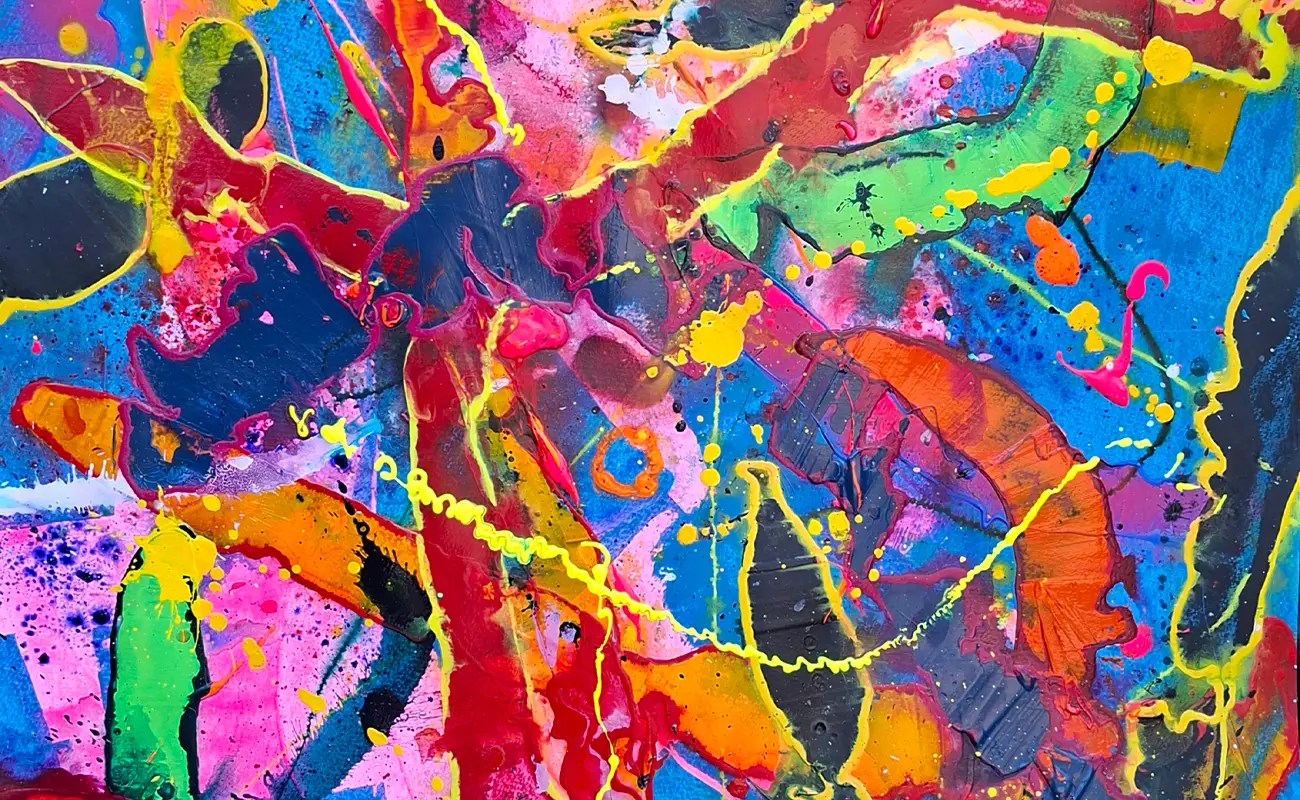
Paul Bellingham has spent roughly six decades making art, but the paintings he produces now are rooted in a period of profound personal and artistic change. Working primarily in contemporary abstraction and what he describes as post abstract expressionism, he builds vivid compositions from acrylic washes, dense acrylic passages, Posca pen, oil glazes, oilstick, and more recently acrylic inks. The resulting surfaces are restless and layered, animated by bold color, graphic contour, staining, drips, and shifting organic forms. They retain the immediacy of spontaneous painting while showing the hand of an artist who has spent years testing how different materials can interrupt, absorb, cover, and reactivate one another.
His path toward abstraction was gradual. Bellingham grew up in Essex in the south of England and recalls a difficult childhood shaped by isolation. Drawing and writing stories offered a private space from an early age, and art remained a constant even as adolescence brought drugs, alcohol, and later serious consequences for his mental health. He continued to work with figuration for many years and still attends life drawing sessions, but his painting increasingly moved away from representation toward a language that could hold interior experience more directly.
That shift did not erase the figure so much as loosen its boundaries. In many of Bellingham’s paintings, loops, blocks, ribbons, splashes, and irregular shapes gather into dense fields that occasionally suggest heads, bodies, or presences without settling into fixed representation. Other works distribute activity across almost the entire surface, making the eye travel rather than rest on one dominant motif. He describes the work as a reflection of his interior life and of the human condition. Its intensity comes from allowing unstable forms to remain active, with color and gesture carrying emotional weight where narrative once did.

Paul Bellingham: Recovery as a Change in Color
At the age of fifty, Bellingham entered recovery from alcohol and drug addiction. He connects the transformation that followed with a major change in his art. Earlier work could be dark in its depictions of life, while the paintings that emerged through recovery became, in his view, more hopeful and unexpectedly beautiful. Thirteen years of recovery through 12 step fellowships and a spiritual path have given him a different relationship with daily life, creativity, friendship, and the act of making. The change is not presented as a clean break with the past, but as an ongoing process in which experience is carried forward and converted into new visual energy.
Color became central to that change. Electric blues, acidic greens, hot pinks, yellows, oranges, and deep reds collide with black and darker deposits, producing paintings that can feel exuberant and volatile at once. The chromatic force is never merely decorative. Bellingham links his bold use of color and form partly to his earlier experience with psychedelics, yet the current work also reflects a renewed attachment to life. Saturation, contrast, and movement communicate energy without requiring the paintings to resolve into a single emotional key.
His practice has also become closely tied to spirituality and nature. Bellingham practices Centering Prayer meditation and spends time walking in nearby woods, experiences he feels have made the work more organic. Rather than planning a final image in advance, he allows forms to develop through accumulation and response. Translucent washes reveal earlier decisions, thicker passages create physical weight, and drawn outlines sometimes contain or redirect more spontaneous gestures. The friction between freedom and structure gives the paintings their distinctive pulse, keeping improvisation visible without letting the composition dissolve into accident.

The Discipline of Improvisation
Jazz is one of the clearest parallels Bellingham uses for his work. He listens to it constantly, including while painting, and thinks of the paintings as a form of visual jazz. The comparison is visible in the way his compositions move. Repeated marks establish a kind of rhythm, unexpected shapes interrupt it, and layers arrive like variations that change the meaning of what came before. Harmony is possible, but so is cacophony. What matters is the energy created by their coexistence. This way of working turns the canvas into a site of call and response, where one mark provokes the next rather than serving a predetermined design.
His references are wide ranging. Bellingham has studied art history for years and names Caravaggio, Rembrandt, Van Gogh, Picasso, and Matisse among his enduring interests, alongside Surrealists such as Yves Tanguy, Salvador Dali, Rene Magritte, and Paul Delvaux. In abstraction, he points to Jackson Pollock, the later work of John Hoyland, Tomory Dodge, and Jade Fadojutimi. He is also drawn to the quantum world, from the microscopic to the vast, a scale of thinking that fits his interest in forms that seem to mutate, collide, and reorganize themselves.
His formal education arrived later in life and required persistence. Two years ago, Bellingham completed a BA in Fine Art at the University of Chichester after nine years of study. He was subsequently accepted onto a diploma course at the Royal College of Art that would have preceded an MA, but burnout made the prospect of three more years of academic study and a daily Brighton to London commute impossible. The decision was disappointing, yet it did not interrupt his practice. He continued to work daily, outside an institutional structure, because painting remained the essential activity. The academic route stopped, but the discipline of returning to the studio did not.

Paul Bellingham: A Studio Built Around Continuity
Bellingham works in his flat in Brighton, a space that functions as both studio and refuge. His process is daily and materially direct. Over the past two and a half years, his work has moved toward a style based mainly on acrylics and acrylic inks applied to canvas, wood panels, and large heavy sheets of watercolor paper. Across these supports, staining, drawing, poured passages, scratches, and raised edges coexist, creating surfaces in which the physical history of making remains visible. A free flowing wash may sit beside a sharply articulated contour, while a thicker layer can partially bury an earlier decision without fully erasing it.
One painting from his degree show holds particular significance. The six foot square canvas from his Cascade series embodies the practice he developed between 2022 and 2024. Built with acrylic washes, acrylics, Posca pens, oil glazes, and oilsticks, it brings together the layered methods that define his approach. The work does not depend on a conventional focal point. Instead, energy circulates across the surface through color, gesture, contour, and changing densities, allowing the composition to feel active from edge to edge.
Bellingham does not claim to know exactly where the work will go next. He expects it to reveal itself over time, with bold and vibrant color remaining at the center of his visual language. Travel, close relationships, friendship, recovery, spirituality, and a renewed love of life continue to feed the work, but painting itself remains the constant. He believes he was born to create art, and that conviction is less a statement of destiny than a description of sustained practice: a life organized around looking, making, changing, and beginning again.