“Ultimately, by giving the dobermans a space in the fine art world, I give myself a space in the fine art world, a world typically dominated by men.”
Where Internet Memory Meets the Painted Surface
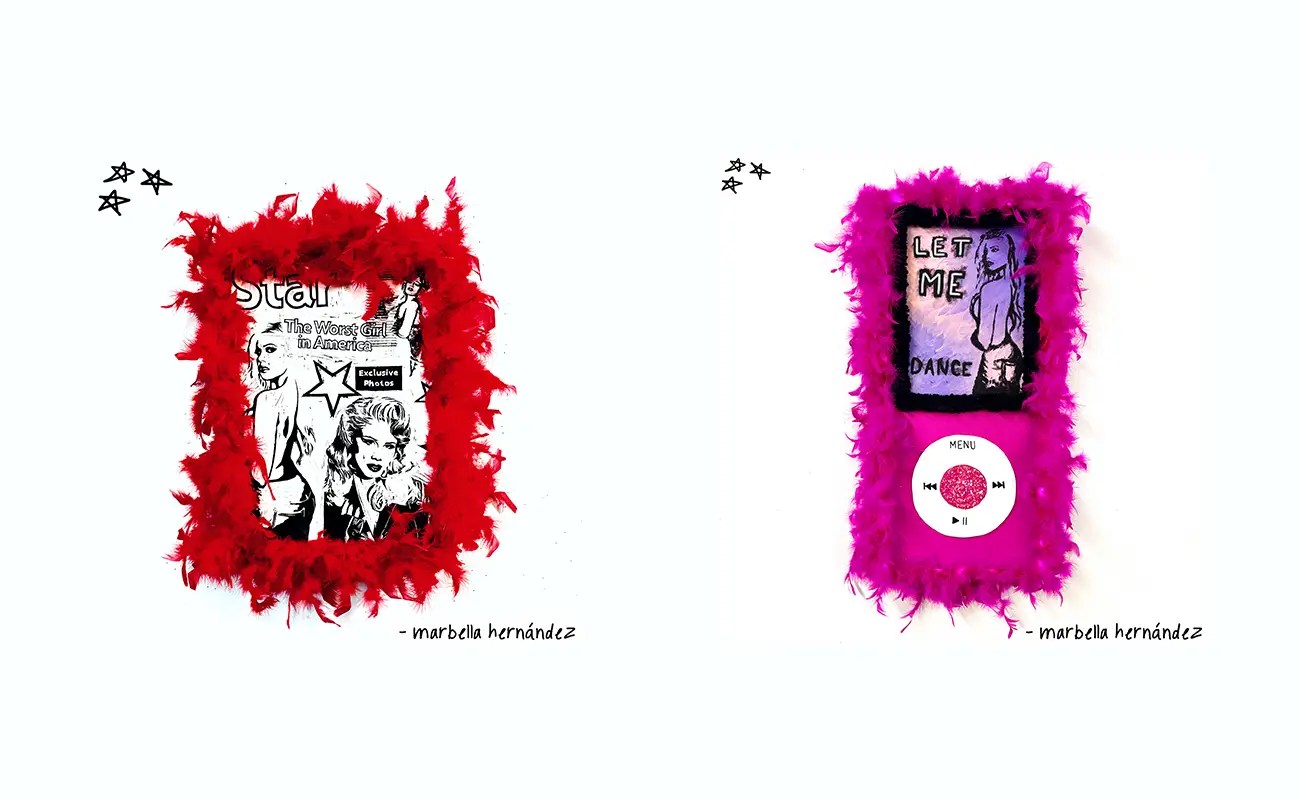
Marbella Hernandez approaches contemporary painting as a collision of personal memory, popular culture, urban experience, and an unapologetically playful visual attitude. Based in Dallas, Texas, the mixed media painter primarily works with acrylic while allowing materials and processes from craft traditions to enter the conversation. Her creative identity is deeply connected to growing up in Houston during the 2000s and 2010s, particularly at a moment when internet culture increasingly shaped how young people encountered music, humor, fashion, identity, and one another. Rather than separating those influences into neat categories, Hernandez brings them together. The everyday imagery of her upbringing can coexist with references to music videos, memes, femininity, and the attitudes of alternative youth culture. Her paintings consequently become spaces where seemingly casual cultural fragments acquire greater weight. Bright colors and camp sensibilities make the work immediately energetic, but beneath that surface lies an artist interested in social structures, sexuality, protest, economic inequality, and the question of who is permitted to occupy cultural spaces.
Hernandez did not initially establish her artistic practice in Houston. A decisive change arrived in 2022, when she relocated from Houston to the Dallas area to study painting at The University of Texas at Arlington. Her relationship with the medium intensified there, transforming painting from an academic pursuit into the form through which she could most effectively articulate her perspective. She discovered that the painted image could function as a voice, giving her a way to address subjects that mattered personally while retaining humor, color, and visual excess. Socioeconomic conditions, sexuality, femininity, and protest became recurring concerns rather than isolated subjects. These themes are not presented through restrained aesthetics. Hernandez describes her style with the word “audacious,” an apt characterization of paintings built around bold color, camp, and a punk inflection. That combination gives her work a productive tension. Serious questions can emerge from imagery associated with entertainment or online culture, while playful surfaces can carry observations about prejudice, representation, gender, and social power.
This tension also reflects Hernandez’s refusal to treat the experiences of her youth as culturally disposable. Internet memes, music videos, teenage listening habits, and memories of Houston are not peripheral references in her practice. They are part of the visual vocabulary through which she understands herself and the culture surrounding her. Her paintings bridge ordinary urban experience and pop culture precisely because those categories were already intertwined in her formative years. What she encountered on screens existed alongside what she experienced in daily life, and both became material for artistic reinterpretation. Hernandez therefore creates from a perspective shaped by accumulation. An image can carry the memory of a music video, the attitude of a pop song, a childhood association, and a contemporary social concern simultaneously. The result is work that embraces abundance rather than purification. By allowing personal history and mass media to occupy the same surface, she treats painting as a place where identity can remain complicated, contradictory, humorous, politically alert, and continuously unfinished.

Marbella Hernandez: Building a Language from Everything She Learned
The hybrid character of Hernandez’s work extends far beyond subject matter. Her technical vocabulary has developed from skills acquired at radically different moments in her life, and she actively combines processes that conventional artistic hierarchies might keep separate. Sewing techniques learned at seven can enter into conversation with acrylic painting methods acquired at twenty one. Crochet skills dating from age nine can be reconsidered beside carpentry knowledge learned at twenty. For Hernandez, these combinations are not simply evidence of versatility. They express a broader commitment to creativity without restrictive boundaries. A painting does not need to remain exclusively painted, nor does a technique associated with craft need to stay outside the language of contemporary fine art. Her practice instead treats accumulated knowledge as an expanding set of possibilities. Skills from childhood remain available rather than becoming obsolete, while later technical training gives her new ways to activate them. The physical construction of the work therefore mirrors the way Hernandez gathers cultural references, combining separate histories until they form a distinctly personal visual language.
Her sources of inspiration operate through the same process of combination. Hernandez describes the work as a celebration of both the person she once was and the person she is becoming, which makes autobiography an active resource rather than a fixed narrative. Memories of childhood in Houston can be placed beside the music she listens to today. Images remembered from music videos can interact with memes encountered during her formative years online. Each reference is removed from its original setting and brought into a new relationship with the others. Music has particular importance within this network. Hernandez identifies singer Slayyyter as a major influence, especially because of the artist’s treatment of femininity and her willingness to address upbringing, sexuality, and lived experience through alternative pop. Hernandez recognizes a parallel between that musical approach and her own painting practice. Where Slayyyter works through songs, Hernandez uses color, imagery, material, and construction to consider similarly personal subjects and the social expectations attached to them.
The music of Hernandez’s teenage years also remains embedded in her aesthetic sensibility. Pop punk, rock, and emo were significant parts of her listening life, and traces of those genres continue to appear in small ways throughout her paintings. Their presence helps explain the punk edge that complicates the brighter, campier qualities of her visual language. Rather than reproducing the aesthetics of a particular musical subculture literally, Hernandez allows those earlier influences to filter into attitude, detail, and energy. This approach makes nostalgia more than a backward glance. Childhood memories, adolescent media, and present day interests are continually reorganized according to the artist she is becoming. Such movement is central to her practice because it prevents biography from settling into a single story. Hernandez can acknowledge where her ideas originate while changing what those sources mean through new combinations. Her work becomes a record of continuity and transformation, showing how creative identity can grow by retaining old skills, revisiting formative media, and permitting unexpected relationships between them.

The Doberman as Image, Stereotype, and Claim to Space
The clearest concentration of Hernandez’s social concerns can be found in Good Dog or Bad Dog?, the work she identifies as her most meaningful piece to date. Measuring 68 by 50 inches, the mixed media painting is made on unstretched cotton canvas using acrylic, gesso, screws, spray paint, and thread. Its material range immediately reflects Hernandez’s interest in breaking down distinctions between painting, construction, and craft. At the center of the composition are three Dobermans, animals chosen not simply for their appearance but for the assumptions that frequently surround them. Hernandez is interested in the breed’s reputation for aggression and in stereotypes connecting Dobermans with ownership by people of color. That association becomes the basis for a broader examination of prejudice. Just as observers may see a particular dog and make an immediate judgment about danger, Hernandez draws attention to the ways people of color can be subjected to assumptions of aggression before their individuality is considered. The dogs thus become a vehicle for examining racism and socioeconomic injustice through an image that is both recognizable and charged.
The significance of the Dobermans is also rooted in Hernandez’s personal history with animals. She grew up around dogs, all of them rescues, giving the subject an autobiographical dimension alongside its social commentary. Yet her decision to paint Dobermans was equally motivated by what she perceives within fine art representation. Rather than choosing breeds such as poodles or golden retrievers, which she associates more readily with established fine art imagery, Hernandez wanted to create room for dogs that she believes are less commonly granted that position. This act of representation carries a second meaning. Giving the Doberman space inside fine art becomes connected to Hernandez’s own effort to claim space within an art world she sees as historically dominated by men. The animal is therefore not merely a symbol imposed upon the painting. It connects memories of rescued dogs, racial stereotyping, economic inequality, gendered structures, and questions of cultural legitimacy. A familiar subject becomes a way to ask who receives acceptance before judgment and who must fight to be seen differently.
The materials of Good Dog or Bad Dog? reinforce this challenge to established boundaries. Acrylic and gesso sit alongside screws, spray paint, and thread, making the work physically embody Hernandez’s desire to bring craft processes into dialogue with fine art practices. Thread is not treated as secondary simply because it carries associations with sewing or handcraft, just as the Doberman is not considered unworthy of representation because of cultural stereotypes surrounding the breed. These decisions reveal a consistent principle running through Hernandez’s practice: categories become most interesting when their boundaries are questioned. Her commitment to craft is particularly important because she wants techniques and materials often positioned outside conventional fine art traditions to receive meaningful space within them. In this sense, the painting makes several claims at once. It argues for the complexity of an animal reduced to stereotype, confronts racialized assumptions about aggression, considers socioeconomic injustice, asserts Hernandez’s own presence as a woman in fine art, and validates forms of making that she believes deserve greater recognition.

Marbella Hernandez: Shaping the Next Surface
Hernandez’s working process remains closely connected to the internet culture that helped form her perspective. Rather than treating online media merely as distraction or entertainment, she uses it as an active research environment. Recently, this has meant returning to music videos she watched while growing up and reconsidering them through the eyes of her current practice. She studies fragments and extracts visual snippets that can trigger ideas for paintings, allowing familiar imagery to take on new possibilities when separated from its original context. This process resembles the way memory itself operates, with particular colors, scenes, gestures, or moods surviving long after the complete source has faded from immediate attention. By revisiting those videos intentionally, Hernandez can compare the media that influenced her younger self with the concerns that occupy her now. The process also maintains continuity with her established method of combining personal history and contemporary interests. The internet remains both an archive of her formative culture and a living source from which new visual connections can emerge.
Those investigations are feeding into a new series that Hernandez is currently brainstorming. Femininity will become a central concern, extending a subject already present in her work and in the musical influences she values. At the same time, the project is intended to advance her technical experimentation. Hernandez hopes to produce the paintings on Masonite panels rather than relying solely on conventional rectangular supports. Using a jigsaw, she plans to shape the panels herself, introducing construction directly into the form of each work before painting begins. The choice is consistent with her interest in carpentry and with a broader practice that refuses to keep technical disciplines isolated from one another. Instead of regarding the support as a neutral background, she can make its silhouette part of the artwork’s visual language. Such an approach offers another way for her to test the relationship between painting and object, while maintaining the boldness, cultural references, and personal concerns that already characterize her work.
Hernandez hopes the forthcoming series will function both as a celebration of what she has already made and as an opening toward new opportunities in the art world. That balance between continuity and expansion closely reflects the larger structure of her practice. She does not abandon sewing when she learns painting, childhood memories when she discovers new music, or internet culture when she begins addressing serious social questions. Instead, each stage adds another possibility to what can enter the work. Her planned shaped Masonite paintings continue this pattern by connecting painting with fabrication while directing greater attention toward femininity and the media images that informed her upbringing. The ambition is not simply to change surfaces for novelty. It is to extend a creative philosophy in which technique, identity, popular culture, and social commentary can remain mobile. For Hernandez, artistic development appears to mean increasing the number of connections she can make, then finding forms bold enough to hold them together without reducing their contradictions.