Stories Written in Oil Rather Than Words
Born in 1999, Tina Figarelli has established a distinctive voice within contemporary figurative realism by combining classical technique with intimate storytelling. Originally from the Chicago area and working from her studio while connected to East Oaks Studio in Raleigh, North Carolina, she approaches painting as more than an exercise in representation. Every composition is built around an emotional narrative, inviting viewers to experience moments of grief, love, remembrance, and quiet reflection through carefully observed figures, interiors, portraits, and still life. Her paintings possess the atmosphere of personal memories, encouraging sustained attention rather than immediate interpretation. Instead of relying on dramatic action, she allows gesture, light, color, and subtle symbolism to carry meaning, creating works that unfold gradually as viewers spend time with them. This narrative instinct traces back to childhood, when she imagined becoming an author and filled pages with elaborate stories. Although her creative language eventually shifted from writing to painting, that early fascination with storytelling remains central to her artistic identity, transforming each canvas into a visual narrative shaped by feeling, observation, and emotional honesty.
Rather than treating realism as an end in itself, Figarelli uses technical precision to support emotional expression. Portraits become opportunities to communicate inner experience, while familiar domestic spaces and carefully arranged still lifes carry personal significance beyond their immediate appearance. Her paintings seek to capture the emotional character of a subject instead of simply recording physical likeness, creating images that feel intimate without becoming sentimental. Every compositional choice contributes to a broader narrative structure, allowing viewers to discover meaning through atmosphere as much as through recognizable subject matter. This thoughtful balance between craftsmanship and storytelling distinguishes her work within contemporary realism, demonstrating that classical methods can remain deeply relevant when paired with authentic personal vision. By inviting audiences into carefully constructed moments of tenderness, vulnerability, and remembrance, Figarelli transforms ordinary scenes into emotionally resonant experiences that continue to reveal new layers over time.
The artist’s commitment to sincerity extends into every aspect of her practice. She begins many paintings with a title, a narrative concept, or a specific emotional question before developing the visual composition capable of expressing it. Sometimes this process grows from existing references, while other projects require entirely new photo sessions designed around the intended story. Throughout the painting process, she describes the work as an ongoing conversation, allowing the image to evolve as its colors, relationships, and emotional direction become clearer. This openness prevents her paintings from becoming rigid illustrations of predetermined ideas. Instead, each work develops through sustained engagement, balancing careful planning with responsiveness to the unfolding creative process. The resulting paintings possess both technical confidence and emotional immediacy, reflecting an artist who values meaningful communication as highly as refined execution.

Tina Figarelli: Classical Foundations with Contemporary Sensitivity
A defining turning point in Figarelli’s artistic journey came during a visit to the Art Institute of Chicago, where nineteenth-century academic painters revealed the possibilities of figurative realism at its highest level. Feeling dissatisfied with the limited classical instruction available during her education, she committed herself to studying the artists who inspired her most. William-Adolphe Bouguereau, Henri Fantin-Latour, Antonio Mancini, and John Singer Sargent became important influences, each demonstrating how technical excellence could communicate psychological depth rather than mere visual accuracy. Bouguereau, in particular, left a lasting impression through his ability to render living presence with extraordinary sensitivity. This encounter shaped her artistic ambitions, encouraging her to pursue rigorous study that would allow her to unite refined craftsmanship with emotional storytelling instead of treating these qualities as separate artistic goals.
That commitment led her to East Oaks Studio in Raleigh, North Carolina, where she studied under portrait artist Louis Carr. The disciplined environment strengthened her understanding of drawing, color relationships, form, and observational painting while reinforcing the importance of technical excellence in service of expression. Rather than pursuing realism as photographic imitation, Figarelli developed an approach in which every carefully modeled surface contributes to the emotional experience of the finished work. Her paintings demonstrate restraint, precision, and sensitivity, using classical methods to communicate intimacy rather than spectacle. Through disciplined study, she found the technical vocabulary necessary to support increasingly ambitious narratives, allowing emotional clarity and visual refinement to exist together naturally. This foundation continues to inform every stage of her creative process, providing consistency while leaving room for personal evolution.
Recognition has followed the steady development of her practice. Figarelli has earned placements in multiple Portrait Society of America competitions and received first place in the organization’s Member’s Only competition for her painting To Bury A Friend, a work that reflects her enduring engagement with themes of grief and remembrance. She was also featured in Southwest Art Magazine as one of the publication’s “21 under 31: Young Artists to Watch in 2020.” Her paintings have appeared in numerous solo and group exhibitions across local and national galleries, including presentations with the Salmagundi Club, Oil Painters of America, and Portrait Society Future Generation exhibitions. Collectors throughout the United States and internationally have acquired her work, reflecting growing appreciation for paintings that combine technical sophistication with emotional sincerity.

Color, Memory, and the Quiet Language of Everyday Life
One of the most recognizable qualities within Figarelli’s paintings is her thoughtful use of color. Soft pinks, gentle lavenders, earthy browns, and restrained neutral tones appear repeatedly throughout her work, creating a visual language closely connected to memory, femininity, and emotional warmth. These colors originate from deeply personal associations with childhood, including bows, pastel clothing, meaningful friendships, and quiet domestic experiences. Rather than distancing herself from hues sometimes dismissed as overly delicate, she embraces them confidently, allowing softness to become an expressive strength instead of a limitation. Brown and neutral passages provide visual balance, grounding the lighter colors with stability while preventing the paintings from losing emotional depth. Together, these carefully considered palettes establish an atmosphere that feels comforting, reflective, and quietly powerful.
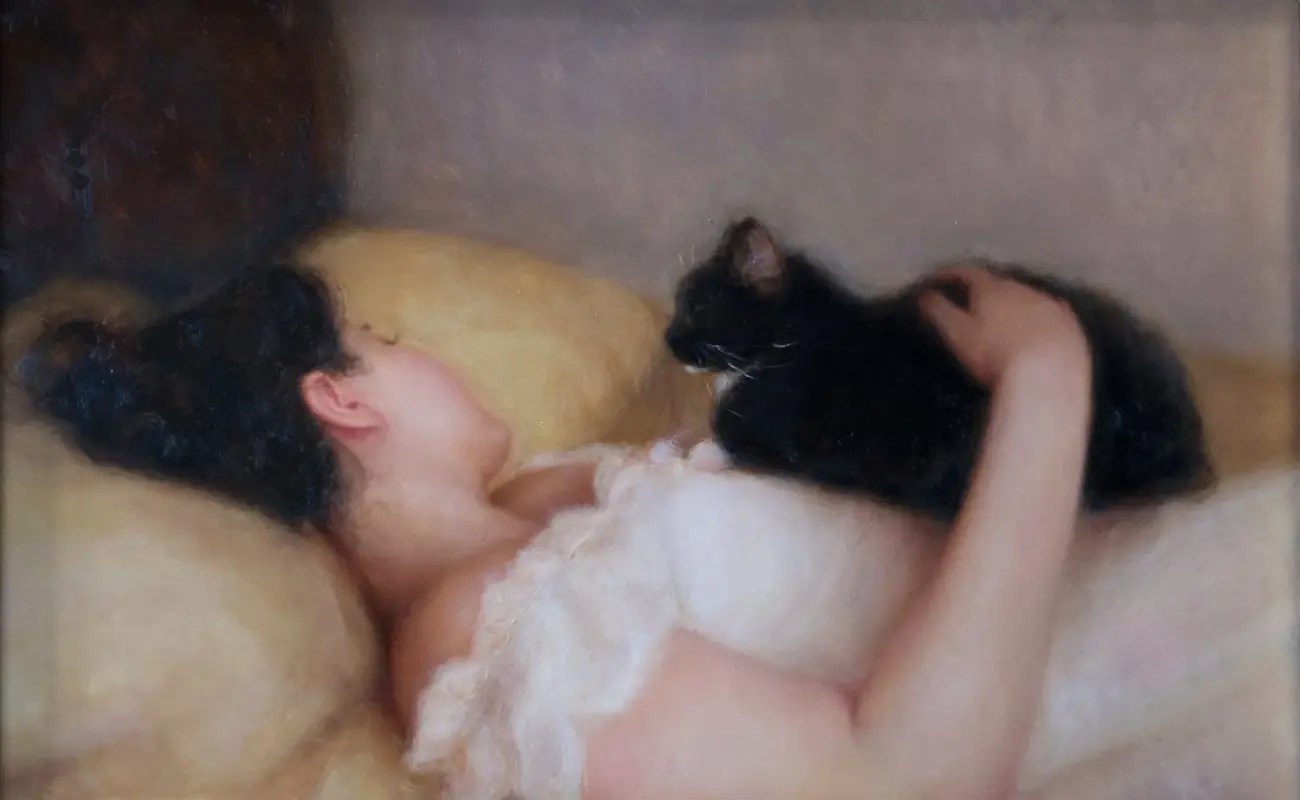
Self-portraiture occupies a particularly meaningful place within her practice because it offers complete freedom over narrative, expression, and presentation. By placing herself before the viewer, Figarelli can explore emotional states and personal experiences without relying on outside interpretation during the initial creative process. These works allow her to respond directly to changing circumstances in her own life while maintaining the broader storytelling concerns that define her practice. Her studio routine also adapts to emotional reality rather than following a rigid formula. During more difficult periods, she often turns toward smaller portrait studies or paintings of her beloved cat, Zelda. At other times, when she feels prepared to engage with more demanding themes, she develops larger narrative compositions that examine grief, remembrance, love, and personal reflection with greater complexity.
Zelda represents more than a favorite companion within Figarelli’s artistic world. The recurring presence of her cat reflects a broader philosophy that everyday affection deserves serious artistic attention. Paintings featuring Zelda exist alongside emotionally weighty narrative works because both emerge from the same commitment to painting subjects that genuinely matter. This approach is closely connected to the guiding principle that transformed her artistic direction: paint what you love. Rather than creating work based on external expectations, she discovered greater authenticity by following genuine emotional attachment, whether that meant exploring womanhood, creating intimate portraits, or celebrating ordinary moments shared at home. This philosophy strengthens the emotional consistency of her practice, allowing both ambitious narrative paintings and modest personal studies to participate equally in her larger artistic vision.

Tina Figarelli: Painting Beauty with Purpose
Beauty occupies an essential place within Figarelli’s artistic philosophy, not as decoration but as a meaningful form of communication. She believes that carefully crafted images can offer recognition, comfort, tenderness, and hope while remaining intellectually and emotionally substantial. Her paintings invite viewers into experiences that are deeply personal yet broadly relatable, encouraging reflection through quiet observation instead of dramatic spectacle. Technical discipline and emotional sincerity remain inseparable throughout her work, with every compositional decision serving the larger narrative intention. This balance allows her paintings to resonate across different audiences while preserving the intimacy that makes each image distinctive. By combining classical realism with contemporary emotional awareness, she demonstrates that traditional techniques remain capable of expressing modern experiences with remarkable sensitivity.
The emotional strength of her work comes from its willingness to embrace vulnerability without sacrificing craftsmanship. Themes of grief, love, memory, and connection appear repeatedly, not through overt symbolism alone but through atmosphere, gesture, and carefully observed human presence. Paintings such as To Bury A Friend illustrate how personal experience can be translated into visual language that speaks to universal emotions while remaining grounded in individual narrative. Her figures often appear suspended within moments of contemplation, allowing viewers space to bring their own memories and interpretations into conversation with the work. This openness encourages repeated viewing, revealing additional emotional and visual complexity over time rather than offering immediate resolution.
Today, Figarelli continues to build a body of work that bridges historical influences with deeply personal storytelling. Classical training provides the technical structure, while lived experience supplies emotional direction, resulting in paintings that feel both timeless and contemporary. Whether depicting intimate interiors, expressive portraits, symbolic still lifes, or the quiet companionship of Zelda, she consistently approaches each subject with care, patience, and narrative purpose. Her work demonstrates that realism can remain emotionally expansive when guided by authenticity rather than imitation. Through this combination of disciplined observation and heartfelt storytelling, Tina Figarelli continues to create paintings that encourage viewers to slow down, reflect, and discover meaning within moments of beauty, memory, and human connection.