Realism Set in Motion
Case Maclaim has spent decades expanding what spray painting can do with the human figure. The German painter and muralist, born Andreas von Chrzanowski in Schmalkalden, Thuringia, in 1979, helped establish photorealistic aerosol painting within contemporary graffiti and urban art. Yet technical fidelity is only the entry point to his work. Across monumental walls and studio canvases, bodies split, repeat, overlap and shift in perspective. Familiar anatomy becomes unstable, turning recognizable imagery into a field of movement, ambiguity and psychological suggestion.
His route into painting joined disciplines that rarely meet so directly. Maclaim began painting graffiti in 1995 while growing up in the former East Germany. After school, he trained as a painter, then studied restoration at the Erfurt University of Applied Sciences, completing a diploma while continuing to make graffiti and support himself through commissions and related work. He briefly balanced restoration with artistic practice after graduation before committing fully to painting. Trade skills, conservation principles and self-directed aerosol experimentation consequently developed side by side rather than in separate phases.
Around the turn of the millennium, he co-founded the Ma’Claim Crew with artists including Akut, Rusk and Tasso. The group became closely identified with photorealistic graffiti when sophisticated figurative spray painting was still relatively uncommon. Instead of rejecting graffiti conventions, they stretched them through photographic references, figurative technique and mural scale. Their 2006 book, Ma’Claim: Finest Photorealistic Graffiti, documented both finished works and practical methods for rendering skin, eyes, metal, fades and motion blur. For Maclaim, the later spread of photorealistic aerosol painting marked an evolution of the medium he had helped push forward.

Case Maclaim: The Hand as a Moving Language
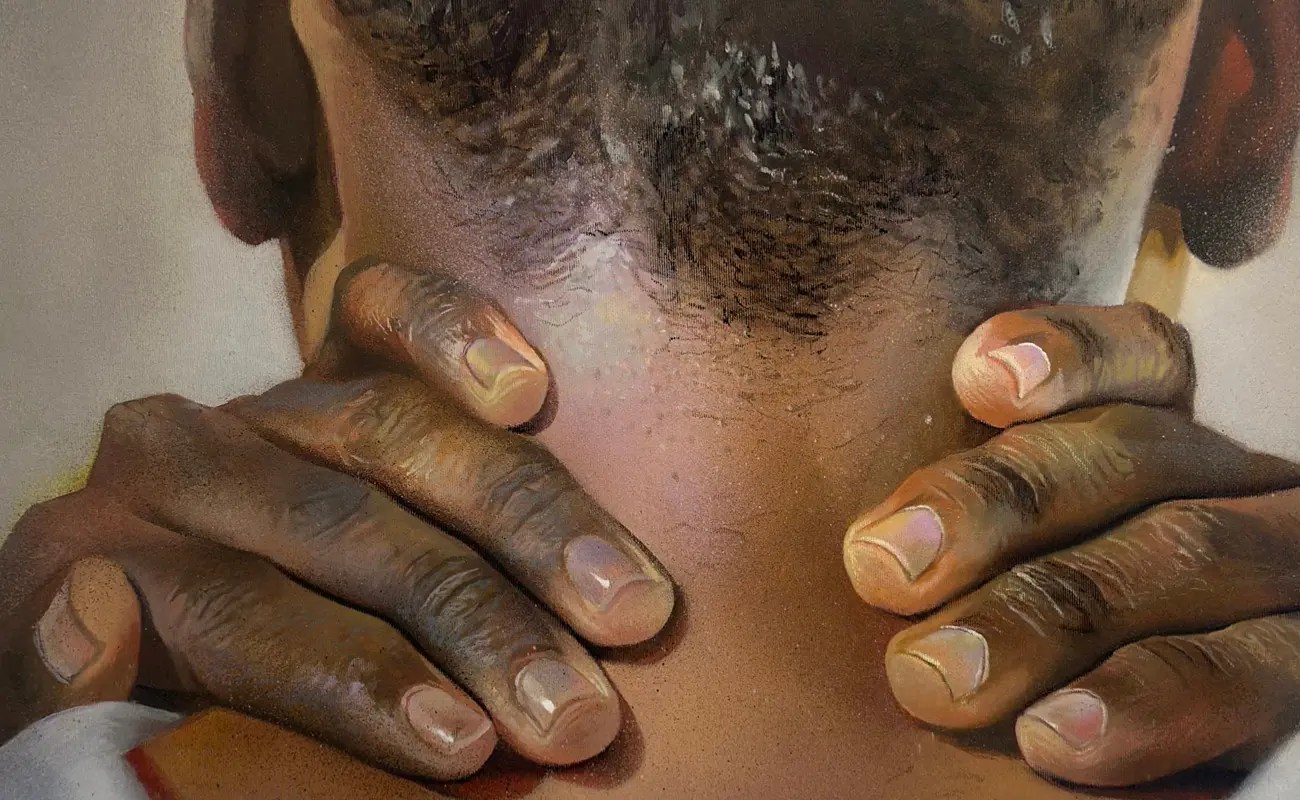
Photography gives Maclaim a foundation, but copying is rarely his destination. He starts from the legibility of the body and then unsettles it. Figures can be compressed, multiplied or fused with other forms; polished surfaces occupy uncertain spaces; and realistic anatomy enters compositions that resist a single explanation. Uncertainty, melancholy and difficult aspects of human experience recur within his studio practice, but he avoids prescribing a fixed story. Recognition draws viewers in, while the unresolved construction of the image leaves narrative ownership open.
Hands have become the clearest expression of this approach. Their anatomical complexity matters, but their communicative power matters more. Fingers point, clasp, conceal, support and pull, sometimes appearing in successive positions like frames from an animation. By superimposing gestures, Maclaim makes a static wall or canvas seem to contain duration. Movement can signify bodily action, collective energy, power or social change. The hand is therefore both subject and device, carrying meaning before words are required.
That vocabulary can also become site and context specific. In Heimat, Maclaim developed a hand sign connected with the idea of home through dialogue with an organization supporting deaf people, bringing his recurring motif into direct contact with nonverbal communication. The work demonstrates why gesture remains so productive for him: a hand can be immediately understood yet remain open to different emotional and cultural readings. Rather than using photorealism to close interpretation through exact description, he uses exactitude to make a gesture vivid enough to invite interpretation.

Walls That Change the Point of View
Maclaim’s smooth transitions conceal a physical process built on distance, motion and control. With aerosol, the tool never touches the surface, so the painter’s body becomes crucial to the mark. Shadows and tonal shifts emerge through layered clouds of pigment, with colors effectively mixing on the wall. On very large façades he also uses brushes and rollers, reserving spray paint for contours, transitions and detailed passages when appropriate. His painter’s training strengthened his understanding of color, while restoration gave him practical knowledge of substrates, architecture, durability and intervention.
Those conservation principles shaped Hidden Track, an anamorphic project created in former military bunkers at the Wisentwald nature trail near Münster. Maclaim photographed animals, calculated perspectival distortions around a selected viewing point, and combined painting, canvas, photography and digital editing. Where imagery appeared on historic bunker gates, he chose not to paint permanently onto the structures. The decision followed the restoration principle of reversibility learned during his studies. Here, architecture is more than a support: its history, surfaces and viewing conditions determine how the artwork takes form.
Urban commissions likewise begin with attention to place. Maclaim has said that locations influence his art, and his projects can incorporate a building’s divisions, sight lines, neighborhood context or local history. At Frankfurt’s Ostendstraße railway station, one of his largest interventions sends a sequence of running hands through an extended underground environment. The repeated gestures create progression rather than a frozen image, echoing the movement of passengers through the station itself. Scale becomes meaningful because the composition responds to how people physically encounter the site, not because size alone produces spectacle.

Case Maclaim: Dignity Inside the Image
Perspective carries social consequences in several of Maclaim’s figurative murals. The Fabulous Tale of Being Different, painted in Madrid, portrays a confident Black child in a golden wheelchair wearing a self-made mermaid costume. Maclaim imagined the figure as the protagonist of an unknown fairy tale rather than a character from an established story. The mural invites viewers, especially children, to invent that story themselves while questioning rigid expectations about who familiar cultural figures are permitted to be. The recognizable image opens a narrative instead of completing one.
In Streetview, he again addresses representation through the mechanics of looking. The mural depicts artist Finn Zielsdorf, a wheelchair user, from an unusual overhead viewpoint. Zielsdorf holds a mirror and looks toward the spectator through its reflection, reversing the customary physical relation in which someone seated must look upward at standing people. The mirror also lets the portrayed person determine how much of himself is visible. Maclaim’s photorealism thus becomes a way to reorganize the viewer’s spatial relationship to another person, allowing composition itself to carry questions of agency and dignity.
His studio series Be a Mensch brings those ethical concerns into a more private working context. While preparing eleven canvases, Maclaim considered the difference between painting murals amid passersby and immediate reactions and working in the comparative isolation of the studio. What he sought to preserve was the viewer’s freedom to form a personal story. The series centered on the Mensch as a person of dignity, responsibility and noble character, making explicit concerns already embedded in his treatment of vulnerability and human behavior. Across graffiti, commissions and gallery painting, precision remains a means rather than an endpoint: a disciplined structure through which bodies can communicate, perspectives can shift and viewers can imagine beyond what they first recognize.