“The installation does not ask who we are. It asks how many we have already been.”
Where the Image Becomes a Place
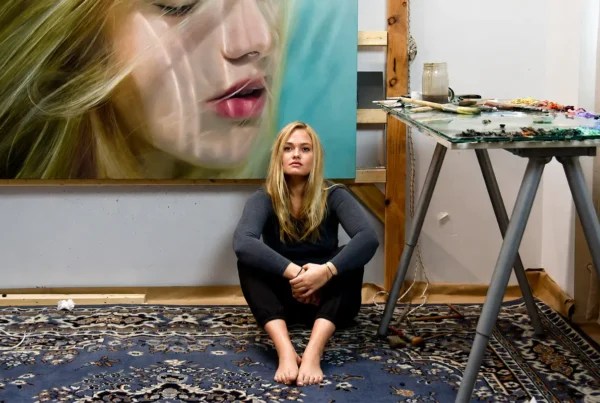
Olga Neff builds art around moments that resist fixed definitions: the distance between two bodies, the movement from one identity to another, the fragile point at which the present becomes memory. Working across photography, video, sound, text, objects, installation, and performance, she approaches each medium as part of a larger experiential structure. Her interest is not simply in producing images to be viewed from a distance. She wants to create situations that can be entered, inhabited, and felt, allowing the viewer to encounter a work through space and duration.
Neff’s route into art followed an unconventional course. She studied economics, worked in consulting, and ran her own business while making art at the edges of her professional life. Without the established habits that formal art education might have provided earlier, she developed her visual thinking through independent questioning. Choices had to acquire their own logic and justification. In 2025, she completed a Master’s at the Institute of Visual Arts in Russia. Rather than describing the degree as the beginning of her artistic practice, Neff considers it a step toward greater visibility for work that had already developed over time.
Certain concerns have remained remarkably consistent throughout that progression. The relationship between the body and its surroundings, interior experience, movement, memory, and thresholds all recur in her practice. What has changed is the scale through which she addresses them. A concern that could once be contained within an individual photograph has expanded toward environments where images coexist with sound, objects, text, moving pictures, and performance. The transition from image to installation is therefore less a departure than an extension of the same questions.

Olga Neff: Learning to Enter the Work
Theatre provided Neff with an early model for thinking about immersion. She performed as a child and continued watching theatre as an adult, absorbing its capacity to surround an audience with an unfolding experience. The lasting lesson was that art could be something a person enters rather than merely observes. A story might be lived through instead of encountered as a static object. That understanding later became central to the way she approached photography and eventually helped propel her toward video and installation.
Her use of multiple media follows this pursuit of depth. Photography, video, sound, text, objects, and performance are layered not because Neff considers any individual form inadequate, but because their interaction can produce a more complex encounter. Each contributes a different sensory or conceptual dimension. Together, they can establish what she describes as a field of experience, one capable of interrupting ordinary attention long enough for an internal shift to occur. The viewer is consequently positioned less as a detached observer than as a participant moving through the work’s logic.
Living between countries and languages has further shaped this approach. Movement exposes Neff to accumulating perspectives and different versions of the self, but it also disrupts continuity and attachment to place. Within that condition, recording becomes necessary. Photographs, video frames, and written lines preserve moments that might otherwise disappear, functioning as ways of holding experience rather than simply indulging nostalgia. Memory in her practice is therefore inseparable from movement. The act of keeping an image or phrase becomes a response to the instability produced by transition.

Two Hands at the Edge of the Visible
One photograph condenses many of these ideas into an unusually spare composition. Beyond, from the series Cicle, shows an open palm with a small tattoo at the wrist. Against the dark wall behind it appears the shadow of another hand, reaching toward the first without making contact. Flesh and darkness occupy the same frame, separated by a narrow interval. The image evokes Michelangelo’s Creation of Adam, particularly the charged gap between reaching hands, while redirecting that familiar gesture toward Neff’s persistent question about what might exist beyond the visible.
The photograph was technically simple to produce. Neff used a studio, one light source, and approximately twenty minutes. Its conceptual weight, however, depends on exact control of what enters the frame. She knew that she needed both a physical hand and the shadow of another reaching toward it. The person creating that shadow was her daughter. Her presence transforms the photograph without requiring her body to be fully shown. The image contains two hands and two generations, bringing the continuation of life into the work as a physical circumstance rather than an invented symbol.
The unresolved distance between the hands also connects Beyond to the idea of the infra-thin, associated in Neff’s thinking with Marcel Duchamp. She is drawn to the almost imperceptible threshold between states, when one condition is on the verge of becoming another. In Beyond, that interval carries questions she deliberately leaves open: what lies on the other side of visibility, and what might happen if the two forms meet? Neff imagines possibilities ranging from matter encountering antimatter to nothing or everything. The photograph does not resolve those possibilities. Its force resides in sustaining the instant before resolution.

Olga Neff: The Many Selves We Carry
Across projects and media, Neff repeatedly returns to memory, movement, and passage through a life. She considers what people carry with them, what they abandon, what remains recognizable, and who they become through successive changes. These are not separate subjects so much as different approaches to a recurring point of fascination: the nearly invisible instant when one state passes into another. Her interest in accumulation also informs this thinking. Memories, identities, images, and experiences gather rather than simply replacing what came before, complicating any idea of the self as singular or stable.
Her forthcoming project Understudies brings that question directly into the experience of identity. Conceived as an installation, it invites people to remember earlier versions of themselves: who they once were, which identities they consciously tried on, and which ones emerged without being noticed at the time. Neff begins from the observation that people perform many versions of themselves throughout a lifetime, yet rarely have an opportunity to consider those versions simultaneously. The project creates a space in which that accumulated personal history can become present rather than remaining abstract.
The theatrical resonance of the title is closely aligned with Neff’s broader practice. Understudies imagines identity through roles without reducing those roles to something false or disposable. Instead, it proposes an encounter in which a person might stand beside the past, consider another role, and recognize that previous selves continue to belong to the person they have become. It shifts the familiar question of identity away from a search for one definitive answer. For Neff, the more compelling question concerns multiplicity: not simply who we are now, but how many people we have already been.