“I believe that my art represents freedom now that I don’t need to make art for somebody else’s approval I can truly make something I can call my own.”
Freedom in Color
Michael Guevara returned to painting through a simple act: making art with friends without a grade, deadline, or institutional expectation attached. Born in 2005 and raised in Miami, Florida, the abstract painter grew up surrounded by visual culture. His parents loved art and regularly took him to galleries and museums, while Miami’s murals and graffiti offered another kind of education in color, scale, and public expression. That early exposure gave him abundant material to absorb, but the more decisive element in his current practice is the freedom he has reclaimed. Painting now belongs to him again, and that shift has become central to both his process and the emotional character of his work.
Art had been part of Guevara’s life since childhood. He drew and painted freely, responding to whatever interested him and allowing ideas to arrive without needing to justify them. School changed that relationship. Producing work for grades eventually left him burned out, and he stopped making art for a period. His return came only within the last year, when an impromptu painting session with friends reminded him what creation could feel like without pressure. The experience was significant enough to redirect his attention toward art with new seriousness. Since then, he has chosen to put his energy into painting rather than treating it as an occasional activity.
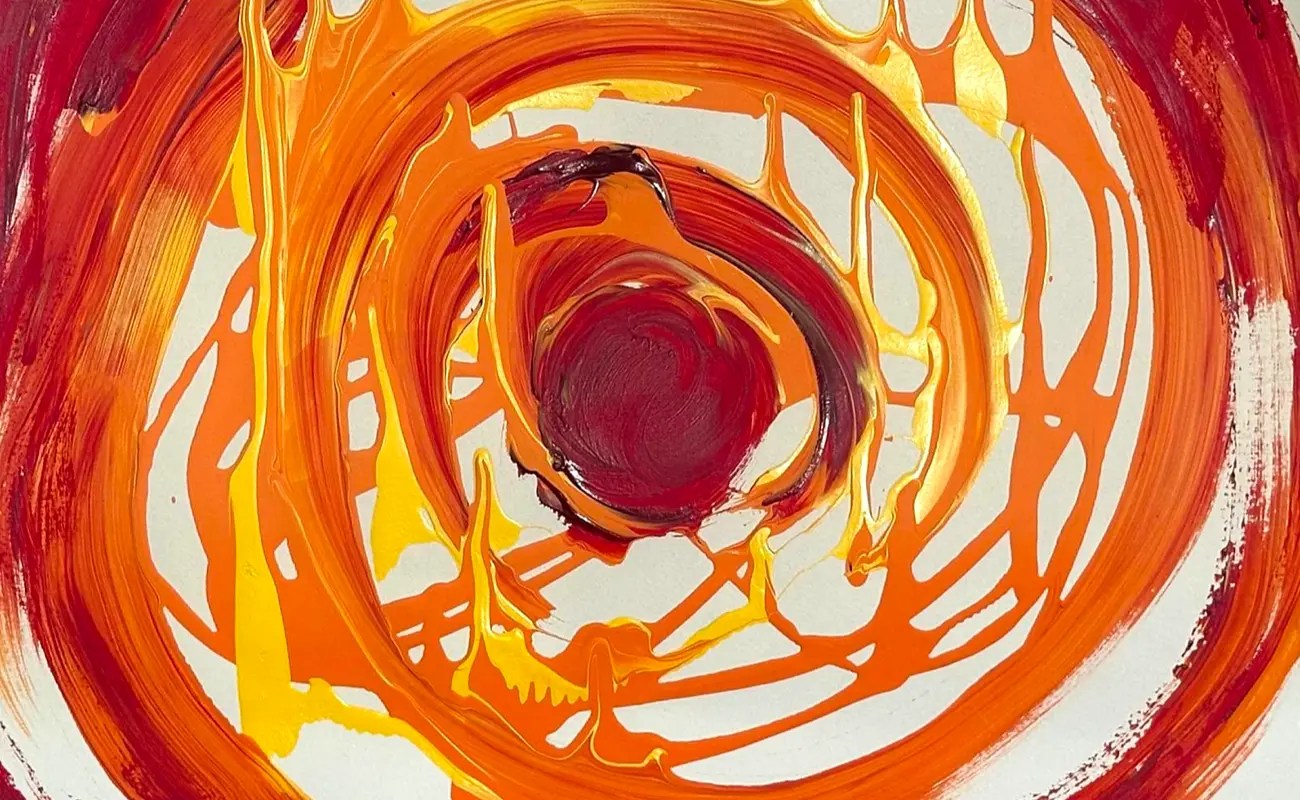
That renewed commitment is closely connected to self expression. Guevara describes painting as almost therapeutic, a way to hold a conversation with himself and give visual form to emotions that resist language. His abstract style is colorful, expressive, and deliberately open, qualities he connects to parts of himself he once felt afraid to embody. Rather than working toward someone else’s approval, he sees the canvas as a place where private feeling can become visible on his own terms. The resulting practice is less concerned with satisfying an external standard than with preserving the sense of possibility that first drew him to art.

Michael Guevara: Nature as an Emotional Trigger
Nature provides one of Guevara’s most consistent sources of influence. He does not limit inspiration to dramatic landscapes or rare encounters. Clouds overhead and lizards moving through the grass can be enough to catch his attention. What matters is not only the appearance of these things, but the feelings they activate. Time outdoors helps him slow his thoughts, examine what he is experiencing, and process emotions that may later find their way into paint. Nature therefore functions as both visual stimulus and mental space, giving him a setting in which observation and introspection can occur together.
That relationship can be felt in the titles of his recent paintings. Works from 2026 include “Wrath of the Sea Dragon,” “Dandelions in the Wind,” “Reflection of Water with an Altered Mind,” “Sunset Spiral,” and “Pollination.” Other titles, such as “Staring Into Infinity with You,” “Alone,” “Melting Upwards,” “The Odds of Two Souls Meeting,” and “Still Motion,” point toward psychological states, relationships, movement, and perception. Taken together, the titles show how Guevara moves between external phenomena and internal experience. Natural imagery can become a route into emotion, while an emotional condition can acquire the force or movement of something observed in the physical world.
His preference for acrylic paint supports the immediacy of this approach. Guevara likes to work quickly, and acrylic’s fast drying time suits that pace. Speed, in his case, is not presented as a shortcut but as part of how he responds to feeling while it is present. The medium allows him to act on an impulse, build color, and keep momentum without waiting long between decisions. That responsiveness fits a practice founded on freedom: the work can develop through the act of painting itself, with emotion and visual instinct moving together rather than being forced into a predetermined result.

The Painting That Broke the Barrier
“Still Motion V1,” created in 2025, occupies a pivotal place in Guevara’s return to art. It was the first painting he made after his period away, and he recalls creating it while in a heavily altered state of mind. More importantly, the process helped him cross a psychological threshold. He had been afraid to admit that he wanted to be an artist, and this painting became the point at which that fear began to loosen. The work matters not simply because it marked a chronological restart, but because Guevara recognized something of his own mental state in the image after making it.
He describes the painting as an unplanned representation of turmoil. At the time, life seemed to be moving past him rapidly, accompanied by hopelessness and the fear of being swallowed up by circumstances. In the composition, he saw those feelings reflected in the relationship between green and blue, with the green appearing almost overtaken by the blue. The image gave shape to an experience he had struggled to articulate directly. That discovery also clarified what painting could do for him: it could register emotions before he fully understood how to explain them, then offer a visual object through which those emotions could be recognized.
The work was made with acrylic, reinforcing a medium choice that has continued to suit Guevara’s fast working rhythm. Its importance also helps explain the emotional logic behind later titles such as “Still Motion” and “Reflection of Water with an Altered Mind.” Guevara’s paintings are connected to perception, change, and the unstable movement of feeling, but he does not describe them through a fixed symbolic system. Instead, his account of “Still Motion V1” shows an artist learning from what appears during the process. Meaning can emerge through color and form, then become clearer once the painting exists in front of him.

Michael Guevara: Building a Practice Through Repetition
Guevara now tries to paint every day, turning his renewed enthusiasm into a regular discipline. One recurring commitment is Free Art Friday Miami, an Instagram project through which he gives away free artwork each week at @freeartfriday_miami. The schedule pushes him to remain ahead on new, original paintings and gives him a practical reason to keep producing. He also values the exercise for what it does creatively. Regular output keeps him testing ideas and stretching what he calls his creative muscles, making experimentation part of the routine rather than something reserved for occasional bursts of inspiration.
Commissions create a different structure within that routine. When he has commissioned work underway, it takes priority before he heads to his regular job. His current day to day life therefore moves between personal painting, weekly giveaways, commissioned projects, and employment outside his studio practice. That combination places real demands on his time, yet his stated goal remains consistent: to keep painting. The frequency matters because his return to art is still relatively recent. Each new work strengthens a practice that only a short time ago had been set aside, converting a rediscovered passion into sustained activity.
The next major step is his first collection. Guevara has not yet settled on its theme and is still considering what could unify the group of works, so the project remains open rather than predetermined. That uncertainty is consistent with the freedom at the center of his current approach. Recent paintings from 2026 already span ideas of nature, solitude, connection, altered perception, movement, and transformation, offering several possible directions without requiring one to dominate. For an artist who returned to painting by escaping the pressure to create for approval, the unresolved collection is not presented as a problem to disguise. It is simply the next question waiting to be worked out through the practice itself.