Painting the Invisible
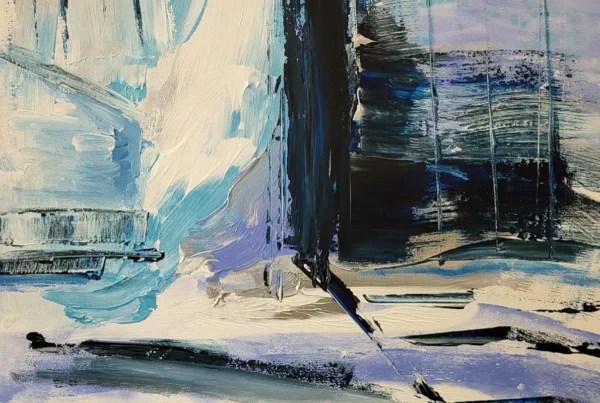
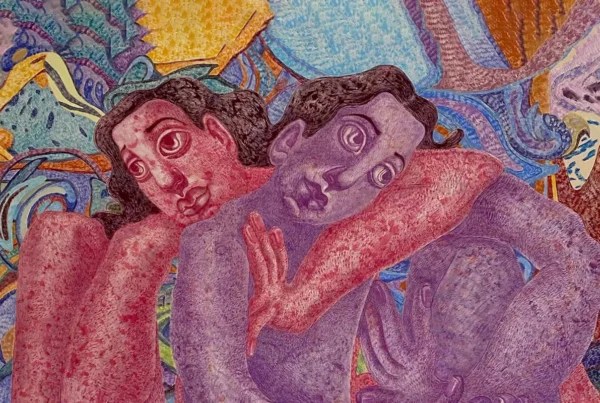
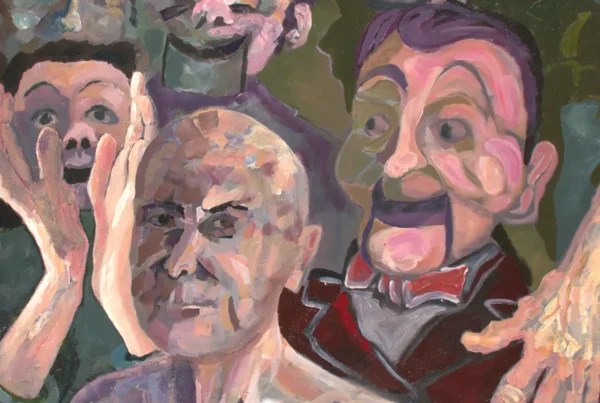
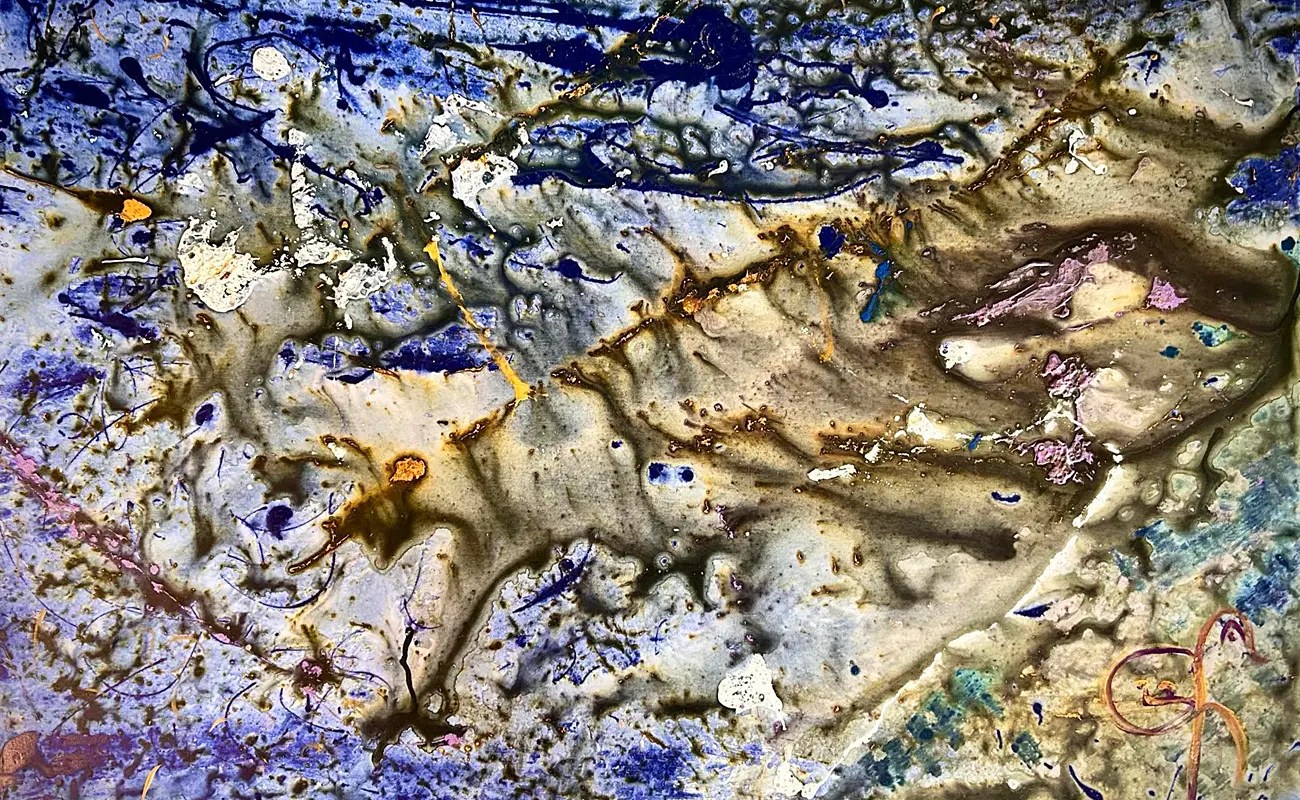
Anush Babayan approaches painting as a meeting point between sensory perception, inward concentration, and symbolic thought. Her images rarely behave like stable scenes. Instead, they seem to gather themselves from currents of pigment, veils of color, filaments, stains, spirals, cracks, splashes, and partially recognizable forms. Faces, eyes, wings, branches, and celestial shapes emerge from these unstable fields without fully separating from them. That formal ambiguity is central to the work’s effect. Rather than asking the viewer to identify an image and then decode it, Babayan allows recognition to arrive slowly, almost as an event within the act of looking. The surfaces appear atmospheric and tactile at once, with translucent passages set against denser accumulations of blue, violet, ochre, gold, green, white, and black. Such combinations establish a visual language in which matter appears to shift between body, landscape, memory, and cosmos. Her formula of thinking with the eyes, hearing with the heart, and painting through the movement of Spirit finds its most convincing visual equivalent in this instability between physical mark and immaterial suggestion.
This visual language places Babayan closest to several overlapping tendencies rather than to one established movement. The most immediate connection is with lyrical abstraction, particularly its preference for color, rhythm, gesture, and emotional atmosphere over fixed narrative. Yet her practice is less purely nonobjective than much lyrical abstraction because symbols repeatedly surface within the chromatic field. Eyes, human presences, birdlike forms, roots, spirals, and luminous centers give the paintings an iconographic structure that pulls them toward contemporary spiritual abstraction and neo-symbolist painting. The cosmic imagery in The Eyes of Universe, the inward gaze associated with Mother of the Universe, and the protective or intermediary presences suggested by Guardian Angels all establish painting as a threshold between visible form and metaphysical speculation. In that sense, the label “Magical Impressionism” can be understood not as a conventional art-historical category, but as a personal synthesis: impressionistic in its dependence on sensation and shifting perception, magical in its insistence that perception may disclose energies, memories, and meanings beyond ordinary appearances.
The work also shares affinities with visionary art, although Babayan’s academic background and emphasis on philosophical structure distinguish her from the anti-institutional associations sometimes attached to that field. Visionary art often treats the image as a vehicle for states of consciousness, spiritual encounter, cosmology, or inner revelation, and these concerns are unmistakable in Babayan’s paintings. At the same time, the work maintains a painterly rather than illustrative logic. In My Feelings, The Soul of Poetry, Lumistion, and Turbullanse, title and image appear to operate less as literal explanation than as prompts for states of perception. The viewer is encouraged to experience meaning through rhythm, density, color temperature, and the emergence of forms from otherwise fluid structures. This distinction matters. The paintings are strongest when spiritual symbolism remains embedded in painterly uncertainty, because the image then does not merely represent transcendence but attempts to stage the sensation of becoming aware of something that cannot be fully named. That quality gives the work relevance within contemporary discussions of post-secular art, where spiritual experience returns not as doctrine but as a mode of perception.

Anush Babayan: Between Lyrical Abstraction and Spiritual Symbolism
Babayan’s relationship to lyrical abstraction is especially visible in the way gesture seems to organize the picture before recognizable motifs do. Curving lines, expanding halos, broken contours, drips, scattered dots, and directional sweeps create a sense that the image is being carried forward by movement. This corresponds closely to her stated interest in the Far Eastern principles of breath, “one movement,” and the line as a trace of inner state. The choice of rice paper, mineral pigments, and a Chinese brush reinforces that orientation toward responsiveness, absorption, and the physical consequence of touch. Yet the paintings do not imitate classical ink painting. Their chromatic intensity, layered density, and symbolic figuration move in another direction, combining calligraphic sensitivity with a more saturated and materially crowded surface. The result is best understood as a contemporary cross-cultural method rather than a stylistic quotation.
This principle extends beyond material choice into the very structure of Babayan’s process. Her paintings are created without sketches or preliminary drawings and are conceived “in one breath,” in the immediacy of the here and now. Once the work is complete, no line or point is corrected. Gesture therefore carries the full weight of the artist’s inner state at the moment of creation. The process moves through unconscious and conscious, unintentional and intentional states, allowing thoughts, feelings, experiences, and inward perception to converge directly in the mark. In this sense, the influence of Chinese GuoHua and Japanese Suiboku is philosophical as much as technical: breath, gesture, concentration, and image become inseparable. Each painting records an unrepeatable configuration of attention and movement, much as a lived moment cannot be reproduced exactly.
Her symbolic vocabulary, however, does not stand apart from this gestural structure. The Mother In Universal, elsewhere described as Mother of the Universe, is exemplary because the face does not function as portraiture. It appears suspended between apparition and dissolution, with an eye that turns the act of seeing inward. The surrounding violet and blue zones, flashes of gold, feather-like textures, and circular movements encourage a reading in which the human figure becomes an energetic node within a larger cosmic structure. Similar operations recur elsewhere. The eye becomes a recurring emblem of consciousness; wings suggest protection, transition, or ascent; branching forms evoke both trees and bodily networks; spirals imply recurrence, origin, and continuation. These devices connect Babayan with neo-symbolist tendencies in contemporary painting, where signs are not used to construct a single allegorical code but to create layers of possible association.
For Babayan, however, symbolism and abstraction are not independent elements subsequently brought together. Their inseparability is foundational to the practice itself. Symbolic thought is already present within the abstract movement of line, point, gesture, color, and texture, while abstraction carries the symbolic potential generated through consciousness, memory, sensation, and intuition. The image emerges from their synthesis rather than from a sequence in which one precedes or modifies the other. This helps explain why recurring motifs do not function simply as predetermined signs placed onto an abstract field. They arise within the same continuous process that generates the surrounding surface.
The resulting tension between legibility and uncertainty remains essential, but it operates within every painting rather than as a quality achieved only in selected works. A face is simultaneously a field, a wing is also a brush movement, and a cosmic form is also the physical residue of pigment meeting paper. Recognition and abstraction therefore unfold together. The uniqueness of each work follows from the same principle: because the painting records a particular, unrepeated convergence of breath, gesture, consciousness, and circumstance, it cannot be recreated in precisely the same form. What appears symbolic and what appears abstract belong to a single event of perception and making.

Gesture, Breath, and the Interdisciplinary Image
The interdisciplinary character of Babayan’s practice is not incidental background but a structural component of the paintings. Her formation in philology, pedagogy, music, philosophy, and research-based thinking gives her a model of perception in which images behave like language, rhythm, and systems of relation. She describes the world as something heard, read, felt, and seen simultaneously, and the paintings reflect that layered cognition. Circular motifs function almost like recurring refrains, lines resemble notations or fragments of script, and color often operates less descriptively than rhythmically. This brings the work close to contemporary synesthetic and transdisciplinary approaches, in which one sensory or intellectual register is translated into another. The paintings do not literally visualize music or poetry, but they adopt structures associated with both: repetition, pause, crescendo, resonance, fragmentation, and return. Her ritual of prayer, poetry, Bach, meditation, and inner silence before painting also shifts process away from spontaneous self-expression alone. The studio becomes a site of preparation in which attention is cultivated before gesture begins.
This aspect becomes especially important in bodies of work such as Visual Prayer, The Flame of Knowledge, Cosmos. Time. Space, Ancestral Guidance, The Taste of the Apricot Land, Faces of Love, Dream Imagination, and The Universe. Taken together, these titles reveal that Babayan repeatedly organizes painting around states of transmission. Knowledge passes into light, ancestry into presence, place into taste and memory, love into faces, dream into image, and the universe into an intimate field of perception. People as Trees, Trees as People makes the logic particularly clear because it collapses distinctions between human and natural structures, while Tenderness: Animals. Birds. Flowers extends attention toward other living forms. The Path to Oneself: Performance Based on Paintings also indicates that Babayan does not regard the painted surface as an isolated endpoint. Painting can become a score for performance, reflection, or self-recognition. This expanded understanding of the image places her near contemporary practices concerned with embodiment and phenomenology, even though her primary language remains painterly rather than installation-based.
Her emphasis on inherited memory further complicates the cosmic orientation of the work by grounding it in human continuity. Family, loss, cultural history, and generational transmission prevent the spiritual dimension from floating free of lived experience. The idea that creativity can carry memory forward gives a social and ethical dimension to symbols that might otherwise remain private. Ancestral Guidance is especially important in this respect, because ancestry is not framed only as recollection but as a continuing force shaping values, responsibility, beauty, and identity. This orientation has affinities with contemporary memory art, but Babayan differs from archival or documentary practitioners because she does not present evidence, records, or historical fragments. Instead, memory is transformed into atmosphere, gesture, and symbolic presence. That choice gives the paintings emotional immediacy, though it also asks the viewer to accept a highly interior language. The work therefore occupies a productive boundary between personal cosmology and shared archetype, relying on familiar signs while attempting to reactivate them through color, movement, and material intensity.

Anush Babayan: Magical Impressionism in Contemporary Context
“Magical Impressionism” is most useful when understood as a framework associated with Babayan’s practice for bringing together perception, spirituality, symbolism, and painterly immediacy. It should not be confused with historical Impressionism, whose central concerns included modern life, optical sensation, and changing effects of light in the visible world. Babayan shares with Impressionism an interest in perception and light, but she redirects both toward inner experience. Her “light” is psychological, spiritual, and symbolic as much as optical. In this respect, the work is closer to the long history of spiritual abstraction that runs from early twentieth-century attempts to connect color with inner necessity toward later forms of gestural, visionary, and meditative painting. Yet Babayan’s insistence on scientific and analytical thought introduces another layer. She treats emotion and intuition not as opposites of knowledge but as parallel systems of understanding. That position helps distinguish the work from purely mystical painting. The paintings propose that sensation, intellect, ritual, and visual form can coexist within one perceptual structure.
Her recurring cosmic imagery also connects with biomorphic and cosmological abstraction. Several compositions suggest cellular structures, nebulae, currents, branching networks, or organic membranes without settling into literal depictions of biology or astronomy. This gives the paintings an intermediate scale: a form may look microscopic and celestial at the same time. The effect supports Babayan’s central proposition that the human being participates in a larger system of interconnected structures. The Eyes of Universe makes that relationship explicit, but it also appears throughout the work in circular vortices, radiating lines, suspended figures, and forms that seem to expand beyond their own boundaries. The result has a phenomenological quality because scale becomes unstable. Viewers may feel that they are looking outward into space, inward into the body, or into a psychic image that fuses both. This ambiguity is one of the most compelling features of the practice, and it allows cosmic symbolism to function through formal experience rather than through iconography alone.
Within contemporary art, Babayan can therefore be positioned at the intersection of lyrical abstraction, spiritual abstraction, visionary painting, neo-symbolism, biomorphic cosmology, and transdisciplinary perception. None of these labels fully contains the practice, and that incompleteness is productive. Guardian Angels, My Feelings, The Soul of Poetry, Lumistion, Turbullanse, Mother of the Universe, and The Eyes of Universe demonstrate a consistent attempt to make inner states visible without reducing them to straightforward narrative. The practice gains distinction from its combination of saturated color, calligraphic movement, textured surfaces, recurring archetypal motifs, and a declared philosophy of connection between the visible and invisible.
Seen through Babayan’s process, the inseparability of symbolic and abstract form is not an artistic threshold to be reached but the fundamental condition from which every painting begins. Each work emerges as a singular encounter among matter, consciousness, memory, intuition, and light, shaped through an unrepeated sequence of breath and gesture. “Magical Impressionism” therefore becomes more than a descriptive phrase. It becomes a coherent method for understanding painting as an immediate and unrepeatable act in which inner experience and visible form come into being together.