“Creating art is not only my daily purpose but also my greatest passion and my way of expressing life itself.”
The Quiet Origins of a Personal Visual Language
Stefan Roos creates paintings that move between instinct and structure, transforming private experience into luminous fields of color, gesture, and symbolism. Born and raised in the Canton of Bern, Switzerland, he spent his early years among mountains, forests, open meadows, animals, and seasonal blooms. That natural environment offered more than a childhood setting. It established a lasting sensitivity to organic movement, shifting light, emotional atmosphere, and the relationships connecting living forms. Roos remembers himself as a quiet and contented child whose strongest enthusiasm was drawing and painting. Creative activity gave him a direct way to respond to the world before he had developed a formal artistic philosophy. The visual impressions of the Swiss landscape remained stored within him, later resurfacing through flowing shapes, radiant colors, and compositions that suggest natural growth without becoming literal descriptions. His contemporary mixed media paintings now occupy a space between abstraction and recognition, allowing viewers to sense figures, water, landscapes, or vegetation while preserving the openness of personal interpretation.
Around the age of thirty, Roos recognized that art was not simply an enduring interest but his central purpose. That realization marked the beginning of a disciplined commitment that has continued for more than two decades. Passion alone did not define this decision. Consistency, daily practice, and a willingness to trust gradual development became equally important. Rather than building his work around the authority of established masters or responding to passing contemporary trends, he chose to follow his own intuition. This independence allowed his visual language to emerge through repeated experimentation instead of imitation. Each painting became part of a longer process in which gestures, colors, symbols, and spatial relationships were tested through direct engagement with the canvas. The resulting work balances freedom with control. Fluid brushwork and translucent layers generate spontaneity, while recurring forms create continuity across his practice. Roos approaches artistic identity as something strengthened through sustained attention, personal honesty, and the courage to let experience guide formal decisions.
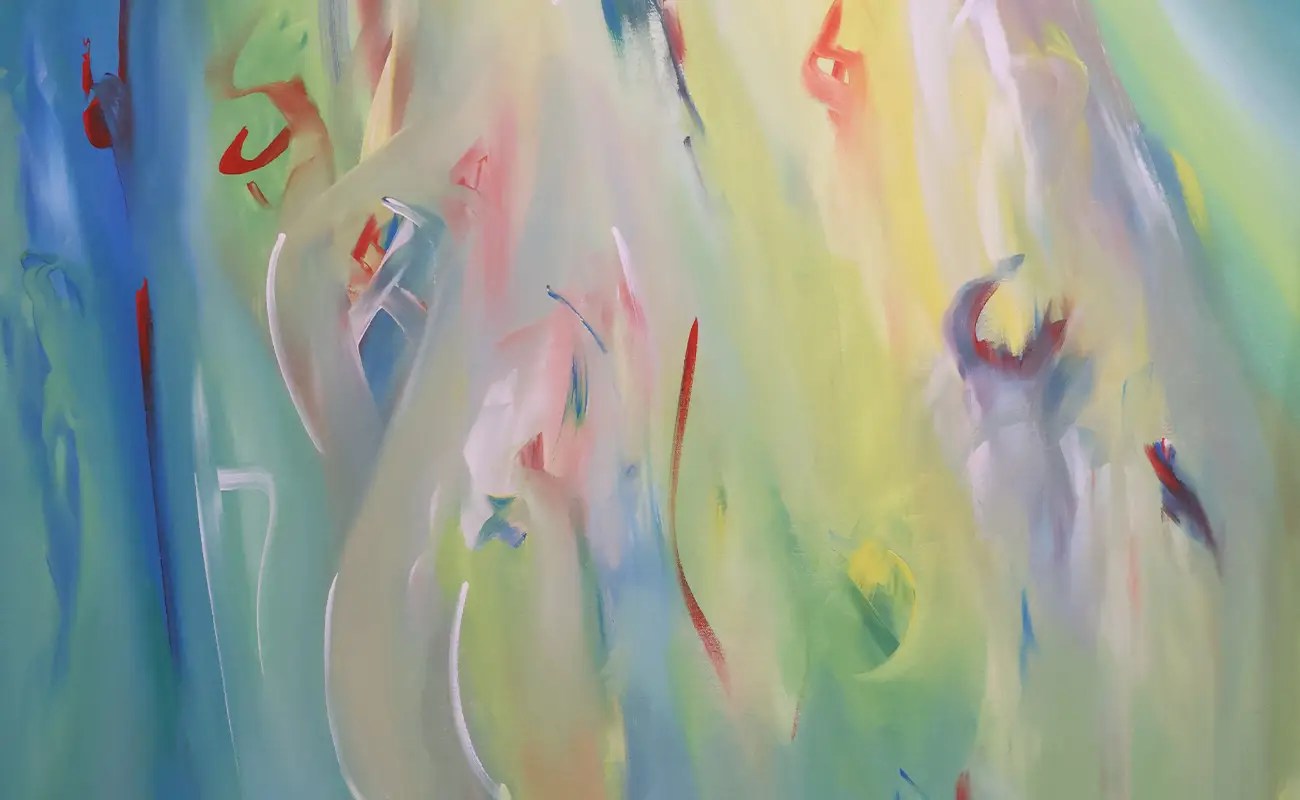
His paintings frequently shift between serene monochromatic passages and vibrant combinations of high intensity color. Broad forms can resemble human bodies, natural formations, water currents, or expanding plant life, yet they resist fixed representation. This uncertainty is essential to the viewing experience because it invites recognition without imposing a single reading. Expressive lines in red, black, or white often interrupt softer areas, introducing tension, direction, and visual rhythm. Geometric elements may coexist with biomorphic silhouettes, while occasional references to chessboards or expansive landscapes suggest strategy, memory, balance, and the changing conditions of life. Roos does not use these elements to illustrate straightforward narratives. Instead, he constructs psychological spaces in which color and form carry emotional weight. The viewer is encouraged to remain with the painting long enough for subtle layers and relationships to become visible. Movement, stillness, harmony, and contradiction are held together, reflecting an artistic practice grounded in observation but open to the unseen patterns shaping human thought.

Stefan Roos: Symbols That Hold Opposing Forces Together
Two recurring symbols give the work of Stefan Roos a distinctive conceptual foundation: the sine wave and the circle. The sine wave represents the rhythm and duality of existence, including day and night, large and small, black and white, and yin and yang. Its continuous movement suggests that opposites are not isolated conditions but connected phases within an ongoing cycle. The line rises, falls, and returns, creating a visual model of change, contrast, and renewal. Within his paintings, this form can operate as a structural device, an energetic current, or a symbolic measure of emotional movement. It reflects the belief that life develops through alternating states rather than remaining stable. Joy and difficulty, stillness and action, certainty and doubt all contribute to a larger continuity. By incorporating the sine wave into abstract compositions, Roos gives a familiar mathematical form a personal and philosophical meaning. Its repetition establishes a recognizable signature while allowing each painting to address a different emotional condition.
The circle carries a complementary significance. Roos views it as a symbol of the human mind and the origin of every creative idea. Its closed form can suggest wholeness, concentration, continuity, or the protected space in which imagination begins. When placed beside the directional movement of the sine wave, the circle creates a dialogue between inward thought and outward experience. One form contains, while the other travels. Together, they express the relationship between consciousness and the changing world. This pairing also supports the compositional balance found throughout his work. Spontaneous marks may appear energetic and unpredictable, but the repeated symbols provide anchors that organize the surrounding movement. Roos therefore connects intuition with order without allowing either to dominate. His paintings remain open and emotionally responsive while retaining an underlying sense of coherence. The symbols do not function as decorative additions. They are central elements of a language developed through years of sustained practice, personal reflection, and direct experimentation.
A sense of femininity also appears frequently in Roos’ compositions, sometimes through curving silhouettes and sometimes through the emotional qualities associated with strength, grace, protection, and continuity. These suggestions are rarely literal. They emerge through shape, movement, color, and atmosphere, allowing the feminine presence to remain symbolic and open. His broader interests continue to expand beyond the human figure. Nature, technology, geometric forms, and the balance between organic and constructed systems all influence his evolving approach. This range does not weaken the unity of his work because each subject is filtered through the same fundamental concerns: rhythm, transformation, opposition, consciousness, and connection. Even when a painting introduces a new technique or visual reference, it remains linked to the larger structure of his practice. The result is an expanding body of work that preserves a recognizable identity while resisting repetition. Roos treats experimentation as a natural extension of his visual language, using unfamiliar subjects to test how his established symbols and gestures can carry new meanings.

From Daily Experience to the Final Brushstroke
Personal experience continually reshapes the paintings of Stefan Roos. Everyday events, joyful encounters, difficult moments, relationships, nature, sport, music, travel, and family all enter his creative thinking. He does not separate artistic inspiration from ordinary life. A conversation, a physical sensation, a changing landscape, or a moment of emotional pressure can influence color, gesture, or composition. This openness allows his work to remain connected to lived experience without becoming autobiographical illustration. Family holds particular importance, providing both emotional grounding and a recurring source of meaning. Nature retains a similarly powerful role, linking his present practice to the landscapes of his childhood in Bern. Music and sport contribute ideas of rhythm, movement, discipline, and energy, while travel introduces different visual environments and perspectives. These influences meet within his imagination, which he describes as an endless source. Rather than waiting for rare moments of inspiration, Roos maintains an attentive relationship with the world, recognizing that creative material can emerge from any direction.
His studio process begins with stillness. Meditation helps him quiet external noise and connect with a deeper level of concentration before he starts painting. This preparation does not lead to a fixed plan. Instead, it creates the mental openness required for intuitive work. Roos usually approaches a blank canvas with brush and paint, beginning in the upper left corner. From that point, the composition develops naturally through a sequence of responsive choices. One mark suggests another, colors create new tensions, and emerging forms determine the direction of later gestures. The painting gradually travels across the surface until the final brushstroke reaches the lower right corner. There, his personal symbol completes the visual journey. This movement from one corner to another gives the process a quiet internal structure while preserving spontaneity. The canvas becomes both a physical surface and a record of time, carrying the progression of decisions from the first contact to the closing sign.
Working intuitively every day has made art both Roos’ purpose and his primary means of expressing life. The studio offers distance from outside demands, creating a focused environment in which thought, emotion, and physical action can meet. Yet his method is not uncontrolled improvisation. Years of practice have strengthened his ability to recognize when a composition requires restraint, contrast, light, depth, or greater movement. Spontaneity is supported by experience, while harmony is achieved through sustained attention to the developing image. This balance explains why his paintings can feel meditative and energetic at the same time. Their fluid forms suggest freedom, but the placement of symbols, lines, and color fields reveals careful visual judgment. Prolonged viewing often uncovers relationships that are not immediately visible, including translucent layers, shifting spatial depths, and subtle references to natural or human forms. Roos invites viewers to slow down, allowing perception to change as the painting reveals its internal rhythm.

Stefan Roos: The Tree as Woman and the Shape of Belonging
Among the works that define the artistic language of Stefan Roos, “The Tree as Woman” holds particular significance. The painting brings together abstraction, vibrant color, symbolism, light, depth, movement, and mixed media techniques within a single composition. Its central image unites the female figure with the form of a tree, connecting human identity to growth, rootedness, endurance, and natural cycles. The woman as tree embodies regal beauty and inner strength while also representing the central role of family. This symbolic fusion allows Roos to express several ideas without reducing them to a literal scene. The tree suggests stability and expansion, while the feminine presence introduces emotional authority, care, and continuity. Light and color strengthen the sense of vitality, and the abstract construction prevents the image from becoming fixed. Viewers can experience the figure as a person, a natural form, or an emotional presence shaped by their own associations.
“The Tree as Woman” also demonstrates Roos’ desire to unite emotion, nature, and symbolic thought. Its meaning is not carried by subject matter alone but through the interaction of visual elements. Color establishes mood, layered surfaces create depth, and directional marks animate the composition. The image appears grounded and in motion at once, reflecting the same dualities represented by his sine wave. Strength can coexist with tenderness, stability with transformation, and individuality with family connection. The work therefore functions as a concentrated expression of themes present across his wider practice. It draws from personal values without closing itself to universal interpretation. Many viewers can recognize the importance of family, resilience, beauty, and belonging even without knowing the circumstances behind the painting. Roos achieves this accessibility by allowing symbolic forms to remain spacious. He offers visual cues rather than complete explanations, encouraging each viewer to form an independent emotional relationship with the work.
Roos currently presents his paintings internationally through ART BOXY, extending the reach of a practice developed through years of private discipline and intuitive exploration. Sixteen of his artworks are also included in the World ART Collection 2026 by Cultur Lab, scheduled for publication in New York during autumn 2026. His focus throughout 2026 is to introduce his work to a broader international audience while continuing to strengthen his artistic career. New exhibitions, collaborations, and meaningful encounters form part of that ambition, yet his central commitment remains unchanged. He intends to continue following his own path rather than adjusting his work to external trends. This independence has shaped his development from the beginning, allowing his symbols, methods, and emotional concerns to evolve with consistency. Future opportunities may bring his paintings into new cultural settings, but the foundation of the work will remain rooted in intuition, daily practice, personal experience, and the search for connections between nature, humanity, and consciousness.