“It has long been my ambition to create even a single timeless work.”
Between Tradition and an Unfamiliar Future
Minako Yamano works from a meeting point between Japanese painting traditions and the expanded possibilities she encountered in New York. Trained first in Japanese Traditional Painting at Musashino Art University in Tokyo, she later completed an MFA in Painting at Pratt Institute. A three-year scholarship from the Japanese Ministry of Cultural Affairs supported her studies abroad, and she was also named an “L’Étoile des Arts” by the Louvre Museum. Rather than treating these experiences as separate chapters, Yamano has allowed them to overlap, building a practice in which inherited techniques can coexist with silkscreen, computer graphics, and contemporary source imagery.
That combination has helped shape the dreamlike atmosphere viewers often identify in her work. Yamano has long felt close to surrealism, but she does not understand the surreal solely through the history of the European movement. In her view, a surrealist way of seeing was already deeply embedded in Japanese aesthetics long before Surrealism was formally defined. This conviction gives her work a broader historical frame. Dream, ambiguity, unusual shifts of scale, and unexpected visual relationships do not function for her as stylistic quotations so much as part of a sensibility she recognizes across different times and cultures.
The cosmic quality sometimes attributed to her paintings is equally unforced. Yamano notes that viewers may describe her work as dreamy or suggestive of a cosmic world even when she did not consciously set out to create that effect. Such responses correspond with a practice that repeatedly joins unlike visual and material languages. Traditional painting, digital processes, silver leaf, rust, mechanical imagery, and expansive spatial thinking can all enter the same conversation. The result is not a rejection of tradition but an effort to keep it active, capable of absorbing unfamiliar materials and contemporary experience without losing its depth.

Minako Yamano: Learning to See Through Two Cultures
Yamano’s path toward art began at home, though not through a conventional model of career encouragement. Her grandfather and mother both painted as amateurs, and her mother placed unusual importance on artistic experience. She took her children to exhibitions, theater performances, and films, and spoke frequently about what mattered in art and culture. At the same time, Yamano recalls receiving little guidance toward academic or professional opportunities, despite being a strong student. The contradiction left a lasting impression: art was treated as essential, while conventional achievement was approached with suspicion.
She describes that upbringing as both difficult and formative. Her mother’s strained relationship with her own father, a prominent doctor, contributed to a distrust of successful careers and social status. For Yamano, this meant that attending art university felt less like a rebellion than the path that remained most available. She still carries some bitterness about opportunities that were not encouraged, yet her perspective has become more layered with time. The sustained exposure to culture during childhood gave her a sensitivity that she now considers fundamental to her development as an artist.
Formal training then widened that early foundation. At Musashino Art University, Yamano studied the materials and methods of Japanese traditional painting. In New York, Pratt Institute introduced a very different environment, giving her room to work with silkscreen and computer graphics alongside painting. The contrast between these systems became productive rather than divisive. Japanese technique gave her a disciplined relationship with surface, material, and space, while New York expanded the range of tools through which an image could be constructed. Her current practice depends on both, not as competing identities but as accumulated ways of seeing.

The Union of Opposites
Among the works Yamano returns to for inspiration, Hasegawa Tōhaku’s Pine Trees occupies a special place. Painted more than four centuries ago, the screens remain striking to her because of the economy of their brushwork and the scale of the space they create. A familiar motif becomes something open, atmospheric, and unexpectedly modern. What matters most to Yamano is the way the work seems to escape its historical moment. In front of such a painting, she feels that time loses its authority, and that an image can continue to communicate directly across centuries.
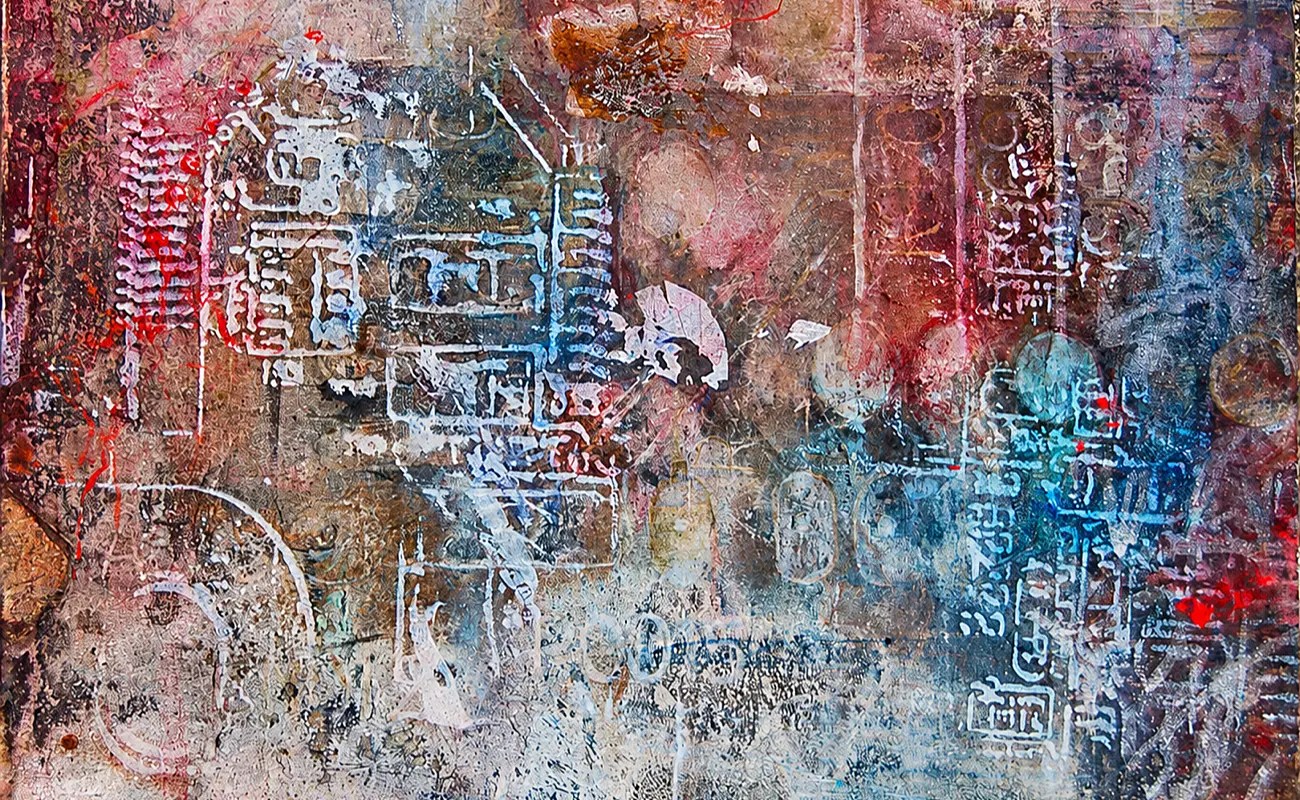
That possibility has become one of her deepest ambitions. Yamano wants to create at least one work that can remain emotionally legible beyond its own period, carrying intention and feeling across differences of time. Her interest in timelessness is not based on removing signs of the present. On the contrary, one of her most meaningful works begins with an object inseparable from contemporary technology. LIFE X (10), the first piece she ever sold, developed from an image of a disassembled hard drive. She transferred that image by silkscreen onto silver leaf, then oxidized the surface to produce a rusted texture.
For Yamano, LIFE X (10) is especially important because it brings her central theme into unusually concentrated form. She describes that theme as the union of opposites: pain and joy, movement and stillness, light and darkness, the ancient and the modern, the microscopic and the cosmic. The work places machine imagery against a material associated with older artistic traditions, then subjects its reflective surface to chemical change. The contrast is physical as well as conceptual. Silver catches light while oxidation marks time; a hard drive suggests data and engineering while its dismantled form can resemble a mysterious organic or celestial structure. In this convergence, the opposites are not cancelled out. They remain visible together.

Minako Yamano: Returning to the Folding Screen
Yamano is now able to devote most of her time to painting, a change that has opened space for ideas she has wanted to pursue more fully. Her day-to-day focus is direct: she is working to bring as many of those ideas into material form as possible. The practical conditions of the studio also matter. With enough room to work at a larger scale, she can reconsider formats that were previously difficult to realize and allow her compositions to develop beyond the dimensions of smaller works.
The format she is most eager to return to is the folding screen. This is not a new discovery for Yamano but a return to the medium she identifies with her original starting point. Folding screens connect naturally to her education in Japanese painting, yet her years of experimentation have changed what returning can mean. Silkscreen, computer graphics, metallic surfaces, oxidation, and imagery drawn from modern technology now sit within her vocabulary. A large screen can therefore become a place where older structures of Japanese painting meet processes and references that belong unmistakably to the present.
That return also brings her ambitions full circle. Hasegawa Tōhaku showed her how a folding screen could create immense space with minimal means and continue speaking to viewers centuries later. Yamano approaches the format from her own position, carrying both Japanese training and the technical freedom she developed in New York. Her goal is not to reproduce the past, but to test whether a historically rooted form can hold the contradictions that drive her work today. The large-scale screens she hopes to create offer room for precisely that experiment, bringing ancient and modern, stillness and movement, material surface and cosmic suggestion into a single field.