“The symbol belongs to all of us; what happens around it belongs to the individual.”

The Moment Material Became Necessary
Mandeva’s artistic life began with an awakening rather than a conventional career plan. Born in Bulgaria to two accomplished painters, she grew up with art woven into everyday life, yet chose economics instead of following her parents into the profession. That decision was shaped partly by what she observed around her: women artists in the Balkan culture of her youth were often expected to balance creative work with domestic responsibilities while struggling to be recognized independently of successful men in their lives. Education and financial independence became her chosen route, leading to a Master’s degree in Accounting and Control, work as an accountant, and eventually an accountancy firm she has run for more than two decades.
Art nevertheless remained close. On 17 April 2017, at forty-three, Mandeva took her youngest child to a ceramics lesson. When the teacher placed a ball of clay in her hands and asked her to knead it, the physical response was immediate. Her heart raced, and what had seemed dormant suddenly felt unavoidable. Three months later, she sat the entrance examinations for the National Academy of Art in Sofia and received the highest possible mark in ceramics. She completed both Bachelor’s and Master’s degrees, the latter with distinction, and is now pursuing doctoral research.
Her education also carried her beyond Bulgaria. An Erasmus placement at the University of Hertfordshire brought her to the UK in 2019 for what was intended to be five months, but England became a second base. She now lives and works between Bulgaria and the UK. That divided geography mirrors another productive duality in her life: decades of accounting trained her in precision, responsibility, and structure, while art opened a space for intuition and emotional movement. Her practice repeatedly returns to the meeting point between those tendencies, asking how a tangible material, object, or symbol can hold something that cannot be physically grasped.

Mandeva: Giving Thought a Visible Structure
Clay was Mandeva’s first artistic love, and its physical intelligence remains central to how she understands making. She values the way it resists, responds, and retains the pressure of the hand. Her studies extended from ceramics into porcelain and glass, strengthening a material instinct that continues even when she is working on canvas. After moving to England, however, she no longer had the studio infrastructure required for serious ceramic work, particularly a kiln. Rather than quieting her need to create, that practical limitation redirected it toward painting.
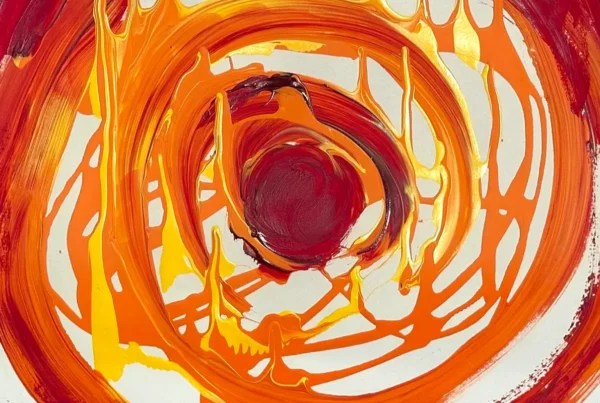
The shift changed the conditions of her work. Clay brought technical and physical demands, while canvas offered a place where flowing, interconnected marks that develop intuitively across a surface. She treats them as a visual language for the movement of thought, tracing how ideas generate other ideas and how memories, feelings, and associations intersect, separate, and reconnect. Her interest is not in illustrating thought literally, but in giving visual presence to an invisible force capable of altering perception and prompting action.
That language is especially clear in the Talismans series. Mandeva begins with recognizable objects and symbols, including keys, butterflies, apples, grapes, horses, and poppies, then builds networks of line, color, and association around them. The familiar image acts as an anchor for ideas such as luck, courage, freedom, transformation, abundance, or happiness. Alongside these conceptual paintings, she maintains a quieter relationship with landscape, particularly the English countryside. Fields, water, seasonal changes, and shifting light allow her to work through observation rather than symbolic deconstruction. The approaches differ visually, but both answer the same persistent need to turn experience into form.

Symbols That Survive Familiarity
Mandeva’s influences resist a single lineage. Art was a constant subject in her childhood home, where artists, movements, and competing ways of seeing were discussed as part of ordinary family life. Five years at the National Academy of Art widened that field through art history, from prehistoric cave painting and ancient civilizations to the Renaissance, Impressionism, and Modernism. What holds her attention across such different periods is individuality: the point at which an artist develops a visual language distinctive enough to reveal a particular sensibility rather than simply a recognizable style.
Impressionism brings her particular joy because of its attention to light, color, atmosphere, and fleeting ordinary beauty, qualities that connect naturally with her own landscape paintings. She also feels an affinity with Toshiko Takaezu, whose movement between ceramics, painting, and textile demonstrated a creative identity that was not confined to one medium. Mandeva discovered that connection after her own circumstances had already pushed her from ceramics toward painting, so she does not describe Takaezu as the cause of that transition. Instead, Takaezu’s example affirmed something Mandeva had experienced directly: materials may change while the impulse to create persists.
That idea also shapes Wings of Transformation, an oil painting on canvas from Talismans and one of Mandeva’s most personally significant works. Its central butterfly is intentionally familiar. Rather than avoiding a symbol because it risks being called a cliché, she accepts its accumulated cultural meaning. For her, images can endure precisely because generations continue to recognize something in them. She paints the butterfly recognizably, then begins her intervention through neuro-lines, opening the clear form into an abstract field of shapes, color, memory, sensation, and association. The shared symbol supplies certainty; the surrounding network records a more individual interior experience.

Mandeva: Returning to Form Through New Tools
Wings of Transformation clarifies a central tension in Mandeva’s work between collective recognition and private interpretation. She does not want to erase the established meanings of symbols or manufacture novelty by rejecting them. In Talismans, an apple can invoke gravity, ripe grapes abundance, a horse the crossing of limits, poppies courage, and a butterfly transformation. These associations provide an accessible visual starting point. From there, abstraction allows the image to loosen, making room for the less stable movement of thought and feeling. The butterfly is therefore not the final subject of Wings of Transformation, but the threshold to an invisible process of change.
Her working life is equally defined by movement between different systems. Mandeva continues to run her accountancy firm while pursuing a doctorate and maintaining her art practice. She has no single studio routine because each medium and idea requires a different entry point. A painting may begin with a symbol or thought that persists until it demands physical form. A landscape may start with something immediate, such as a particular light, color, or place. This flexibility is practical, but it also reflects the broader trajectory of an artist whose development has repeatedly been shaped by changing circumstances rather than allegiance to one process.
Her next direction reconnects material practice with emerging technology. Alongside participation in the Agia Napa Biennale 2026 in Cyprus, Mandeva is focused on doctoral research into the design of silicate forms through artificial intelligence and high technologies, examining the balance among aesthetics, sustainability, and efficiency. Porcelain and glass remain particular interests, now considered in relation to AI and digital fabrication. She is not pursuing technology as a substitute for the artist or for knowledge held in the hand. Her question is what can happen when human intuition, material experience, and new tools meet. Clay first awakened her practice, painting expanded it when clay became inaccessible, and her research is now bringing her back toward three-dimensional form through a route she could not have anticipated in 2017.