“Curiosity and development are the foundation of my work, and for the past 20 years, they have driven me in various directions.”
Beyond the Surface of Seeing
Paula Jaszczyk has built an artistic practice that refuses to remain confined within the traditional limits of painting. Based in Poland, she is a visual artist, professor, researcher and editor whose work continuously investigates the connections between colour, sound, movement, space and human perception. A graduate of the Academy of Fine Arts in Warsaw, where she completed her diploma with distinction and later returned as a lecturer before becoming a professor, she has developed a career shaped equally by artistic experimentation, academic research and interdisciplinary collaboration. Prestigious distinctions, including the Diploma 2005 Award, scholarships from the Minister of Culture and National Heritage, the Mazovian Doctoral Scholarship and the Young Poland programme, supported an artistic path defined by sustained curiosity rather than adherence to a single discipline. Throughout more than two decades of practice, she has consistently expanded the possibilities of painting by allowing it to interact with multimedia installation, audiovisual performance, choreography, music and spatial construction while maintaining colour as the essential force guiding every creative decision.
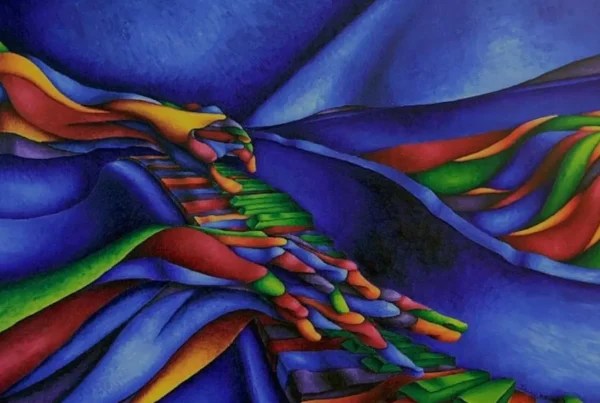
Rather than treating colour as a decorative feature, Jaszczyk approaches it as an active language capable of shaping emotional, psychological and sensory experience. Warm and cool tones, harmony and dissonance, rhythm and contrast all become instruments through which viewers encounter works that move between abstraction and representation. Her paintings examine how chromatic relationships alter perception, while her multimedia projects extend these investigations into physical space where projected light, moving images and sound transform static surfaces into immersive environments. This ongoing dialogue between two-dimensional painting and three-dimensional construction reflects her belief that artistic media should influence one another instead of remaining isolated. By allowing visual art to intersect with music, dance, film and even scent, she has established an expansive creative vocabulary that continually challenges conventional distinctions between artistic categories while remaining firmly rooted in painterly thinking.
Equally important is the role of teaching within Jaszczyk’s career. Since joining the Faculty of Media Art at the Academy of Fine Arts in Warsaw in 2006, and later becoming affiliated with the University of Siedlce, she has treated education as an extension of artistic research. Questions explored in her own studio frequently evolve into collaborative investigations with students, musicians, dancers and researchers. This reciprocal relationship between making art and sharing knowledge reinforces her conviction that creativity flourishes through dialogue rather than isolation. Publications such as Interdisciplinarity: Visual Arts: Internal and External Correlations and Tensions, which she conceived and edited, demonstrate this broader commitment to examining artistic practice from multiple perspectives while encouraging others to explore the productive tensions that emerge whenever different forms of expression meet.

Paula Jaszczyk: Colour Between Sound and Space
A decisive turning point arrived early in Jaszczyk’s career through the creation of Kalejdoskop Podróży (Kaleidoscope of Journeys) in 2005. Composed of sixty geometric paintings suspended into a three-dimensional arrangement and animated with projected colour, the installation transformed conventional painting into an immersive spatial experience. She later described this project as the moment when she stopped thinking of herself solely as a painter representing reality and instead embraced the role of an artist driven by curiosity and exploration. The work introduced many ideas that would define her future practice, including the crossing of disciplinary boundaries, the interaction between physical and projected forms, and the belief that colour gains new expressive possibilities when it occupies architectural space rather than remaining fixed upon a canvas. This project established a conceptual foundation that continued to influence her artistic investigations for years to come.
These ideas developed further during her doctoral research at the Academy of Fine Arts in Warsaw between 2006 and 2010. Her artistic project, Inwencja C-Colour, accompanied by the dissertation The Sound of Colour: A Multimedia Spatial Form as a Visual Record of a Score, explored whether colour might possess qualities analogous to musical sound. Instead of presenting abstract theories alone, Jaszczyk designed an original visual score interpreted by musicians from the Kwartludium ensemble, connecting geometric forms, instrumental timbres and carefully constructed colour relationships. This ambitious undertaking encouraged her to study harmony and piano, enabling deeper collaboration with composers and performers while strengthening her understanding of how visual rhythm and musical structure might influence one another. Historical figures including Eugène Delacroix, Wassily Kandinsky, Alexander Scriabin, Arnold Schoenberg, Zofia Stryjeńska and František Kupka provided intellectual context, yet her work remained firmly centred upon developing an independent artistic language.
Collaboration gradually became one of the defining characteristics of Jaszczyk’s practice. Through projects such as Figuraté, Six Views of Paula, Praeter, Blue, Azure, Cobalt, Zocha, Myths, I Like Moniuszko, Acis and Galatea and Bry-Tan, she demonstrated that painting, choreography, music and moving image could transform one another through continuous exchange. The Creative Laboratory, initiated in 2012, extended these principles into education by bringing together students from the Academy of Fine Arts and the Fryderyk Chopin University of Music. Exercises encouraged visual artists to think musically while musicians explored colour as a creative stimulus, revealing how each discipline possesses distinct understandings of rhythm, duration and perception. Rather than simply combining media, Jaszczyk carefully balanced their relationships so that every element retained its own expressive identity while contributing to a unified artistic experience.

The Human Figure, Movement and Inner Transformation
Although abstraction occupies a central place within Jaszczyk’s work, the human body has remained an equally significant subject. Her Meanders series originated after meeting actress and violinist Patrycja Kujawska, whose striking appearance inspired reflections on identity, emotion and the ambiguity of gender. Photographic studies evolved into twelve paintings that later inspired composer Alicja Gronau to create Six Views of Paula. This collaboration transformed static paintings into animated visualisations accompanied by live music and choreography, allowing painted figures to enter time through movement. The project demonstrated how imagery originally conceived for canvas could acquire entirely new emotional dimensions when interpreted by dancers and musicians. Rather than replacing painting, these interdisciplinary collaborations revealed previously hidden qualities within it, reinforcing Jaszczyk’s conviction that different artistic forms can continually enrich one another.
One particularly meaningful artwork emerged from this collaboration. Deeply affected by the third piece of music called: “Entanglement,” Jaszczyk expanded the accompanying imagery into the multimedia installation Entanglement from the Meanders Series. Large suspended forms, projected animation and layered spatial construction surrounded audiences with fragmented human silhouettes that appeared almost alive through synchronisation with music. This work stands among the clearest demonstrations of her long-standing commitment to merging painting, sound, movement, space and emotional experience into a unified artistic language. Philosopher and art historian Monika Murawska later described the installation as revealing the fundamentally synaesthetic nature of perception, highlighting the difficulty of separating seeing from hearing within Jaszczyk’s creative universe.
Another important milestone was Composition in Green for Nature and Piano, developed over approximately two years with support from Poland’s most prestigious artistic scholarship, the Young Poland programme. Jaszczyk personally recorded birdsong during extended visits to forests, composed an original piano score, produced the visual material, and edited the complete sound environment. The finished installation established a dialogue between natural recordings, represented through images of trees and bark, and abstract musical structures, visualised through evolving fields of colour corresponding to musical pitches. Displayed on layered translucent screens illuminated from behind, the work created a contemplative atmosphere in which realistic imagery gradually dissolved into abstraction. This project encapsulated many recurring concerns within her practice, uniting colour, sound, perception, environment, and emotional reflection within a carefully balanced sensory experience.

Paula Jaszczyk: Rebuilding Through Art
The most personal transformation within Jaszczyk’s career emerged after a severe psychological crisis that began in 2018. Depression interrupted both her creative practice and her sense of identity, leaving her unable to produce artwork or recognise meaning within artistic activity. Recovery required many years of sustained effort, therapy and conscious self-observation. Rather than attempting to erase this experience, she eventually chose to transform it into art. Her growing interest in psychology, already reflected in earlier research concerning perception and emotional response, acquired profound personal significance during this period. She came to understand healing not as a return to an earlier self but as the gradual formation of a different person shaped by vulnerability, resilience and acceptance. These experiences introduced a deeply autobiographical dimension to work that had previously centred primarily upon interdisciplinary formal investigation.
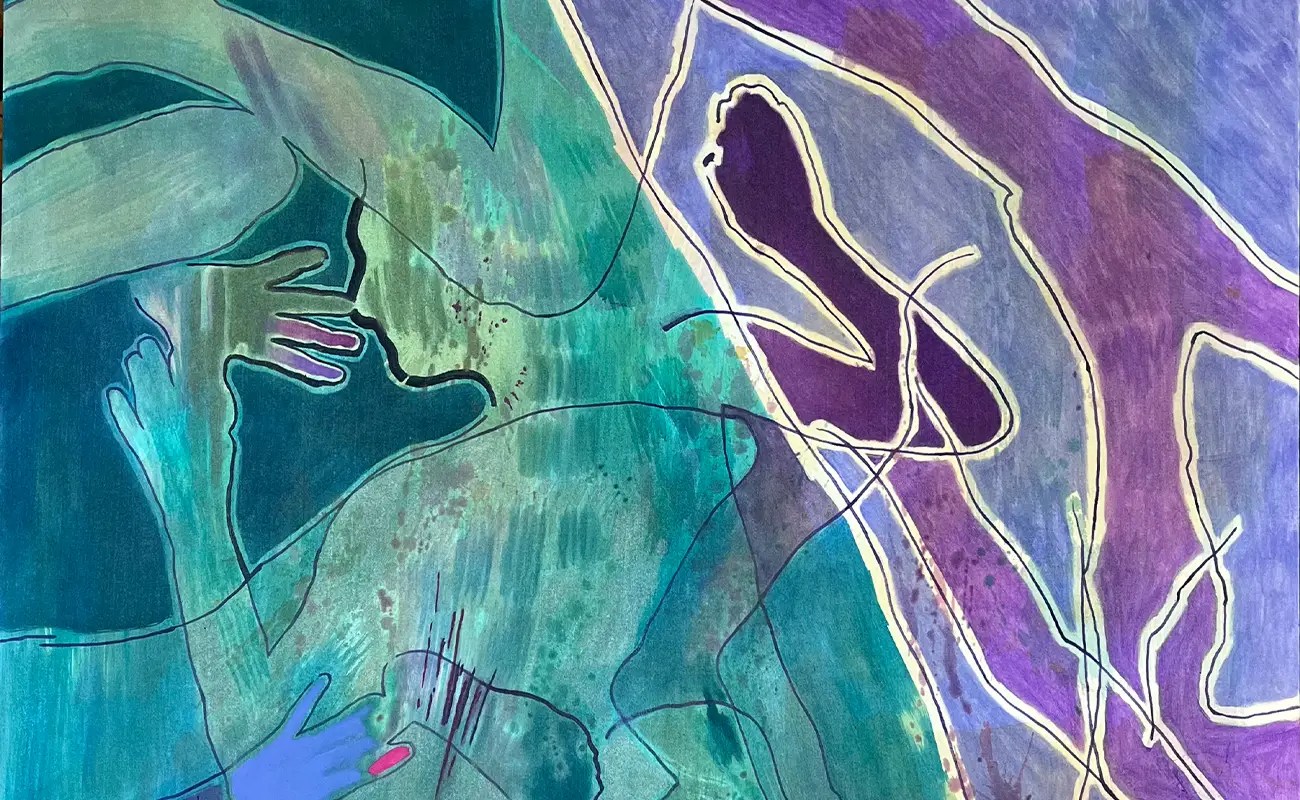
This new direction culminated in the 2025 project Things Will Be Different Now. Things Will Be Harder Now. [The Experience of Psychological Crisis], consisting of ten paintings, an audiovisual work and an artist’s book documenting experiences between 2014 and 2024. Fragmented outlines of her own body, traced directly onto canvases, became visual records of emotional disintegration, grief and reconstruction. Stripes, intersecting forms and layered compositions reflected fractured memory rather than chronological storytelling. The accompanying audiovisual work, featuring an original score by Anna Ignatowicz-Glińska and marimba performance by Magdalena Kordylasińska-Pękala, intensified these themes by extracting isolated body fragments from the paintings and allowing sound to deepen their emotional resonance. Rather than presenting suffering as spectacle, the project encouraged thoughtful conversations about trauma, recovery and the importance of compassionate understanding.
Despite confronting painful experiences, Jaszczyk’s work continues to return to colour as its enduring source of vitality and hope. Throughout decades of experimentation spanning painting, multimedia installation, concert visualisation, research, education and publication, colour has remained the constant element connecting every stage of her artistic evolution. Whether investigating chromatic relationships within abstraction, translating musical structures into visual form, animating painted figures through movement or documenting psychological recovery, she consistently demonstrates that colour possesses emotional, perceptual and symbolic capacities extending far beyond aesthetic appearance. Today she is also preparing a book exploring the relationship between visual arts and music, drawing upon both historical research and her own extensive practice. This continuing project reflects the same curiosity that has shaped her career from the beginning, confirming that exploration, dialogue and openness remain at the heart of everything she creates.