Between Exposure and Obscurity
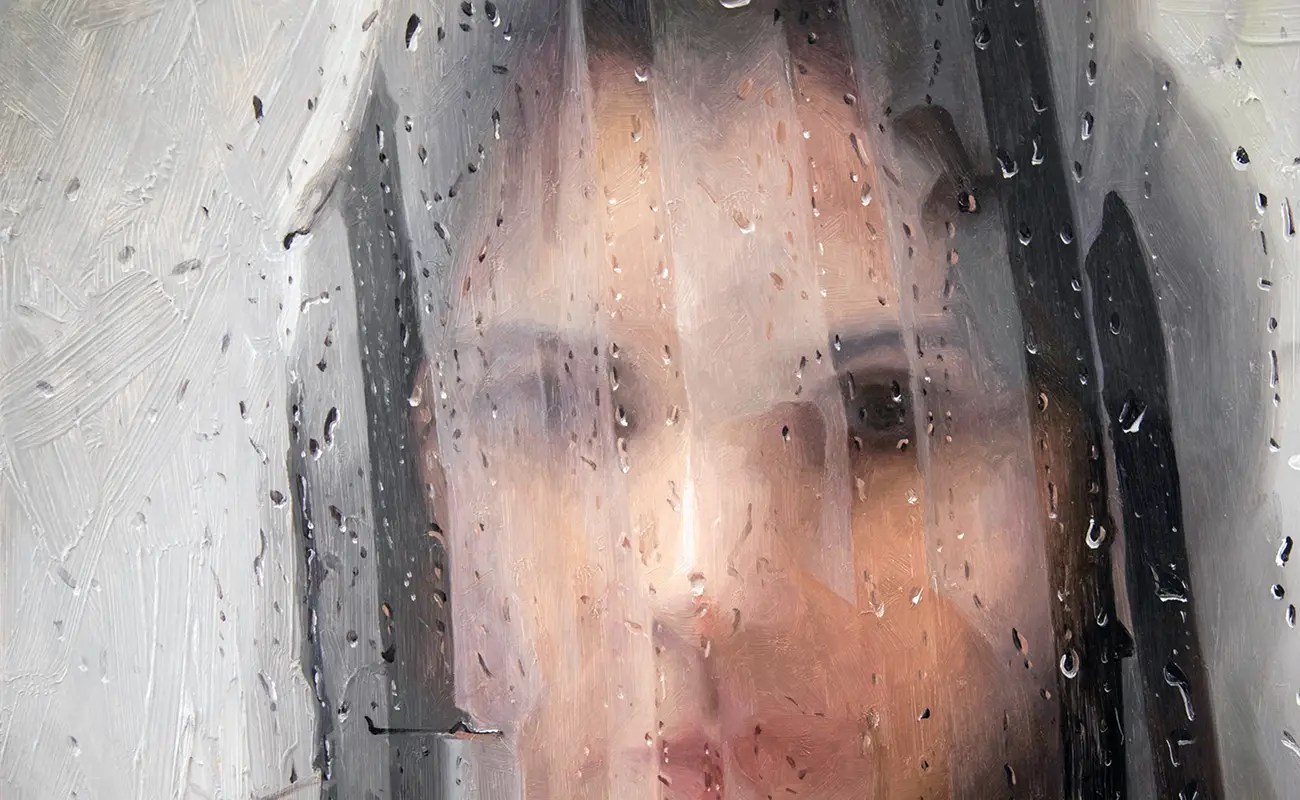
Alyssa Monks has spent decades reshaping contemporary figurative painting through images that exist between revelation and concealment. Working primarily in large scale oil paintings, she constructs emotionally charged scenes where the body appears behind layers of steam, water, glass, vinyl, and foliage. These translucent surfaces interrupt direct viewing, forcing the eye to navigate distortion before reaching the figure itself. Rather than functioning as simple visual effects, these barriers alter the emotional rhythm of each painting. The viewer becomes aware of looking as an act filled with uncertainty, longing, and fragile intimacy. Through this approach, Monks challenges conventional realism while preserving its emotional immediacy. Her paintings carry a sense of closeness that feels both physical and psychological, inviting viewers into suspended moments where vulnerability and protection exist simultaneously. The resulting images resist easy interpretation, existing in a space where abstraction and representation continually exchange roles.
Born in New Jersey in 1977, Monks developed an early relationship with oil painting during childhood, discovering the expressive possibilities of material long before entering professional art institutions. Her education moved through several influential environments, including studies at The New School in New York, Boston College, Lorenzo de’ Medici in Florence, and the New York Academy of Art, where she earned her MFA in 2001. This classical foundation provided her with technical precision while encouraging an evolving relationship with realism. Instead of treating realism as a fixed objective, Monks transformed it into an unstable language capable of carrying emotion, memory, and contradiction. Her command of anatomy, light, and composition allows her to destabilize these same elements with confidence. In many paintings, forms dissolve under condensation or fracture behind reflections, creating images that feel suspended between certainty and disappearance. That instability has become central to her visual identity and one of the defining characteristics of her career.
Recognition for Monks’s work has grown steadily through major exhibitions, institutional collections, public talks, and appearances across cultural media. Her paintings have been shown internationally, including exhibitions such as “Intimacy” at the Kunst Museum in Ahlen, Germany, and “Reconfiguring the Body in American Art, 1820-2009” at the National Academy Museum of Fine Arts in New York. Her 2023 solo exhibition, “Where Longing Meets Limits,” presented another significant chapter in her exploration of emotional and physical thresholds. Beyond galleries and museums, her paintings reached broader audiences through season six of the television series The Americans. Her influence expanded further through teaching, lectures, workshops, and mentorships that emphasize experimentation alongside discipline. In 2015, she delivered a TED talk at Indiana University discussing the evolution of her work and artistic philosophy. These varied platforms reflect the broad resonance of a practice rooted not only in technical achievement but also in emotional intelligence and human connection.

Alyssa Monks: The Language of Surface and Touch
The surfaces of Alyssa Monks’s paintings carry extraordinary physical intensity. Thick applications of oil paint preserve every revision, hesitation, and gesture, allowing the canvas to function almost like a record of lived movement. Brushstrokes accumulate in dense layers that resemble sediment or fossilized traces of decision making. This tactile quality creates a tension that differs sharply from photographic realism, even when her paintings appear highly precise from a distance. Up close, the illusion fractures into energetic marks, smears, drips, and textured accumulations of pigment. Monks intentionally preserves this instability because it reinforces the humanity embedded within the work. The hand of the artist remains visible, insisting that the painting is not simply an image to consume but a physical object shaped through labor, uncertainty, and touch. Through this approach, she transforms realism into something experiential and alive, where surface becomes inseparable from emotional meaning.
Many of Monks’s early paintings focused on enclosed environments such as showers, bathrooms, tubs, and private interiors where water and steam operated as psychological as well as visual devices. These spaces heightened the sensation of intimacy while simultaneously introducing barriers that interrupted direct access to the body. Steam softened edges, condensation fractured perception, and translucent vinyl distorted anatomy into shifting abstractions. The figure often appeared isolated yet emotionally charged, caught between emergence and retreat. This duality became central to Monks’s artistic language. Her paintings do not simply depict vulnerability; they embody the instability of being seen. The body exists in a constant state of negotiation with its surroundings, neither fully exposed nor entirely hidden. This dynamic encourages viewers to confront their own role in the act of observation. Looking becomes tentative and emotionally loaded, shaped by empathy as much as curiosity. In this way, Monks redefined figurative painting as a site where perception itself becomes unstable and emotionally resonant.
The emotional force of Monks’s work deepened through personal loss and transformation. Following the illness and death of her mother, her paintings shifted away from tightly enclosed interiors toward more expansive natural environments filled with foliage, fragmented light, and looser forms of abstraction. Nature introduced unpredictability and surrender into the work, opening new emotional territory connected to grief, stillness, and connection. Foliage began to function much like steam or water had previously, obscuring and revealing the figure while introducing organic movement and layered depth. Yet despite these changes, the central concern remained constant: the search for human presence within unstable conditions. The paintings continued to explore what it means to feel visible while retaining the need for protection. This evolution expanded the emotional vocabulary of her work without abandoning the intimacy that defined earlier paintings. Instead, Monks broadened the conversation, allowing personal experience to transform both atmosphere and visual structure.

Painting Through Uncertainty and Emotion
Curiosity and empathy sit at the center of Alyssa Monks’s artistic philosophy. Rather than approaching painting as a demonstration of control alone, she embraces uncertainty as an essential part of the creative process. Accidents, distortions, and revisions are not eliminated from the final image but integrated into its emotional architecture. This openness allows the paintings to retain a sense of vulnerability and immediacy that polished surfaces often erase. Monks has consistently resisted the idea that realism should function purely as illusion. Instead, she treats paint as a living material capable of carrying memory, tension, and emotional complexity. Every blurred reflection, disrupted contour, or layered brushstroke contributes to a larger conversation about how people experience themselves and others. The resulting paintings feel psychologically active rather than static, preserving moments that seem suspended between clarity and dissolution.
Her figures often appear isolated, yet they rarely feel detached from the viewer. Emotional connection emerges precisely because the paintings avoid explicit narrative. Monks does not rely on dramatic storytelling or symbolic overstatement to communicate feeling. Instead, mood, gesture, color, texture, and atmosphere carry emotional weight. The paintings function almost like fragments of sensation preserved in oil paint. Faces partially disappear beneath condensation, bodies dissolve into reflections, and skin merges with shifting environments. These visual interruptions create an emotional openness that encourages personal interpretation. Viewers are invited to recognize traces of their own experiences within the ambiguity of the image. This capacity for emotional projection helps explain why her paintings resonate so widely across audiences and contexts. They speak less about specific stories and more about universal conditions such as fragility, longing, isolation, grief, intimacy, and the complicated desire to connect while remaining protected.
Monks’s commitment to emotional honesty also shapes her role as an educator and mentor. Alongside her studio practice, she has lectured internationally, led workshops, and guided younger artists through mentorship programs grounded in experimentation and awareness. Her teaching reflects many of the same principles visible in her paintings: patience, openness, discipline, and respect for process. Technical mastery is treated not as an end point but as a tool for deeper emotional exploration. This philosophy has allowed Monks to influence artists beyond her own generation while maintaining an active and evolving studio practice. Her paintings continue to bridge contemporary abstraction and figurative tradition without fully belonging to either category. That tension gives her work its enduring vitality. She demonstrates that realism can remain radically expressive when it acknowledges instability, physicality, and emotional complexity rather than attempting to conceal them behind perfection.

Alyssa Monks: Painting the Distance Between People
Throughout her career, Alyssa Monks has transformed the painted figure into a site of encounter where emotional distance and physical closeness coexist. Her paintings repeatedly ask how much of a person can truly be seen through the filters imposed by memory, perception, grief, intimacy, and self protection. Water, glass, mirrors, foliage, and steam become more than compositional devices because they mirror the emotional barriers that shape human relationships. These materials interrupt certainty while intensifying emotional presence. A face behind condensation or a body obscured by reflected light can appear more psychologically exposed than a fully visible figure. This paradox lies at the center of Monks’s achievement. She reveals vulnerability through concealment, using distortion to heighten emotional recognition rather than diminish it. The viewer becomes aware that intimacy often exists within fragments, interruptions, and incomplete understanding rather than perfect clarity.
The physicality of paint remains essential to this experience. Monks refuses to separate emotional meaning from material process, allowing thick surfaces and visible gestures to reinforce the humanity embedded within each image. Her paintings remind viewers that every illusion is constructed through touch, revision, and time. Layers of oil accumulate like evidence of thought and feeling, preserving the artist’s presence alongside the figure depicted. This emphasis on material intelligence distinguishes her work from purely photographic realism. The paintings pulse with movement and resistance, refusing passive consumption. Each mark contributes to a larger meditation on embodiment, observation, and emotional memory. Through this approach, Monks continues a long tradition of figurative painting while simultaneously reshaping it for contemporary audiences. Her work acknowledges the fragmented nature of modern perception without surrendering emotional depth or physical intensity.
The lasting impact of Monks’s paintings comes from their ability to hold contradiction without resolving it. Figures remain both present and unreachable, surfaces appear both delicate and aggressive, and realism continuously dissolves into abstraction before returning again. This instability gives her paintings enduring emotional power because they reflect the complexities of human experience rather than simplifying them. Across exhibitions, collections, lectures, television appearances, and educational work, Monks has built a practice rooted in empathy and sustained inquiry. Her paintings continue to ask difficult questions about exposure, connection, grief, desire, and recognition without forcing definitive answers. Instead, they preserve moments of emotional tension where viewers are invited to confront their own perceptions and vulnerabilities. Through paint, texture, distortion, and atmosphere, Alyssa Monks has created a body of work that transforms seeing into an intimate and deeply human act.