“I didn’t choose art. It chose me.”
A Journey Shaped by Movement and Meaning
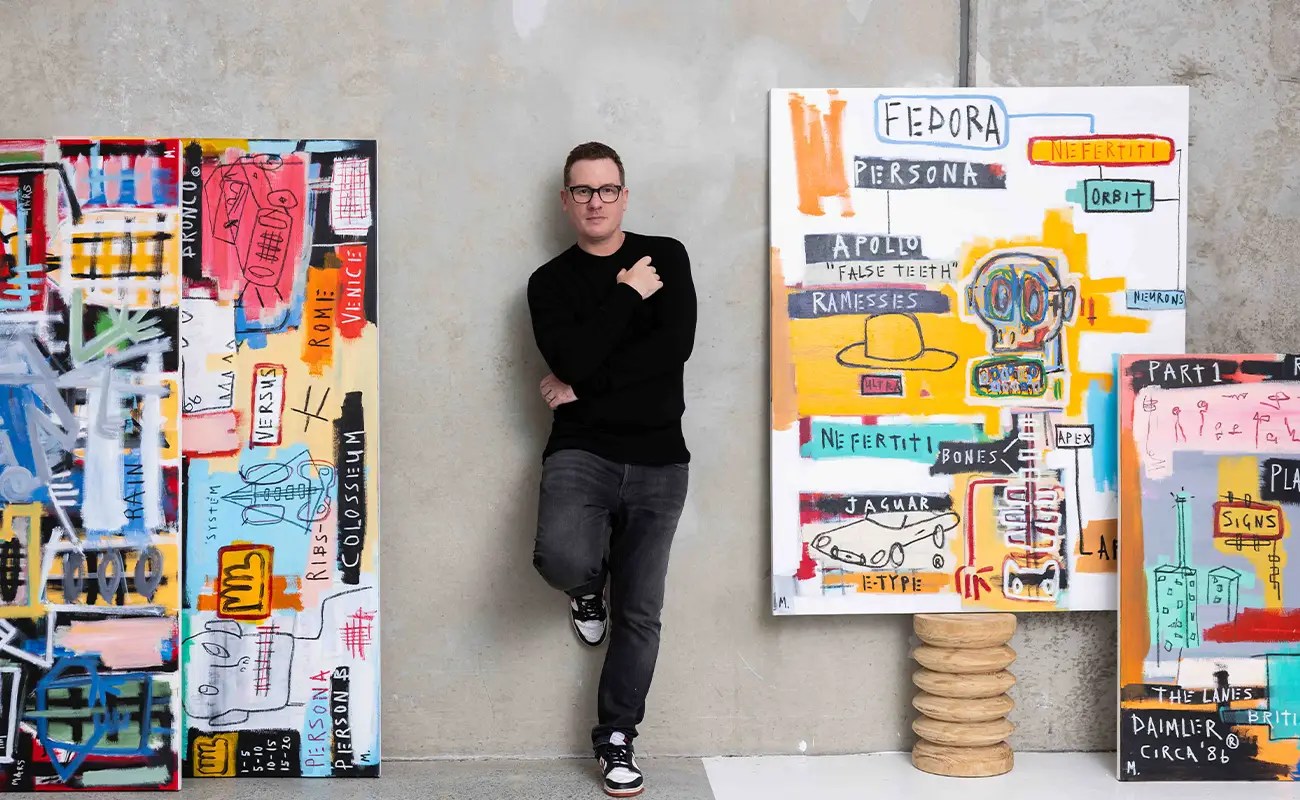
Movement has been a defining force throughout the creative life of Australian multidisciplinary artist Matt Smith, professionally known as M. Based on the Gold Coast, his practice spans expressive painting and wearable art, bringing visual ideas beyond the gallery and into everyday life. Working primarily with acrylic, oil stick, and oil pastel on canvas, he approaches each piece as an evolving conversation rather than a predetermined composition. The extension of his work into clothing reflects his belief that art should remain active, allowing people to carry creativity into public spaces as living canvases. This philosophy transforms artistic expression from something observed into something experienced, reinforcing his desire to connect with audiences through colour, symbolism, and emotional resonance rather than through technical perfection alone.
Growing up during the 1980s and 1990s while moving between Melbourne, Chicago, and London exposed M. to remarkably different cultures, artistic traditions, and social environments. These experiences established a lasting fascination with transition, displacement, and the subtle tension between belonging somewhere and existing between places. Museums, architecture, and cultural encounters from each city became lasting reference points that continue to echo throughout his work. Rather than reproducing literal memories, he channels the emotional atmosphere of those experiences into paintings that suggest movement, layered identities, and shifting perspectives. This broad cultural exposure became an essential part of his visual language, encouraging him to create works that invite viewers to discover multiple meanings instead of settling on immediate interpretations.
Painting entered his life unexpectedly, initially serving as a deeply personal outlet before rapidly developing into a professional career. Recognition arrived early when he became a finalist in the Sydney Rocks Art Prize in 2001, leading to a solo exhibition, participation in a group exhibition in New York City, and the placement of his work in private collections across the world. Looking back, he describes the experience as something that happened to him rather than a path he consciously selected. That perspective remains central to his philosophy today. Instead of controlling every stage of the creative process, he allows each artwork to emerge naturally, believing the strongest images reveal themselves through an intuitive exchange between artist, subconscious thought, and canvas.

M.: Visionism and the Search Beyond the Visible
Rather than identifying particular artists as defining influences, M. consistently points toward ideas, mythology, symbolism, and lived experience as the foundations of his creative practice. His paintings are less concerned with reproducing external reality than with revealing internal perception. He describes the creative process as an energetic dialogue in which images seem to emerge through him rather than solely from him. This openness to intuition allows unexpected forms and meanings to develop organically while encouraging viewers to engage with the emotional and psychological dimensions embedded within each composition. Feeling and connection remain more significant than technical precision, making each painting an exploration of consciousness rather than an exercise in representation.
One of the defining chapters of his life began when he walked away from painting in his late twenties after concluding that art was somehow connected to the personal struggles he was experiencing. What followed was a self-imposed creative exile lasting two decades. During that period he repeatedly considered one question that would eventually redefine his artistic direction. He became fascinated by the possibility of representing the invisible relationship between thoughts and the mental space that exists between them. Although he did not realise it at the time, those years became the intellectual and emotional foundation of Visionism, the artistic movement he later established. Visionism encourages viewers to question not only what they see but also why they perceive it in particular ways, exploring the relationship between perception, subconscious thought, and visual interpretation.
The origins of Visionism reach back even further into childhood memories. His father frequently travelled for work and regularly sent letters written on hotel stationery that incorporated hand-drawn illustrations into simple messages. Reading these letters became an engaging visual puzzle, encouraging M. to interpret symbols alongside language. Even after his father’s passing, he continues to feel connected to those coded communications, recognising their lasting influence on his fascination with hidden meanings and symbolic imagery. Another transformative chapter emerged through his collaboration with an NLP practitioner whose support encouraged him to embrace language more freely within his work. He credits that experience with helping clarify Visionism while profoundly influencing both his artistic direction and his personal recovery. Together, these experiences shaped his mission to bring colour, hope, and renewed energy into the lives of those who encounter his work, making the idea of second chances fundamental to both his philosophy and artistic identity.

Memory, Presence, and the Emotional Life of Painting
Choosing a single artwork to represent his practice is something M. finds almost impossible. Each painting embodies a distinct emotional experience and reflects a different aspect of his identity, making every work deeply personal. Rather than ranking individual pieces, he views them collectively as visual expressions of his inner life. This perspective reinforces his belief that painting is not simply about producing images but about documenting moments of transformation, reflection, and emotional discovery. Every canvas carries its own significance because each emerged from a unique conversation between intuition, memory, and creative instinct.
A particularly meaningful experience occurred when he unexpectedly encountered one of his earlier paintings displayed in someone else’s home. The moment immediately reconnected him with the circumstances surrounding its creation. He remembered the appearance of the room where he had painted it, the quality of the light, the music playing in the background, and the atmosphere that shaped the work. The encounter became far more than a nostalgic recollection. Instead, he experienced the painting almost as though it recognised him in return, creating a powerful exchange between artist and artwork that highlighted the enduring emotional relationship formed during the creative process.
This experience illustrates how M. understands paintings as living records rather than static objects. For him, artworks continue their own existence after leaving the studio while retaining the emotional conditions from which they emerged. When viewers bring those works into their own homes, fresh layers of meaning naturally develop as personal memories become intertwined with the original creative experience. This evolving relationship reflects the broader philosophy behind his practice, where paintings remain open to reinterpretation rather than fixed in a single explanation. Such openness encourages audiences to bring their own perceptions into dialogue with each image, reinforcing the central principles that underpin Visionism.

M.: Creating Light Through Everyday Practice
Creative work occupies nearly every aspect of M.’s daily life. Even outside the studio, his thoughts continually return to ideas, colour relationships, future compositions, and new possibilities. Rather than separating creativity from ordinary routines, he treats artistic thinking as an ongoing process that accompanies him throughout the day. This sustained engagement fuels an expanding body of work that extends across multiple formats while remaining connected through shared themes of symbolism, perception, and emotional transformation. His commitment demonstrates that artistic practice is not limited to moments of production but exists as a continuous way of observing and interpreting the world.
Several major projects currently reflect this expansive approach. Alongside preparing a substantial new body of paintings for a solo exhibition, he is developing a book and a short documentary film that will accompany both the publication and exhibition. At the same time, he continues expanding his wearable art brand through a new campaign that brings his visual language into fashion, reinforcing his long-standing ambition for art to exist beyond gallery walls. These parallel projects reveal a practice that embraces multiple forms of storytelling while maintaining a unified creative vision rooted in connection, symbolism, and personal transformation.
Despite these ambitious undertakings, the place where M. feels most fulfilled remains remarkably simple. His favourite moments occur inside the studio on a rainy day, with music playing, his dog quietly nearby, and a meal slowly cooking while he paints without interruption. Within that environment he experiences painting as an intimate conversation with the universe, a space where losing and rediscovering himself happen simultaneously. Those quiet rituals encapsulate the spirit that runs throughout his work, demonstrating that creativity is ultimately less about performance than presence, and less about certainty than remaining open to whatever images choose to emerge.