“My work is a quiet reflection on life, survival, and the passage of time, on what it means to exist within vulnerability.”
Finding Meaning in the Ordinary
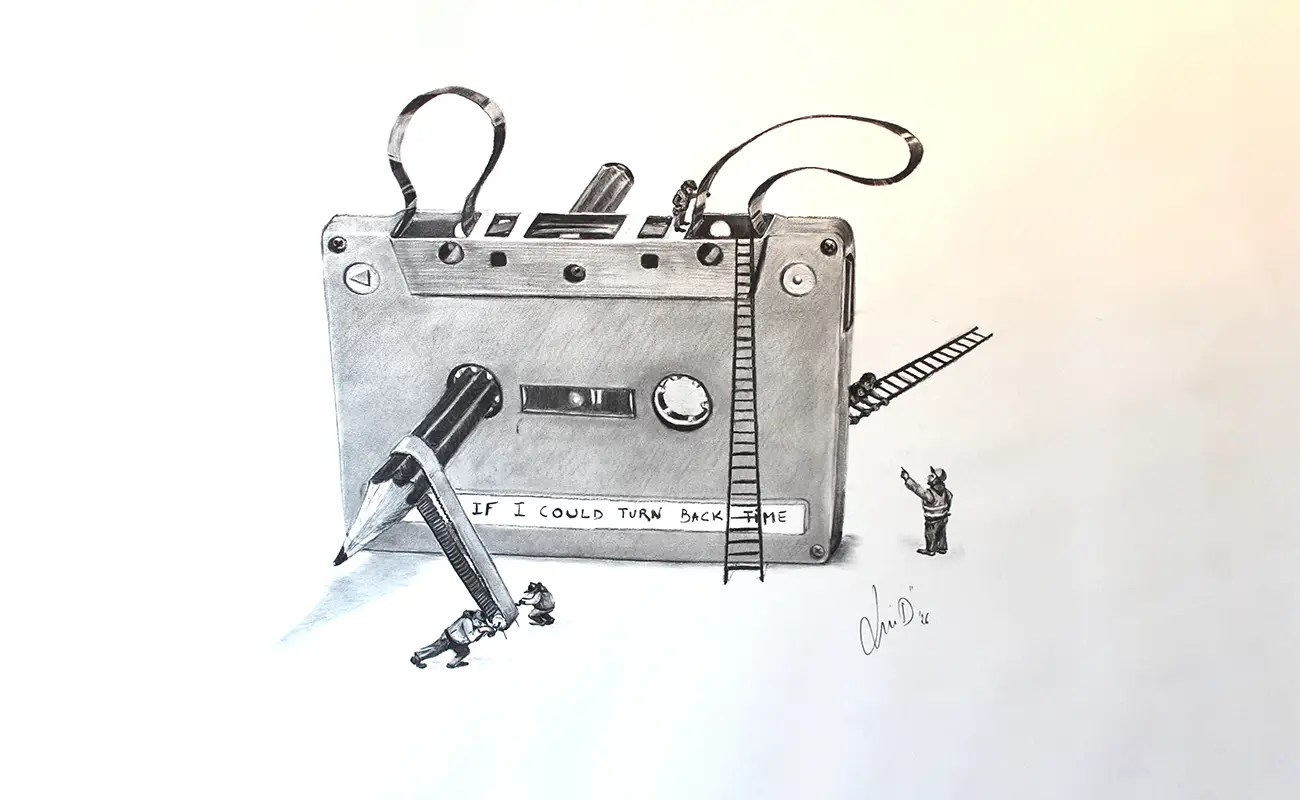
Art often speaks most powerfully through subtle gestures rather than dramatic declarations, and the work of Belgian artist Lindsay Declercq demonstrates this with remarkable clarity. Her practice transforms familiar objects into thoughtful reflections on resilience, vulnerability, communication, and the passing of time. Working primarily with charcoal while also embracing watercolor and monotype, she creates images that encourage careful observation instead of immediate interpretation. Everyday items such as telephones, typewriters, gramophones, hourglasses, life jackets, and games of chance become symbolic environments where miniature human figures interact with oversized forms, inviting viewers to consider their own experiences through poetic visual metaphors. This careful balance between realism and imagination has become a defining characteristic of her artistic voice.
Rather than overwhelming the viewer with elaborate narratives, Declercq relies on restraint, precision, and emotional honesty. Strong charcoal lines, rich tonal contrasts, and an economical approach to composition provide each drawing with both physical presence and conceptual depth. Small human figures climb, repair, balance, or quietly contemplate monumental objects, transforming commonplace possessions into symbols of memory, hope, uncertainty, and perseverance. Humor subtly appears throughout these scenes, never diminishing the seriousness of the themes but instead offering moments of warmth that make difficult subjects approachable. This combination of technical refinement and conceptual simplicity allows audiences to engage with complex emotions without feeling directed toward a single conclusion.
Although her work carries profound emotional weight, it remains notably accessible. Declercq invites reflection instead of imposing interpretation, allowing each viewer to discover personal meaning within her carefully constructed imagery. The quiet confidence of her compositions creates space for contemplation while encouraging curiosity about life’s fragile balance. By presenting recognizable objects through unexpected relationships and altered scale, she demonstrates how ordinary experiences can reveal extraordinary emotional truths. This thoughtful visual language establishes a strong foundation for an artistic practice that values empathy, attentiveness, and shared human experience above spectacle or dramatic effect.

Lindsay Declercq: Rebuilding Through Creativity
Declercq graduated in 2000 from LUCA School of Arts in Ghent with a Master’s degree in Fine Arts with a specialization in Graphic Design. Following her studies, she steadily developed her artistic practice while participating in successful solo and group exhibitions. After a quieter period, she returned to making art with renewed commitment approximately two years before this interview. That return was deeply connected to a period of illness, an experience that fundamentally reshaped her relationship with creativity. Rather than becoming the explicit subject of her work, the experience introduced a deeper sensitivity that quietly informs the emotional atmosphere of her drawings and paintings.
Creating gradually became more than a professional pursuit. Drawing and painting evolved into ways of marking time, restoring balance, and reconnecting with essential aspects of daily existence. Declercq emphasizes that her work is not autobiographical, yet the emotional perspective gained through personal hardship remains present beneath every composition. This subtle distinction allows her images to resonate universally rather than remaining confined to individual experience. Themes of survival, vulnerability, endurance, and hope emerge naturally through symbolic imagery instead of direct narrative, allowing viewers from diverse backgrounds to recognize aspects of their own lives within the work.
Several artistic influences have contributed to the development of her distinctive visual language. She cites Rinus Vandevelde, David Hockney, and Léon Spilliaert among the artists whose work has inspired her thinking. While echoes of their approaches can occasionally be sensed in her sensitivity to composition, atmosphere, or narrative suggestion, Declercq has established a voice that remains unmistakably her own. Precision in drawing combines with conceptual wit, while emotional depth is consistently softened through subtle humor. This carefully balanced approach reflects an artist interested not only in visual excellence but also in creating meaningful encounters between artwork and audience.

Symbols of Time, Resilience, and Wonder
One of Declercq’s most meaningful works is Life is a Bingo, a charcoal drawing created soon after she resumed working intensively. The piece occupies a special place within her practice because it represents both a personal renewal and a broader philosophical reflection. Using the familiar imagery of a game of chance, the drawing considers the unpredictability of existence and reminds viewers that many aspects of life remain beyond individual control. Rather than presenting uncertainty as something fearful, the work encourages gratitude for each day while emphasizing the importance of embracing happiness whenever it appears.
This artwork reflects many of the themes that continue to shape Declercq’s practice. Oversized objects become symbolic landscapes populated by miniature figures whose actions mirror emotional realities rather than literal events. Through these imaginative relationships, abstract ideas such as vulnerability, perseverance, communication, and memory become visually tangible. The restrained monochrome language of charcoal reinforces the timeless quality of these reflections, while the artist’s refined draughtsmanship gives even the simplest compositions remarkable presence. Humor quietly accompanies the symbolism, reminding viewers that resilience often depends upon the ability to find lightness within challenging circumstances.
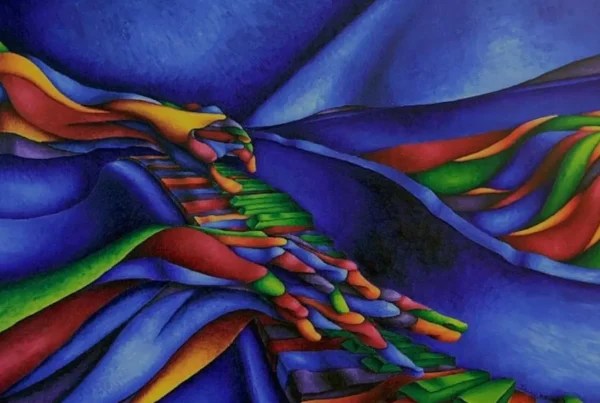
Alongside her charcoal drawings, Declercq’s watercolor and monotype works reveal another dimension of her artistic vision. Rich color palettes and gentle atmospheric effects replace the dramatic tonal contrasts of charcoal, directing attention toward nature, stillness, and moments of quiet beauty. These works celebrate overlooked details and natural rhythms, encouraging slower observation and renewed appreciation for the surrounding world. Together, these contrasting bodies of work create a practice that moves comfortably between introspection and celebration, demonstrating how different media can express complementary emotional perspectives while remaining connected by a shared commitment to compassion and attentiveness.

Lindsay Declercq: Expanding Quiet Narratives into Space
Declercq describes her current practice as one that continues to evolve, with each completed work opening possibilities for further exploration. Rather than viewing her established themes as finished ideas, she approaches them as ongoing conversations that continually reveal new emotional and conceptual dimensions. This sustained curiosity allows her practice to remain dynamic while preserving the consistency that defines her visual identity. Every drawing builds upon previous discoveries, strengthening her exploration of vulnerability, resilience, memory, and the quiet poetry found within familiar objects.
Looking ahead, she hopes to extend these narratives beyond the flat surface of paper by bringing her imagery into large-scale environments. She is particularly interested in allowing her drawings to occupy physical space through three-dimensional or four-dimensional experiences. Such an evolution would preserve the symbolic language already present within her work while inviting viewers to become participants rather than observers. Enlarging her miniature narratives into immersive settings offers exciting possibilities for expanding the emotional dialogue between artwork, object, and audience without abandoning the contemplative qualities that distinguish her practice.
Working from her studio in Belgium, Declercq continues to refine an artistic language rooted in empathy, observation, and thoughtful craftsmanship. Whether through expressive charcoal drawings or luminous watercolor compositions, she consistently encourages viewers to pause, notice, and reflect upon the delicate balance between uncertainty and hope. Her work demonstrates that familiar objects can carry profound emotional significance when approached with imagination and sensitivity. Through technical excellence, conceptual clarity, and quiet optimism, she creates art that gently reminds audiences to embrace life with curiosity, compassion, and an enduring appreciation for the beauty that often exists within ordinary moments.