When the Wall Becomes a Social Space
Fintan Magee has built an international practice around a simple but demanding proposition: figurative painting can speak directly to public life. The Sydney-based Australian painter and muralist creates large-scale works that bring portraiture, allegory, and social observation into streets and shared spaces. Migration, environmental change, racial injustice, class, consumption, displacement, and community recur throughout his work, yet his paintings rarely function as straightforward illustrations of political subjects. Individual people and ordinary experiences remain central, giving broader issues a recognizable human presence.
Born in Lismore, New South Wales, in 1985 and raised in Brisbane, Magee grew up surrounded by creative influences. His father, an artist and sculptor from Derry in Northern Ireland, and his mother, who studied art before architecture and became a landscape architect, encouraged drawing from childhood. During Magee’s earliest years, the family lived in a disused church they had purchased in the countryside. He remembers copying military aircraft from magazines, an activity that helped him understand perspective and representation long before painting became a profession.
Brisbane introduced another visual education. Graffiti was embedded in the neighborhood where Magee grew up, and by twelve or thirteen he was writing graffiti himself. The attraction developed into a formative engagement with scale, walls, and the physical demands of making images in public. Later travels through Europe, including periods working inexpensive jobs in London and Amsterdam, allowed him to continue painting graffiti. Those years established his relationship with the street, but eventually its emphasis on lettering began to feel restrictive. He increasingly saw the wall not simply as a site for writing, but as a vast pictorial surface with possibilities still to explore.

Fintan Magee: From Graffiti Letters to Human Figures
Magee completed a Bachelor of Fine Arts at the Queensland College of Art in 2009. By the end of his studies, he was questioning the conventions that had shaped his graffiti practice. Traditional graffiti offered a highly developed formal language rooted in letters and trains, but he wondered why that vocabulary should determine what he painted. Artists such as Chloe Early and Conor Harrington offered useful examples of how someone could emerge from street culture while pursuing figurative painting and painterly experimentation. Around 2010, Magee began testing that possibility seriously through murals.
The transition was gradual rather than seamless. Moving beyond familiar methods meant abandoning established habits and rebuilding his approach on a much larger scale. Magee has identified approximately 2014 and 2015 as the point when his murals began to feel resolved by his own standards. That long period of adjustment shaped an attitude that continues to inform his practice. Experimentation and failure are necessary, while becoming too comfortable with a recognizable style risks limiting development. Curiosity, alongside a clear understanding of strengths and weaknesses, keeps the work moving.
The human figure eventually became the anchor of this expanded language. Magee considers himself fundamentally a portrait painter, and encounters with people often provide the starting point for his images. For public projects, he has sought subjects whose lives connect meaningfully to the communities surrounding the wall. Individuals therefore do more than represent an abstract theme. Their experiences can open onto questions of migration, inequality, identity, history, or environmental instability. Monumental scale does not turn them into conventional heroes. His figures are often introspective, vulnerable, displaced, or caught in uncertain circumstances, qualities reinforced by a softness influenced by children’s books and the Lowbrow art movement.

Painting the Forces Behind Ordinary Lives
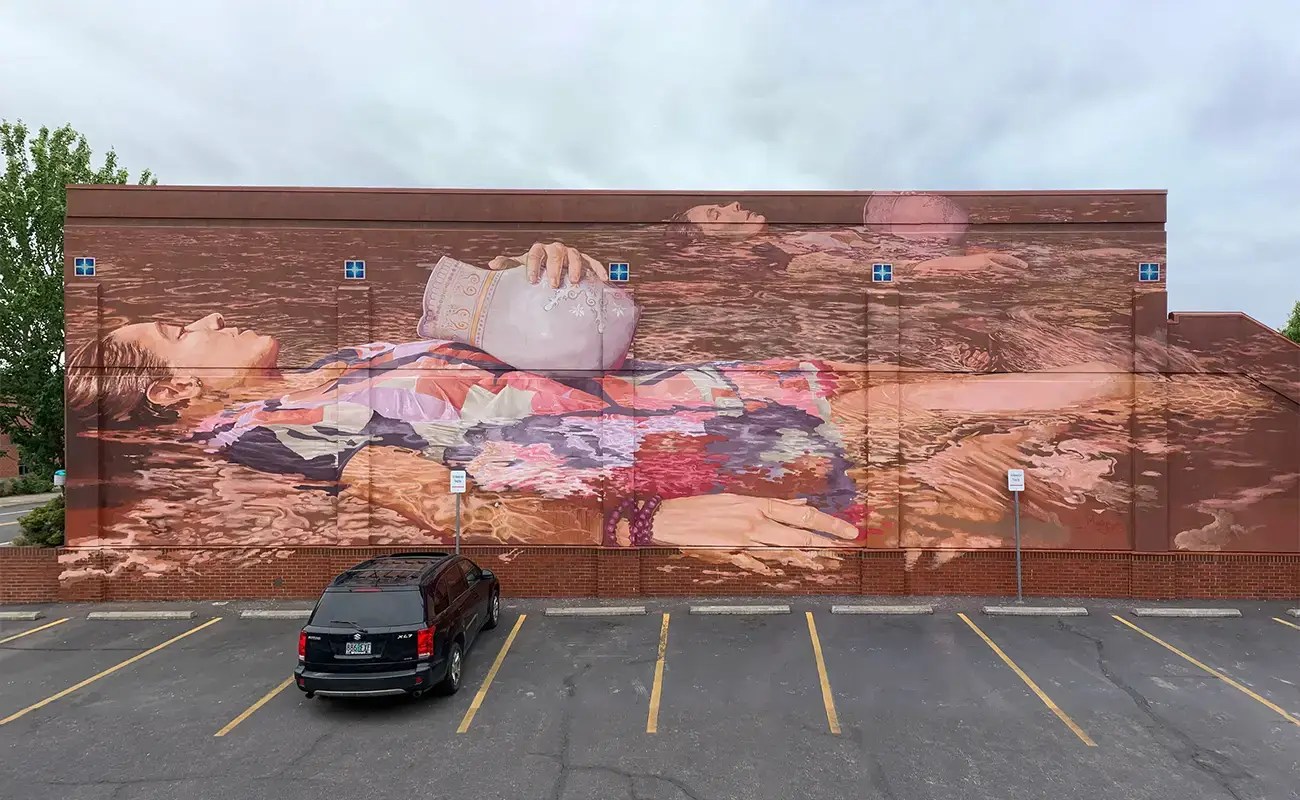
Magee describes much of his imagery as allegorical, allowing recognizable people and environments to carry meanings beyond literal portraiture. Runaway horses have represented civil unrest, while obscured or frosted glass has suggested isolation. Such devices create space between documentary observation and symbolism. Rather than announcing a fixed political message, the paintings can begin with familiar visual material and shift toward larger emotional or social questions. His interest in journalism and public art meets here: specific circumstances matter, but so does the capacity of an image to transform them.
Personal experience has also provided important material. After witnessing the severe Brisbane floods of 2011, Magee developed a body of work concerned with water and environmental instability. The event offered a direct route into questions surrounding climate change, displacement, and the vulnerability of communities. Similar connections between immediate experience and wider conditions appear throughout his treatment of waste, consumption, transition, loss, and inequality. The political dimension of the work is therefore frequently grounded in something observed, encountered, or lived rather than imposed as an abstract concept.
His studio paintings extend this investigation through the relationship between photography and paint. Photorealistic foundations may be blurred, fragmented, distorted, or pushed toward abstraction, making the construction of the image visible. Architectural motifs also carry personal associations. Patterns based on glass found in Queensland houses connect memories of childhood and domestic space with questions of belonging, suburban development, and isolation. Glass is particularly useful because it can reveal and obstruct at the same time. In Magee’s paintings, these formal interventions can change how a subject is read, allowing brushwork and distortion to become active parts of the narrative rather than decorative effects.

Fintan Magee: Public Painting Beyond the Gallery
Place is fundamental to Magee’s mural practice. A wall is not simply a convenient surface for an image conceived elsewhere. He researches local events, industries, histories, and social conditions before developing projects, looking for connections between a painting and the people who will live alongside it. In Norway, for example, he responded to the decline of the local oil industry and its effects on workers by depicting figures connected with that history. The approach reflects his conviction that public art can address lived experience while reaching people who may have little contact with galleries or contemporary art institutions.
That conviction connects Magee to Social Realism and the history of politically engaged mural painting. He has cited Diego Rivera and Grant Wood for their ability to represent working-class experience and social conditions through figurative art. His own understanding of murals was also shaped by exposure to political street imagery in Northern Ireland, linking his father’s background to his awareness of the social force of public images. Magee recognizes that murals can unite communities or sharpen divisions, depending on their imagery and context. Public painting, from this perspective, participates in civic space rather than merely enlarging a private studio practice.
Magee has carried that philosophy across Australia and internationally, completing projects in countries including Belarus, India, Jordan, Spain, Tahiti, Tunisia, and the United States, alongside numerous European locations. His work has appeared in the Asia Pacific Triennial of Contemporary Art and group exhibitions connected with the Honolulu Museum of Art, Urban Nation Museum, Long Beach Museum of Art, and Museum of Fine Arts in Calais. Solo exhibitions including Water World in Melbourne, Waves in Paris, and Big Dry in Los Angeles have further developed concerns visible in his public work. Across walls and studio paintings alike, Magee continues to treat painting as a form of social contact, using individual lives, local histories, and familiar environments to make larger political and environmental forces visible.