“I’m less interested in what a landscape looks like than in what it feels like: its motion, its atmosphere, its pulse.”

The Eye of Consumption
Painting With Motion
Hubert Endl approaches photography as an act of transformation rather than straightforward description. Through Intentional Camera Movement, known as ICM, he uses the physical movement of the camera during exposure to loosen the visible world from fixed form. Trees stretch into luminous bands, grasses become gestures, architecture fractures into overlapping planes, and crowds dissolve into fields of color. His photographs remain connected to recognizable places and subjects, yet they prioritize rhythm, atmosphere, and sensation. For Endl, the camera functions much like a brush, capable of translating a fleeting encounter into an abstract visual story.
That approach grew from a relationship with photography that began when he was seventeen. Working with roll film, he spent long hours in the darkroom and learned a process shaped by patience, precision, and the value of each exposure. Photography later moved to the margins of his life for nearly four decades while he worked as an IT manager in banking and focused on career and family. During those years, the camera remained present mainly through holiday snapshots, preserving a connection to an interest that would eventually return with greater intensity.
Retirement gave Endl the opportunity to commit to photography again, but he did not simply resume the practice he had left behind. Digital technology opened a different kind of freedom, while the discipline of his analog years remained relevant to how he thinks about light, timing, and intention. His equipment traces that continuity. After beginning his history with Canon through the AE 1 in the 1970s, he now works with Canon R7 and R6 Mark II mirrorless cameras. The technology has changed dramatically, but his attention to purposeful image making has endured.

The Castle
Hubert Endl: From Recording to Seeing
The decisive shift in Endl’s practice came when he stopped treating the camera primarily as a device for recording appearances. Movement became a creative instrument. Instead of freezing grasses, water, leaves, or light, he began moving the camera deliberately during exposure, allowing forms to soften, repeat, stretch, and merge. ICM offered a way to make photographs that communicate how a scene feels rather than simply what stands in front of the lens. The resulting images move between representation and abstraction without fully abandoning either.

The Pond
Nature is central to this visual language. Endl is drawn to the sway of grasses, changing light, reflections, trees, water, and seasonal transitions, all subjects that already contain their own forms of motion. In “Sunbeams,” dry winter grass beside an icy river catches the rising sun until the blades appear almost incandescent, their repeated curves resembling rays of light. “The Pond” uses vertical camera movement to stretch trees and their reflections into green and gold bands, turning a quiet scene before spring into an almost symmetrical exchange between land and water.

Woven Sunlight
His techniques vary according to the character of each encounter. Multiple exposure can layer a subject into a shifting, dreamlike presence, while radial zoom pulls the eye toward a point of concentrated energy. In “Dance of the Awns,” ripe wheat is drawn into motion through a radial zoom during exposure, with golden awns appearing to dance around a single green stalk. “Woven Sunlight” uses intentional multiple exposure to transform a backlit tree into overlapping contours around a burst of sun. The method is never separate from the subject; movement becomes the means through which Endl interprets it.

Dance of the Awns
The Familiar World, Reassembled
Endl’s search for movement extends beyond natural landscapes. Architecture, travel, markets, trains, and people also become material for images that resist literal description. In “The Castle,” warm evening light and ICM disrupt the rigidity of a castle courtyard. Arches and windows bend and overlap into layered planes, reflecting his attempt to interpret the scene through a Cubist sensibility rather than a single fixed viewpoint. The photograph turns solid architecture into an unstable arrangement of time, space, and light.

Colourful Market

Ladies Hats
Other works bring a more playful or observational tone. “The Eye of Consumption,” made in Rijeka, places a golden statue amid blurred tourists and surrounding shops, connecting visual motion with the pull of consumer activity. “Ladies Hats” transforms an arts and crafts market into a swirl of summer color, motion, and merchandise, while its accompanying reflection on prices adds humor to the scene. In “Colourful Market,” made at an African market festival, multiple exposure layers figures, tents, warm reds, golds, and blue sky. A central person appears partly present and partly absorbed into the surrounding activity, making the photograph more about the experience of the market than a factual record of it.

Speed
Speed and transition recur throughout the work. In “Speed,” a red locomotive pulling a blue train through a dry summer landscape becomes less an object than a stream of energy as tracks, grass, and sky merge through ICM. “Resting,” by contrast, finds people sitting on a bench in Opatija during the summer heat, looking toward the Adriatic. Even this pause is rendered through Endl’s blurred visual vocabulary. “The human journey” turns railway tracks into a metaphor for lives that may follow an expected course or suddenly bend away from it, linking physical direction with uncertainty about the future.

Resting
Hubert Endl: Golden Drought and the Discipline of Selection
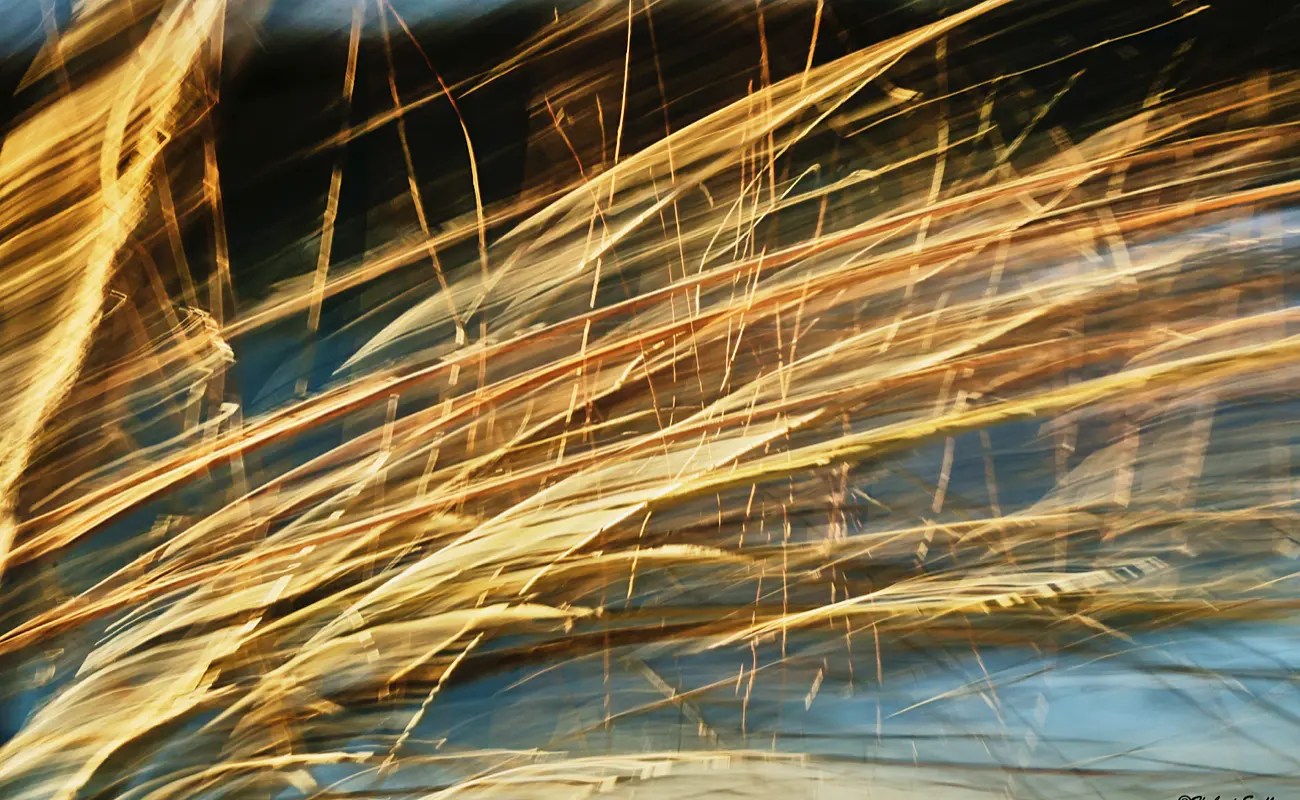
Among Endl’s photographs, “Golden Drought” carries particular personal and artistic significance. He considers it one of his best works, and its subject connects his abstract approach with an explicit concern for nature and climate change. The image began with dried grass at the edge of a pond late in the afternoon, when low sunlight covered the grass in gold. Rather than treating the scene as conventional landscape photography, Endl used an in camera multiple exposure to intensify its structure and atmosphere.
For the first exposure, he made a slow camera movement. For the second, he turned the camera upside down and repeated that movement. The combined exposures create blurred forms with an Impressionistic character, while the pond behind them shimmers in soft blue and gold. Out of focus trees hold the warm evening light around the scene. The dried blades point toward the center, where the pond’s low water level becomes visible. Beauty and environmental unease occupy the same frame, allowing the image to register both the seduction of golden light and the conditions suggested by drought.
Endl’s working routine depends on sustained observation followed by strict editing. He keeps a camera with him at home and while traveling, photographing whenever something catches his attention. Later, when he has enough time and quiet, he reviews the images, edits, and deletes extensively. Usually only about twenty percent survive that first process, and just a few of those ultimately meet his standards. His perspective has also been sharpened through learning from ICM artists Eva Polak, Kate Fish, and Roxanne Bouché Overton, as well as participation in the ICMPhotoMag network and the ICM Academy. His work has appeared in several on screen Artboxy exhibitions, and he is now expanding his digital presence while preparing physical exhibitions, continuing a practice centered on seeing familiar subjects differently.