“Synesthesia is not just about expressing the music, it is intertwined with my life experiences.”
Color That Arrives Before the Canvas
For Isaac D Smith, color is not simply selected from a palette. It can arrive through sound, movement, memory, and physical sensation. Born and raised in Anchorage, Alaska, and now living in Washington State, Smith works primarily through oil painting and custom leaded stained glass. These mediums behave differently, yet both allow him to translate an internal experience shaped by synesthesia, a neurological condition he has experienced since childhood. Music produces colors and shapes in his mind, often in motion, giving his practice a perceptual foundation that links sound, light, form, and lived experience.
Smith describes these visual responses as fluid rather than fixed. Colors and shapes may move through his consciousness with a physical sense of passing around or through his eyes and brain. At times the imagery is dense and intensely saturated; at others it becomes transparent or seems to turn into light itself. That shifting quality helps explain his attraction to oil and glass. Paint gives him material color that can be layered, curved, and pushed across a surface, while stained glass makes illumination an active part of the work.
Yet music is only one part of the equation. Smith connects synesthetic perception with memories and sensations that have stayed with him: Alaska’s dramatic cycles of light and darkness, his one year old son’s expression while discovering fallen leaves in autumn, the physical and emotional pressure of anxiety, and the feeling of wind moving around and through a tree. Rather than reproducing these subjects literally, he looks for their felt character. A plant becomes flow, a landscape becomes a line of movement, and a figure can carry an emotional condition instead of functioning as straightforward representation.

Isaac D Smith: Painting Motion Instead of Objects
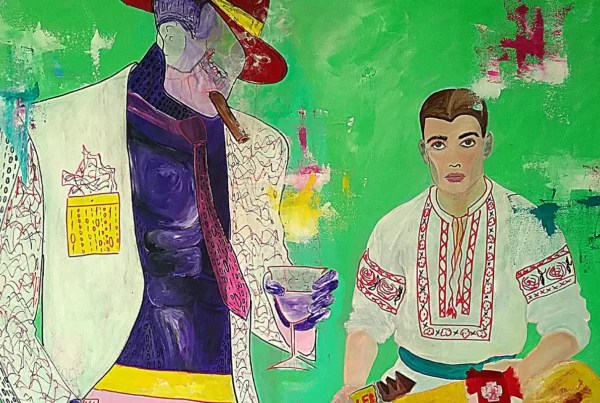
Smith’s oil paintings are marked by saturated color and organic movement. Warm golds, deep greens, and vivid blues recur because they correspond to what he experiences rather than serving as decorative choices. Curves, arcs, and sweeping lines create momentum inside a static surface. This approach shifts attention away from identifying an object and toward sensing its movement. Even when a recognizable figure or natural form appears, representation is not the final goal. The image becomes a structure for communicating rhythm, pressure, lightness, emotion, or change.
Growing offers a clear example. The painting began with Smith observing the curve of a single branch from a hanging basket. What interested him was not botanical description but the elegance of the branch’s motion. A warm yellow ochre ground supports animated greens and yellows, allowing the composition to concentrate on gesture and flow. The resulting image carries a resonance with Japanese art, particularly its attention to line, economy of form, and negative space. Those qualities align with Smith’s instinct to reduce a subject to the movement or feeling that first caught his attention.
Flowing expands that concern across two large canvases, one measuring 48 by 32 inches and the other 42 by 28 inches. The work addresses the movement, lightness, and heaviness of water, but its most consequential decision may be the space between the panels. Smith intentionally leaves the break open so viewers can complete the movement imaginatively. The gap prevents the image from becoming fully contained and makes absence part of the composition. It also parallels his description of synesthetic imagery, which moves through consciousness and resists being held in a single fixed form.

Drawing With Glass and Illumination
Custom leaded stained glass gives Smith another way to work with color, but here light is not merely depicted. It passes through the material and changes the visual experience directly. His pieces are designed with their installation spaces in mind, joining artwork and architecture through the conditions of a specific setting. Innovative beveling techniques introduce dimension, depth, and shifting light play. The result is a practice in which illumination can activate color physically, echoing those moments when Smith’s synesthetic perception becomes transparent or appears as literal light.
The challenge is that glass begins with properties that seem opposed to the fluidity Smith seeks. It is hard, segmented, and traditionally organized through firm divisions between lead lines and colored fields. Smith works against that rigidity by guiding the leading through flowing, organic paths closer to the language of his paintings than to conventional rectilinear stained glass grids. The panels therefore read less like static arrangements and more like drawings constructed from glass, lead, color, and changing illumination. Material hardness is made to suggest grace and movement.
This continuity between painting and stained glass is central to understanding Smith’s practice. The two mediums are not separate stylistic tracks but different solutions to the same perceptual problem: how to give external form to an experience that combines sound, color, shape, motion, and light. Oil allows him to build a visual field from pigment, while glass lets ambient light enter the work as a changing component. Across both, his strongest formal decisions come from translating sensation rather than imitating appearances, making the visible image a record of something first encountered internally.

Isaac D Smith: Hearing the Figure, Seeing the Music
Certain kinds of music intensify Smith’s visual experience. Piano and percussion produce especially vivid imagery, while symphonic and classical works by Beethoven, Bach, and Vivaldi provide abundant color and form. Opera, Latin music, and other compositions with multiple layered components can generate similarly rich responses. Complexity matters because several musical elements can produce a correspondingly active visual field. For Smith, the longstanding artistic question of how music and visual art might occupy the same space is therefore not only conceptual. It begins in everyday perception.
That connection becomes particularly direct in works centered on musicians, including Cellist, Pianist, and Violist. These paintings operate simultaneously as figurative images and translations of the music associated with their subjects. The performer cannot be separated neatly from the sound, because the sound itself produces visual information for Smith. Figure, color, gesture, and musical experience converge within one composition. This helps explain why figurative elements in his work are not intended as conventional likenesses. A body can carry movement and feeling while also serving as a point where seeing and hearing meet.
Smith is now preparing an oil painting of a figure centered on the feeling of letting go, a process he says he has been learning and moving through over the past several years. The project brings his method into a personal emotional register while remaining consistent with the rest of his practice. Life experience, bodily sensation, music, and color are not treated as separate sources. They enter the work together. From Alaska’s extremes of light to a child’s encounter with autumn leaves, from moving water to the force of wind, Smith builds images around how experience feels before it settles into representation.