“I believe everybody has creativity in them and can express themselves through art. You just need to take the time to listen to yourself.”

e.wasserhase with Hyrdra design
Emerald Buddha
From Psychology to Creative Renewal
The artistic journey of e.wasserhase is rooted in an unusual combination of scientific understanding, global experience, and a profound connection with nature. Born in Hamburg, Germany, in the Chinese Year of the Water Rabbit, she adopted “Wasserhase” as her artistic identity, embracing the symbolism of tranquillity, harmony, peace, and emotional balance that the zodiac represents. Throughout an extensive international career with the World Health Organization in Geneva, she travelled widely while living in Germany, England, France, Switzerland, and later dividing her life between the Algarve in Portugal and Andalucia in Spain. Although art was never her formal academic path, her studies in psychology shaped the way she understands human behaviour, emotional wellbeing, and the influence that systems have on people’s lives. Rather than viewing psychology and creativity as separate pursuits, she considers them complementary ways of understanding and restoring the human experience. This perspective established the foundation for an artistic practice that focuses not only on visual beauty but also on emotional restoration, reflection, and personal growth through creative expression.
Her transition into a more dedicated artistic life unfolded gradually alongside an exceptionally demanding professional career. During those years she experimented with numerous forms of creativity, including painting, sculpture, and stone carving before later embracing pottery after relocating to southern Europe. A defining emotional turning point arrived following the death of her mother, who had discovered painting at the age of seventy and spent five fulfilling years immersed in artistic creation. Witnessing that late creative awakening became an enduring source of inspiration, reinforcing the belief that personal growth should never be limited by age or circumstance. That experience strengthened her commitment to lifelong learning and encouraged her to embrace the creative side of herself after many years dominated by analytical work. She often reflects that creativity belongs to everyone, provided individuals allow themselves the time and freedom to reconnect with their inner voice. This philosophy remains central to both her artistic process and her broader outlook on life.
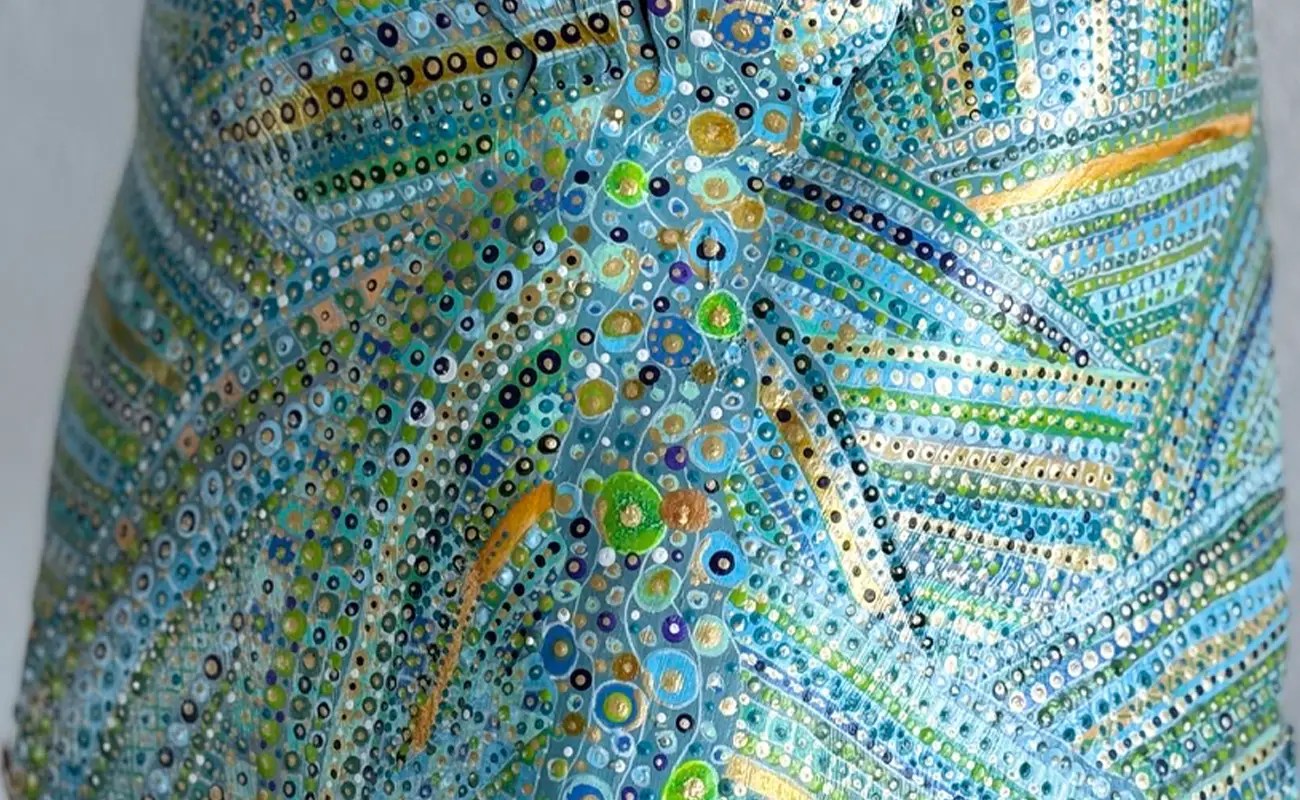
Living in Portugal and Spain introduced her to natural materials that would fundamentally reshape her artistic language. Eucalyptus bark, palm bark, and palm leaves immediately captured her attention, not as discarded organic matter but as sculptural forms already rich with character and possibility. Working with these naturally weathered surfaces inspired the development of her distinctive dot painting technique, which has become one of the defining characteristics of her work. Thousands of carefully placed dots transform overlooked fragments of nature into detailed visual compositions that invite prolonged observation. Meditation, Tai Chi, yoga, and energy work all influence this slow and reflective process, allowing every artwork to emerge intuitively rather than according to rigid planning. She approaches each bark as a collaboration with nature itself, creating pieces that honour organic forms while expressing personal symbolism, mindfulness, and the possibility of healing through attentive creative practice.

Waterblue 3
Hydra
e.wasserhase: Transforming Nature into Visual Meditation
Nature provides both the material and the emotional language of e.wasserhase’s work. Rather than collecting conventional artistic supports, she seeks beauty in pieces of bark and organic surfaces that many people overlook or discard. She is fascinated by the history already contained within each fragment, allowing its contours, textures, and imperfections to influence the final composition. The resulting artworks become conversations between natural structure and human imagination, with no two pieces ever following the same path. Her distinctive dot painting technique creates extraordinary visual density while encouraging a slower way of looking. Every carefully applied mark contributes to an atmosphere of contemplation that reflects the meditative rhythm through which the works are produced. Instead of concealing the original character of the bark, she enhances it, allowing the natural forms to remain visible beneath intricate layers of colour and symbolism that celebrate both transformation and preservation.
Her artistic influences reach far beyond Europe, shaped by decades of international travel and a lifelong admiration for Aboriginal art. Since adolescence she has been inspired by its visual language and its capacity to communicate spirituality, storytelling, and connection with the land. Travel continues to influence individual works in distinctive ways. Journeys to Thailand inspired the fluorescent artwork Emerald Buddha, while visits connected with New Zealand introduced imagery that informed works such as Personam and Fluo 11, reflecting the visual presence of Māori masks and facial designs. The creative process itself remains intentionally flexible. Sometimes a clear concept guides an artwork from the beginning, while at other times the natural material determines its own direction. This openness allows each composition to develop organically, with meaning gradually emerging through sustained engagement rather than predetermined plans. Every completed piece therefore represents a unique dialogue between memory, travel, intuition, and the natural object itself.
Technical experimentation plays an equally important role in expanding her visual language. Acrylic paint remains her principal medium, occasionally complemented by natural pigments, while dotting tools, brushes, and spray paint allow different textures and effects to emerge. Every bark surface is carefully prepared with primer before painting and later sealed for protection, ensuring durability while respecting the original material. Small found objects including metal turtles, Chinese coins, and feathers sometimes become integrated into compositions, introducing movement and symbolic associations that evolve as air currents gently animate the finished work. Fluorescent pigments have recently become one of her favourite creative directions, producing artworks that transform dramatically after dark. She envisions future exhibitions dedicated entirely to these glowing creations, fascinated by the magical atmosphere they generate. Keeping several of these works in her own bedroom allows her to experience that transformation personally, turning ordinary nighttime moments into quiet encounters with luminous colour and imagination.

Angelwings
Songs for Mother Nature
Art, Collaboration, and Environmental Reflection
Several projects demonstrate how e.wasserhase extends her artistic practice beyond individual artworks into broader conversations about society and the environment. During her early work with palm bark she noticed that many naturally curved forms suggested female anatomy, including torsos, corsets, and other organic feminine silhouettes. This observation inspired the artwork Armadura Amazona, which in turn became the catalyst for the project Contemporary Amazons and Art. Through this initiative she explored both the resilience and vulnerability of women, using creativity to acknowledge the many challenges women continue to encounter while celebrating their strength. The project combined playfulness with thoughtful social commentary, encouraging audiences to recognise courage and endurance without sacrificing beauty or imagination. By allowing naturally occurring forms to guide these themes, she transformed discarded materials into powerful visual metaphors that connect personal identity with broader cultural questions.
Creative collaboration also became an important chapter through a partnership with her husband. Inspired partly by her artworks, he began writing poetry during his spare time, eventually leading them to combine their respective practices in the publication Songs for Mother Nature – Art meets Poetry. Producing the book required persistence and patience, particularly while balancing two creative voices within one shared project, yet they remain proud of the finished result. The publication serves as both an artistic collaboration and a heartfelt appeal for environmental responsibility, encouraging greater care for the natural world that sustains all life. Receiving supportive reviews from scientific editors connected with her former workplace added another meaningful dimension to the project, bringing together the scientific community and artistic expression in a way that reflects the balance that has characterised much of her own professional and creative life.
Her work has continued to evolve into new formats, with original designs now appearing on products including tiles, yoga mats, bags, and blouses. Exploring these applications has become another opportunity for experimentation while introducing her imagery into everyday environments beyond galleries. Beneath these developments remains a consistent conviction that contemporary society has become increasingly disconnected from nature and from its own inner instincts. She speaks not of organised religion but of spirituality understood as awareness, presence, and appreciation for the essential relationships between people and the natural world. An observation frequently made during exhibitions illustrates this concern vividly. Many visitors no longer recognise the palm bark materials she transforms into artworks, sometimes believing she has moulded them artificially. Older generations identify them immediately, revealing how changing lifestyles have altered everyday familiarity with the natural environment. For her, this small interaction reflects a much larger cultural shift that art can gently challenge.

Armadura Amazona
Joy
e.wasserhase: Creating Connections That Continue Beyond the Studio
Among the many works she has created, one piece carries especially personal significance. Titled Joy, it consists of a large section of palm bark transformed through countless hours of concentrated attention into an intricate composition dominated by shades of purple, her favourite colour. Throughout its creation she experienced an overwhelming sense of happiness that became inseparable from the artwork itself. Although every finished piece feels deeply personal, Joy occupies a unique place because of the emotional experience that accompanied its making rather than any external recognition. The sustained concentration required over many weeks became part of the artwork’s identity, reinforcing her belief that creative practice is not simply about producing objects but about cultivating meaningful states of mind. For her, the finished piece continues to embody the emotional energy invested throughout its development, preserving a lasting memory of genuine creative fulfilment.
Relationships with collectors and audiences form another rewarding aspect of her artistic life. Whenever someone acquires one of her works, she experiences the exchange as something far more meaningful than a transaction. She feels that each artwork carries a small part of herself into another person’s home, while their appreciation creates a reciprocal bond that continues long after the exhibition has ended. Many visitors later tell her they can no longer pass pieces of palm bark without immediately thinking of her work. Others actively contact her after discovering interesting natural materials during walks or tree maintenance, helping her locate new surfaces for future projects. These unexpected interactions demonstrate how her practice encourages people to notice overlooked elements of their surroundings, strengthening awareness of nature through simple yet memorable encounters that extend beyond gallery walls.
Life in the studio follows no fixed routine, relying instead on moments of inspiration that cannot be scheduled. Some days pass without creative activity, while others become completely absorbed by a single artwork that demands her full attention. During these periods she enters a state of intense concentration in which time seems to disappear entirely, often forgetting even basic daily routines until her husband checks whether she has remembered to eat. Occasionally an unfinished work calls to her during the night, compelling her to return to the studio simply to observe it or continue painting. These quiet encounters reveal the deeply intuitive relationship she maintains with every piece she creates. Rather than forcing ideas into predetermined forms, she allows each artwork to reveal itself gradually through patience, mindfulness, and attentive listening, ensuring that every finished creation reflects both the voice of nature and her own evolving artistic journey.