“Artists never retire. Art is in the blood.”

Color Before Image
For Toril Kojan, painting begins before an image has fully announced itself. Color comes first, opening a field in which intuition, memory, and observation can move freely. Now 82, she continues to work with the conviction that an artistic life does not end with age or professional milestones. Her practice has developed across decades of drawing, painting, design, study, publishing, and sustained studio work, yet one principle has remained constant: she trusts color as the point of departure and allows form to emerge through the act of making.
The path to that practice was not direct. Kojan wanted to pursue art when she was young, but the choice was not encouraged within her family. The practical need to earn a living eventually led her into advertising, marketing, and design, fields in which visual communication remained central even when painting could not yet become her primary occupation. Rather than abandoning art, she kept it active alongside professional life, joining workshops focused on painting techniques and continuing to develop her skills whenever circumstances allowed.
That persistence became a defining part of her development. Later, she completed a four year art education through evening classes and also learned from established artists in Norway and abroad. Formal instruction gave her new tools, but Kojan does not describe education as a substitute for practice. Her own formula is simpler and more demanding: keep painting, accept corrections, and use the guidance as material for further work. The studio, in this sense, becomes an ongoing school in which repetition, risk, and attention matter as much as any single lesson.

Toril Kojan: A Life Built Through Practice
Kojan first found a natural entry into painting through watercolor. It offered a familiar beginning, but her move into acrylics during art school changed the intensity of what she could do. The stronger color made an immediate impression on her. She recognized that color was not simply an element within her compositions but the force around which the rest of the work could organize itself. That realization helped her identify herself as a colorist, and it continues to guide the way she approaches a blank surface many years later.
Her professional and editorial experiences also widened the context in which she understood art. In 1995, she founded the art magazine Kunst For Alle. The magazine brought her into contact with artists she found interesting and gave her opportunities to meet and interview them. Through those conversations, she accumulated knowledge that did not come only from formal study. Listening to other artists explain their decisions, methods, and experiences became another form of education, adding to the lessons already gathered through workshops, school, and her own studio practice.
The balance between learning from others and finding an individual language remains important in Kojan’s account of her work. She has continued to study well beyond her earlier education, including online learning that became increasingly accessible over the years. Since 2019, she has participated in Artandsuccess.com, an art school run by artist Pamela Caughey at a university college level. Kojan credits both Caughey’s teaching and work with influencing her own development, while still describing painting as something that must ultimately be tested through personal experience and continuous making.

From Nature to Colorful Chaos
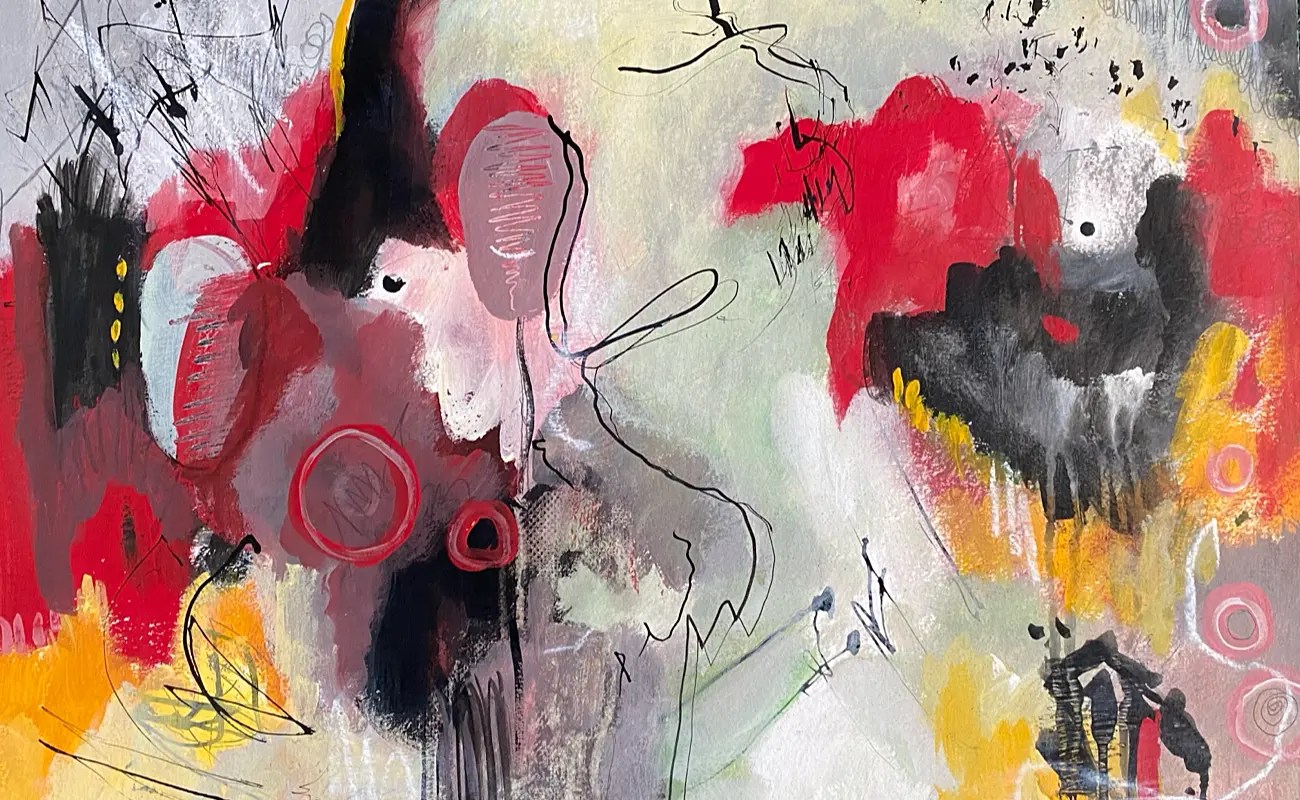
Nature is one of Kojan’s recurring sources of inspiration, but she does not attempt to reproduce what she sees in a literal way. She absorbs impressions and lets them return through painting in altered form. What emerges can begin as what she calls a colorful chaos, a state in which the composition is not yet settled and possibilities remain open. Within that activity, shapes or figurations begin to appear. She pays attention to the ones that feel significant, brings them forward, and gives them a more deliberate place within the final structure.
This process helps explain why her work often sits between nonfigurative painting and recognizable imagery. Kojan says she works mostly in a nonfigurative style, yet images that can be identified frequently remain present. The boundary is therefore flexible rather than fixed. A painting can be driven by color, movement, and intuitive decisions while still allowing a figure or familiar form to surface. Her method depends less on deciding in advance whether a work will be abstract or figurative than on responding to what develops as the layers accumulate.
Her education in Art Therapy strengthened this intuitive approach. Rather than treating spontaneity as something careless or accidental, Kojan gives it a working structure. She begins from within, lets color establish energy, and then selects from what appears. More recently, collage has entered this process as another material possibility. She has introduced collage into painted works and has also made complete collages as independent artworks. The combination of paint and collage is an area she intends to continue pursuing, extending a practice that has repeatedly grown by adding new techniques without giving up its central reliance on color.

Toril Kojan: When a Painting Knows Before the Artist
One work carries an especially direct connection between Kojan’s personal life and her intuitive method. Oh, my God was painted across 2009 and 2010, during a period she describes as very difficult. She had breast cancer, and the experience also contributed to her decision that she wanted to sell Kunst For Alle. The painting did not begin as an illustration of those circumstances. Kojan says she had nothing specific in mind when she started it, which makes the meaning she later recognized in the finished work especially important to her account.
Only after the painting was complete did she look at it and understand how closely it expressed what she had been feeling. That sequence reflects the larger logic of her practice. Meaning does not always have to be planned before the first mark is made. It can become visible afterward, once color, form, and instinct have carried something into the work that the artist may not yet have been able to state directly. In Oh, my God, the completed painting became a way of seeing an emotional condition that had already been present throughout its making.
Kojan’s practice continues from that belief in discovery. Her years in design and publishing, her formal and informal education, her encounters with other artists, and her continued study have all contributed to the work, but none has displaced the importance of painting itself. At 82, she still approaches art as an active process rather than a completed career. Acrylic remains central, collage is opening further possibilities, and nature continues to enter the studio in transformed form. The constant is her willingness to begin with color and find out what it is capable of revealing.