“The subject imposes itself upon us. But it becomes a subject only when we impose ourselves upon it.”
When Painting Refuses a Fixed Answer
Marcos Beccari approaches watercolor from an unusual position: painting is central to his life, but it is not his primary profession. A watercolorist and philosopher, he holds a PhD in Philosophy of Education from the University of São Paulo and teaches at both the Federal University of Paraná and the University of São Paulo. He has also published dozens of books and articles across art, philosophy, and design. That academic foundation inevitably sits beside his painting practice, yet the relationship is not one of professional obligation. Because his livelihood does not depend on making art, painting remains a space where pleasure, curiosity, and freedom can take precedence over career strategy.
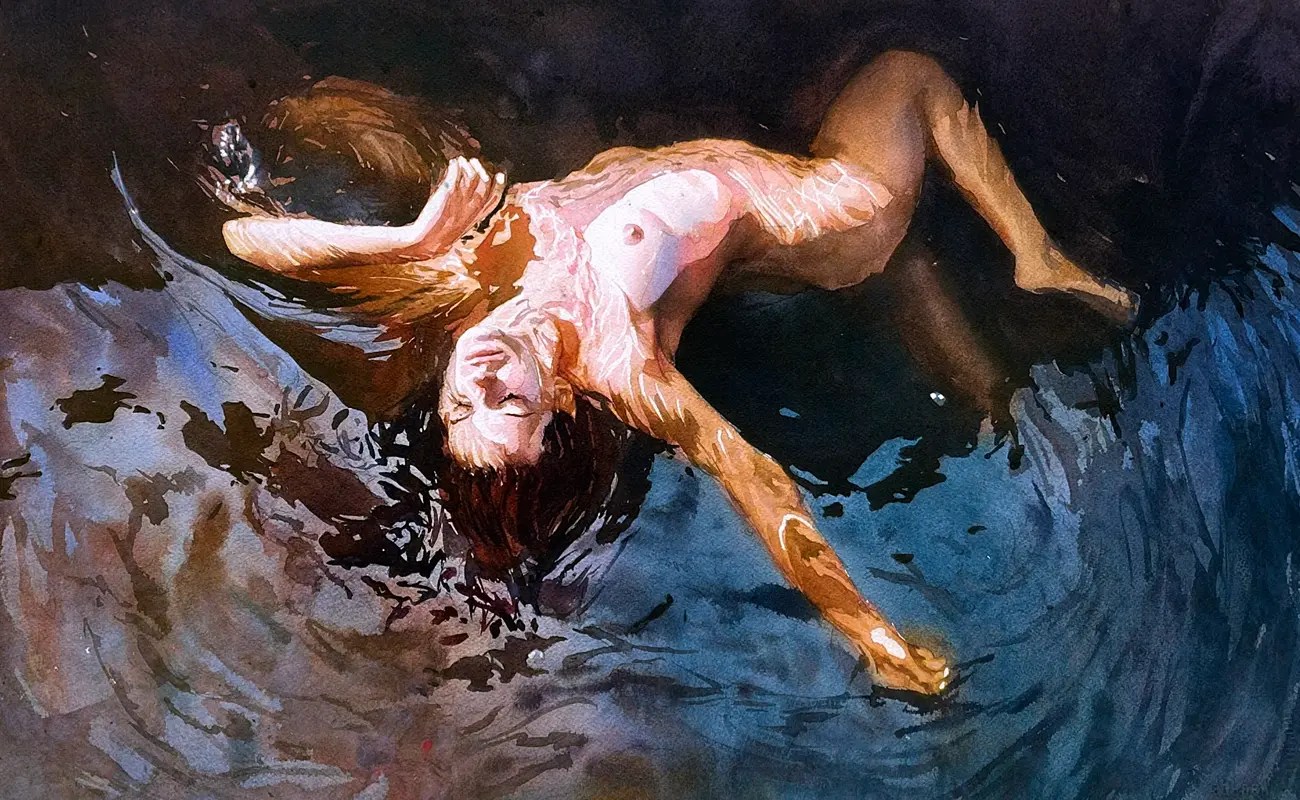
That freedom matters to how Beccari understands artistic identity. He has always enjoyed drawing and painting the human figure, but he resists presenting his development as a tidy progression toward a predetermined style. His work carries strong Baroque and Impressionist influences and is often recognized for technical realism and vibrant color. Those characteristics describe what viewers can see, but for Beccari they do not necessarily explain what happens while an image is being made. Style may become recognizable from the outside before it becomes fully legible to the person holding the brush.
This distinction has led him to question the familiar language used to discuss artists. Questions about defining themes, signature styles, major influences, meaningful works, and future projects can imply that creative practice begins with a stable set of intentions. Beccari finds that assumption too orderly for his own experience. He may recognize a recurring theme only after it has surfaced repeatedly, or understand why an image attracted him only after he has spent time painting it. The work does not simply illustrate a thought already completed in advance. It becomes a way of discovering what the thought, attraction, or subject might actually be.

Marcos Beccari: The Subject Before the Explanation
Beccari returns to a proposition by philosopher Vilém Flusser: the subject imposes itself upon style, yet becomes a subject only after it has been assumed in some way. For Beccari, this opens a productive loop. Something first catches attention, troubles the mind, attracts the eye, or refuses to disappear. The artist does not necessarily choose that encounter in a fully conscious way. Yet the encounter becomes a subject only through an active response, through a gesture, material, rhythm, decision, or particular way of seeing. The subject exerts pressure on the artist, while the artist gives that pressure a form.
This idea complicates the expectation that a painter should always know what he wants to say. Beccari is interested in commitment that can coexist with confusion, and in the strange persistence that draws a person back to something unresolved. Difficulty is not merely an obstacle to overcome. It becomes meaningful when the artist assumes it through the act of working. The same is true of uncertainty. Unknowns become visible only after they have been given some kind of form, which means clarity can emerge from a process that begins without definitive intentions.
Watercolor makes that exchange tangible. Beccari works exclusively in the medium, and he describes painting as a situation in which brush, paper, water, and pigment can redirect what seemed settled at the outset. One mark changes the conditions for the next. A color shifts the temperature of another. An accident can become an opening, while something initially treated as essential can disappear. The image begins to answer back. Instead of treating technique as a neutral instrument for executing an idea, Beccari recognizes material decisions as part of how the subject is found, altered, and understood.

Influence, Realism, and the Life Around the Work
His artistic references help locate the visual lineage behind that process. Beccari names Winslow Homer, John Singer Sargent, and Joaquín Sorolla among a much longer list of influences. Their presence aligns with qualities visible in his own stated interests: the human figure, observational intensity, color, and the possibilities of watercolor. His Baroque and Impressionist influences sit alongside the technical realism for which his paintings are often recognized. Rather than reducing these sources to a formula, Beccari allows influence to remain one component within a broader accumulation of memories, observations, habits, references, failures, desires, doubts, and accidents.
The structure of his life also shapes the work. Beccari does not describe himself as deeply embedded in an artistic career defined by exhibitions or large-scale projects. Instead, he compares his position, with some humor, to Franz Kafka writing alongside a bureaucratic job. The comparison is not about equating their work, but about the separation between a principal profession and a creative practice sustained beside it. For Beccari, academia occupies the main professional role, while painting is protected from the demand to become a continuous sequence of projects, milestones, or career moves.
That distance from professional pressure does not make the practice casual. Beccari tries to paint every weekend, though the routine is not always possible. He has no single work that he elevates above the rest, saying that all of his paintings are equally important to him. This refusal to establish a hierarchy among individual pieces fits his broader resistance to packaging a practice around definitive statements. The significance lies less in identifying one masterpiece or symbolic turning point than in continuing the repeated encounter with watercolor, attention, and uncertainty.

Marcos Beccari: Continuing Is the Project
Beccari has no particular future project he is eager to realize beyond maintaining the practice he already has. Continuing to paint is itself the project. In a culture that often frames artistic development through launches, exhibitions, new series, and escalating ambitions, that position redirects attention toward duration. The weekend rhythm gives painting a recurring place within a life already occupied by teaching, writing, and philosophical work. Its value is not dependent on a promised destination. The act of returning is enough to keep the practice active and open.
This continuity also preserves the contradictions Beccari considers necessary to creative work. Artists may want to understand what they are doing while also needing some portion of the process to remain unknown. They may seek clarity but require uncertainty, or want to finish an image while being drawn back because something still resists resolution. For Beccari, an image can feel alive precisely because it contains more than a clean intention. What came before it enters through memory, observation, failure, habit, reference, accident, desire, and doubt, producing a layered and nonlinear mixture rather than a perfectly controlled statement.
His thinking ultimately shifts attention from the question of what an artist intends to the relationship formed while making. The subject is not simply waiting intact for the painter to represent it, nor is it entirely invented by artistic will. It changes through contact. Beccari’s watercolor practice gives that exchange a material form, allowing water, pigment, paper, gesture, and perception to participate in what the image becomes. Somewhere between what imposes itself on the artist and what the artist imposes in return, the subject begins to live. For Beccari, returning to that uncertain exchange remains more compelling than forcing it into a fixed explanation.