Images That Remember More Than They Reveal
Gill Button has established a distinctive place within contemporary British painting through portraits that begin with familiar imagery yet arrive somewhere deeply personal. Based in London, she transforms photographs and fleeting media references into expressive paintings that invite viewers to reconsider how identity is formed. Rather than documenting recognizable figures, her work uncovers the emotional possibilities hidden beneath appearances, allowing moments of vulnerability, confidence, longing, and reflection to coexist within a single composition. Fashion icons, models, and cinematic personalities often provide the starting point, but these references gradually dissolve into painterly interpretations that belong as much to memory as to observation. Every portrait becomes an encounter with emotional resonance instead of celebrity, encouraging audiences to question how personal experiences influence the way faces are perceived and remembered.
Her paintings consistently blur the boundaries between public imagery and private emotion. Gestural brushwork, unfinished passages, subtle asymmetry, and expressive mark making replace photographic precision, allowing the physical act of painting to become part of the narrative itself. Rather than concealing process, Button embraces it, using visible strokes to communicate psychological depth and immediacy. Glamour is balanced with fragility, while beauty remains grounded in imperfection, making each work feel intimate instead of idealized. The resulting portraits resist straightforward interpretation because they encourage emotional projection, allowing viewers to discover traces of their own memories, fears, aspirations, or quiet moments of recognition within each painted face.
This commitment to emotional portraiture has earned Button international recognition through exhibitions across Europe, Asia, and the United States. Solo presentations have included Traces of You at James Freeman Gallery in London, exhibitions at Han Feng Art Space in Shanghai, Edge of Time at Unit London, and From Iceland to Lalaland at Âme Nue in Hamburg. Group exhibitions have extended her reach to cities including Tokyo, Los Angeles, Madrid, Paris, and Berlin. Alongside her exhibition career, she has contributed to the wider art community through curatorial work, judging the ING Discerning Eye exhibition, participating in panel discussions, and leading painting masterclasses, demonstrating an ongoing commitment to supporting artistic dialogue beyond her own studio.

Gill Button: Portraits Between Glamour and Vulnerability
The emotional complexity of Button’s paintings grows from her fascination with portraiture rather than fame. Although many of her subjects originate from magazines, fashion imagery, or media culture, she approaches them as emotional vessels rather than cultural symbols. She has described herself as a painter of faces whose interest lies less in accurate likeness than in the feelings a portrait can communicate. Many of the individuals she paints remain complete strangers, creating an intriguing relationship between artist and subject that depends upon intuition instead of familiarity. This distance allows each painting to become an imaginative collaboration where observation, empathy, and projection merge into something entirely new.
Fashion occupies an important place within her visual language because it represents identity, transformation, and self expression rather than luxury alone. Clothing, hairstyles, cosmetics, posture, and decorative patterns all become visual clues that reveal emotional states beneath polished surfaces. Subjects frequently appear poised and self assured, yet Button subtly introduces moments of uncertainty that prevent confidence from becoming absolute. The balance between strength and vulnerability gives her portraits remarkable psychological richness, suggesting that carefully constructed public appearances always contain quieter, more private experiences beneath them. Through this approach, glamour becomes inseparable from emotional complexity, making beauty feel thoughtful instead of decorative.
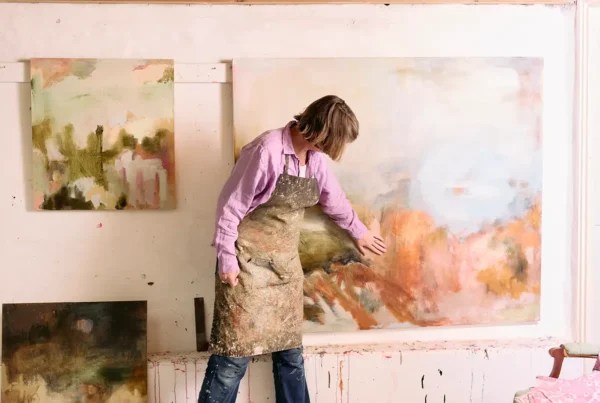
Her painterly techniques reinforce these ideas through an expressive command of oil, watercolour, and ink. Ink offers immediacy and spontaneity, encouraging bold gestures that preserve energy and movement, while oil supports larger compositions with greater narrative presence. Watercolour introduces delicacy and transparency that complement her intuitive handling of portraiture. Across every medium, Button allows brushwork to remain visible, treating the physical surface as an essential part of communication rather than something to disguise. Loose edges, layered textures, shifting shadows, and subtle variations in colour create portraits that appear suspended between memory and reality, encouraging viewers to participate actively in constructing emotional meaning.

Memory, Media, and the Emotional Weight of Images
Button’s work consistently investigates the relationship between contemporary media and personal recollection. Living within a culture saturated by endlessly circulating photographs, advertisements, films, and digital imagery, she asks how these visual experiences become intertwined with individual memory. Rather than rejecting popular culture, she embraces its influence while transforming it through painting. Familiar references gradually lose their original context as they become infused with atmosphere, emotion, and subjective interpretation. This process shifts attention away from the source image and toward the psychological space it creates, revealing how public imagery quietly shapes personal identity and emotional experience.
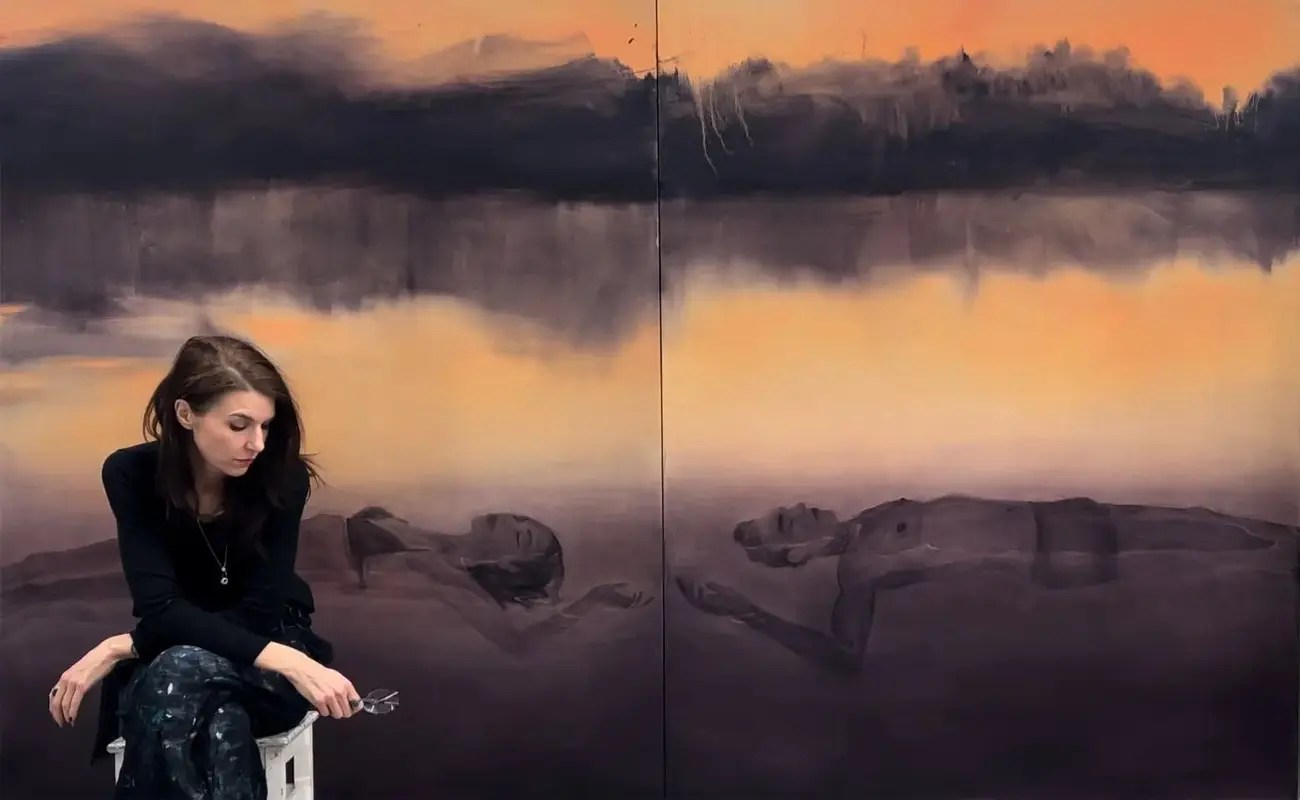
Her larger canvases often possess a cinematic quality that enhances this exploration. Figures appear paused within moments that seem extracted from unseen narratives, creating paintings filled with quiet anticipation rather than explicit storytelling. Dreamlike atmospheres mingle with recollections of childhood, echoes of monochrome photography, classic cinema, Impressionist interiors, and distant emotional landscapes. Instead of presenting complete stories, these compositions offer fragments that invite viewers to imagine what has happened before or what may follow afterward. This openness strengthens the emotional connection between artwork and audience because meaning remains fluid rather than predetermined.
Education and professional experience have contributed significantly to the development of this distinctive artistic voice. After studying at Maidstone College of Art and Kingston School of Art, where she completed a BA with a focus on illustration, Button initially pursued illustration and commissioned work before returning her primary attention to painting. That background provided valuable experience in visual communication while reinforcing her desire to create work capable of reaching broad audiences without sacrificing emotional complexity. Selective commissions continue to complement her independent practice, including collaborations with Gucci, Vanity Fair, the United Nations, and Dries Van Noten, whose internationally distributed project connected her expressive ink paintings with theatrical identity and fashion imagery.

Gill Button: Painting the Space Between Recognition and Feeling
International exhibitions, residencies, and collaborations have continually expanded the scope of Button’s practice while remaining faithful to her central concerns. Residencies at Han Feng Art Space in Shanghai and New York encouraged increasingly ambitious compositions that explored autobiographical emotion alongside themes of desire, fear, memory, and imagination. Participation in the Room on the Roof residency in Amsterdam, developed in partnership with the Rijksmuseum, offered another period of concentrated research and artistic development. Time spent in Iceland also informed a subsequent solo exhibition, demonstrating how place, atmosphere, and lived experience quietly filter into paintings that never rely upon direct description.
Beyond the studio, Button has maintained an active commitment to cultural engagement and charitable initiatives. She has participated in conversations surrounding women in art, social media, and contemporary painting through public panel discussions while sharing her expertise in masterclasses. Her artworks have supported charitable organizations including Art on a Postcard, Hospital Rooms, the Children’s Museum of the Arts, the British Heart Foundation, and campaigns organised by the International Labour Organization addressing human trafficking awareness. Her paintings have also appeared alongside New York Times articles examining changing forms of intimacy shaped by technology, demonstrating the broader cultural relevance of her visual language beyond gallery settings.
Throughout her career, Button has remained committed to exploring the emotional life of images rather than their documentary value. Faces become sites where memory, projection, recognition, and imagination overlap, inviting viewers to examine their own responses as much as the painted subject. Her portraits never settle into straightforward definitions because they exist between confidence and uncertainty, glamour and fragility, familiarity and mystery. Through fluid painterly expression and an unwavering focus on psychological nuance, Gill Button transforms found imagery into profoundly human encounters that continue to resonate long after the initial act of looking.