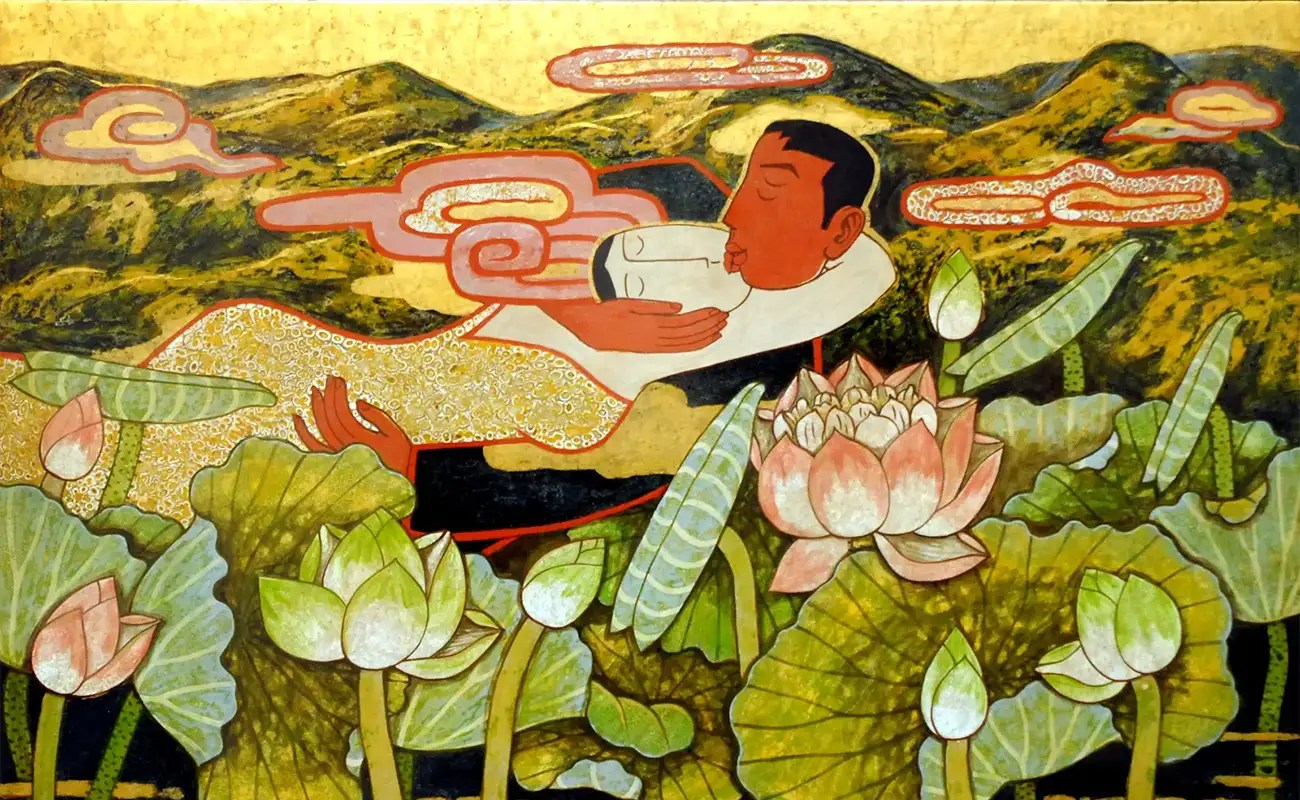
“Golden Summer was the first painting I created after graduating. Executed in lacquer, this piece is the one that defined my artistic style.”
From Coastal Fields to Lasting Artistic Identity
Growing up in the suburbs of Hai Phong, Bui Trong Du (Saatchi Art link) was surrounded by landscapes that would quietly shape his creative vision for decades to come. His childhood unfolded in a village close to the sea, where rice fields, lotus ponds, and open skies formed the backdrop of everyday life. Long afternoons spent herding buffaloes, resting on grassy fields, watching drifting clouds transform into imagined figures, and observing migratory birds gathering along power lines filled his imagination with vivid impressions. Rather than fading with time, these experiences became a lasting source of inspiration that continues to appear throughout his paintings. Nature, memory, and the emotional atmosphere of rural Vietnam remain closely connected to his artistic language, allowing viewers to encounter familiar scenes presented with warmth, clarity, and poetic sensitivity.
Drawing became an essential part of his life from an early age. Whenever free time appeared, he instinctively reached for paper and pencil, developing a habit that naturally evolved into a lifelong commitment. After completing high school, he applied to every art school available, eventually earning admission to the College of Fine Arts Education, an institution dedicated to training future art teachers. Although this was not initially the destination he had envisioned, the experience proved decisive. During his studies he trained in figure drawing with Mr. Minh, an artist recognized for a distinctive style rooted in Vietnamese folk traditions. Beyond technical instruction, his teacher encouraged him to continue pursuing fine arts, offering both confidence and artistic direction. That encouragement became an important turning point, reinforcing his dedication to painting and strengthening his appreciation for cultural heritage.
These formative experiences established the foundation of an artistic practice that remains deeply connected to personal memory while embracing broader cultural influences. His affection for the Vietnamese countryside was never separated from his growing understanding of painting. Instead, lived experience and artistic education developed together, creating a visual language built upon sincerity rather than spectacle. The recurring appearance of lotus flowers, birds, ponds, village life, and youthful memories reflects an artist who continually returns to the emotional landscape of his earliest years. These subjects do not function merely as nostalgic references. They represent enduring symbols of identity that have accompanied him from childhood into a mature artistic career, providing continuity throughout his evolving body of work.
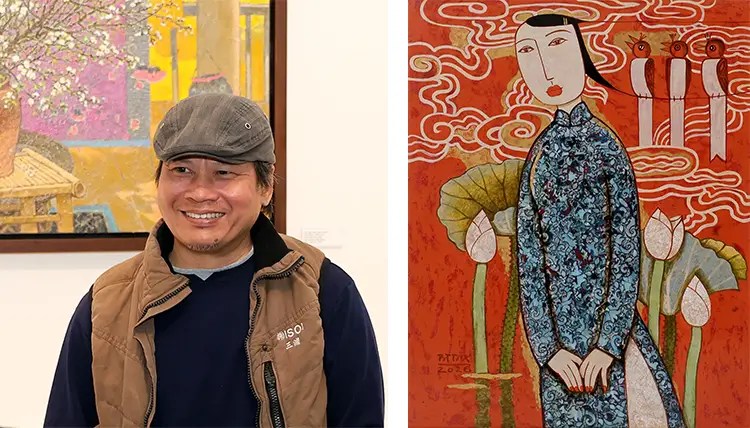
Bui Trong Du: Folk Traditions Reimagined Through Lacquer
As his artistic education progressed, Bui Trong Du became increasingly fascinated by Vietnamese folk art. He admired its direct visual language, simplified forms, and vibrant colors, recognizing qualities that resonated with his own sensibilities. These traditional characteristics gradually merged with inspiration drawn from internationally celebrated artists including Hokusai, Gustav Klimt, and Amedeo Modigliani. Rather than imitating any individual source, he absorbed selected visual ideas while preserving an unmistakably Vietnamese identity. The resulting paintings combine recognizable figurative imagery with carefully stylized compositions that balance elegance, clarity, and emotional expression. Elements of Impressionism and Expressionism occasionally appear, yet they remain integrated within an artistic vocabulary firmly grounded in local traditions.
His paintings frequently present lotus flowers, young women, quiet street corners, flower arrangements, birds, fish, frogs, dragonflies, and other familiar motifs inspired by everyday life. Each subject contributes to an atmosphere that celebrates innocence, harmony, and reflection. Simplified forms are paired with brushwork that recalls the visual rhythm of Vietnamese folk painting, creating works that feel approachable while retaining considerable artistic refinement. Throughout these compositions, ordinary subjects become carriers of memory and cultural continuity. Instead of emphasizing dramatic narratives, the paintings invite viewers to appreciate subtle beauty found within landscapes, seasonal change, and cherished recollections of childhood. This gentle approach allows emotion to emerge naturally through composition, color, and carefully balanced imagery.
Lacquer occupies a central position within his artistic practice and distinguishes his work from many contemporary painters. Mastering this demanding medium requires patience, technical precision, and consistent daily effort, qualities that he embraces as part of his routine. The complexity of lacquer techniques contrasts intentionally with the visual simplicity of his compositions. Materials such as gold, silver, and mother of pearl contribute luminous surfaces that enrich the paintings without overwhelming their quiet atmosphere. This balance between sophisticated craftsmanship and restrained imagery has become a defining characteristic of his artistic identity. By combining traditional materials with simplified figurative expression, he has established a recognizable voice within the broader development of contemporary Vietnamese painting.

Memory, Landscape, and Quiet Emotional Resonance
Born in 1976 in Hai Phong and now living and working in Hanoi, Bui Trong Du has traveled extensively throughout Northern Vietnam during both his studies and professional career. These journeys strengthened his appreciation for the landscapes and cultural traditions of his homeland, deepening themes already rooted in childhood experience. Rural scenery, seasonal beauty, and familiar symbols continue to appear throughout his paintings, reflecting both observation and emotional attachment. Rather than documenting specific locations, he transforms remembered places into poetic visual experiences that encourage viewers to reconnect with their own memories. The landscapes become emotional spaces where nature, culture, and personal history exist together in quiet harmony.
His figurative approach reflects an Oriental aesthetic enriched by subtle influences from Impressionism and Expressionism. Figures are stylized rather than heavily detailed, allowing gesture, posture, and composition to communicate emotional atmosphere with remarkable economy. This visual restraint creates paintings that remain accessible while rewarding sustained attention. Lotus flowers appear repeatedly as enduring symbols of grace and cultural identity, often accompanied by young women whose presence reinforces themes of serenity and elegance. Street scenes, flower vases, birds, and aquatic life similarly contribute to a visual universe where everyday subjects acquire lasting symbolic significance through careful artistic interpretation.
Childhood memories remain among the strongest emotional currents running throughout his work. Birds gathered along electrical wires, fish swimming through quiet waters, frogs, dragonflies, clouds drifting across blue skies, and endless rural afternoons continue to inform his imagination. These images are not presented simply because they are visually appealing. Instead, they function as living reminders of experiences that shaped his understanding of beauty, belonging, and artistic purpose. Their repeated appearance creates continuity across his paintings while reinforcing the deeply personal nature of his creative process. Through these familiar motifs, viewers encounter an artist who transforms ordinary memories into enduring visual poetry rooted firmly within Vietnamese culture.

Bui Trong Du: A Defining Work and an Ongoing Journey
Among all of his paintings, one work occupies a particularly meaningful place within Bui Trong Du’s career. Golden Summer (Hạ Vàng) was the first painting he completed after graduating, and it remains the work he identifies as the defining moment in the development of his artistic identity. Executed in lacquer, the painting represents far more than an early professional achievement. It marks the point where technical knowledge, personal memory, cultural influence, and artistic confidence came together in a unified visual expression. By identifying this work as the foundation of his mature style, he emphasizes the importance of creative breakthroughs that emerge through persistence rather than sudden inspiration.
His commitment to daily practice reflects the discipline demanded by lacquer painting. Unlike faster techniques, lacquer requires extended periods of preparation, layering, polishing, and refinement before reaching its final appearance. This process encourages patience and careful decision making, qualities clearly reflected in the calm visual atmosphere of his paintings. Consistent work in the studio has allowed him to continue refining his distinctive approach while preserving the qualities that first established his reputation. Although artistic influences remain visible, his paintings consistently communicate a personal vision shaped by memory, technical mastery, and respect for Vietnamese artistic traditions.
Looking toward the future, Bui Trong Du has chosen to keep upcoming projects private, describing them as a gift to be revealed in time. This sense of anticipation complements an artistic practice that values thoughtful development over immediate disclosure. His career continues to demonstrate how deeply personal experiences can be transformed into artworks that resonate beyond individual biography. Through lacquer, figurative imagery, and enduring memories of the Vietnamese countryside, he has created a body of work that celebrates cultural continuity while maintaining an individual artistic voice. Each painting reinforces the enduring connection between lived experience and creative expression, inviting audiences to rediscover familiar beauty through the perspective of an artist whose earliest memories continue to illuminate every stage of his journey.