Echoes of Mountains, Myth, and Memory
Brian Serway has established a distinctive artistic voice by transforming the landscapes and folklore of Southern Appalachia into haunting visual narratives that balance intimacy with cosmic wonder. Born in southwest Virginia and now based in Johnson City, Tennessee, he draws lasting inspiration from the forests, mountain hollers, forgotten communities, and enduring traditions of the Blue Ridge region. Rather than treating Appalachia as a collection of familiar symbols, he approaches it as an emotional landscape filled with mystery, memory, wildlife, and imagination. Every illustration reflects a profound attachment to place while inviting viewers into spaces where folklore and contemporary artistic expression exist together. His work has become recognizable for its atmospheric monochromatic imagery, blending fantasy with regional identity in ways that feel timeless without relying on nostalgia. Through carefully composed scenes, he encourages audiences to reconsider the stories embedded within the mountains and the creatures that inhabit them.
Family experiences played a formative role in shaping Serway’s creative development. His mother, an oil painter, introduced him to artistic expression from an early age, encouraging exploration rather than expectation. Childhood hours spent drawing alongside her allowed creativity to become a natural part of everyday life, long before he considered art as a possible career. Regional storytelling added another layer of influence. Family connections to the coal mining communities of West Virginia exposed him to ghost stories, local legends, and cryptids that became permanent fixtures in his imagination. His grandmother, whose life connected places near Pocahontas, Virginia, and Point Pleasant, West Virginia, introduced stories that included Mothman and other mysterious figures. These early encounters shaped the mythology that continues to appear throughout his artwork, blending inherited narratives with personal reflection and artistic invention.
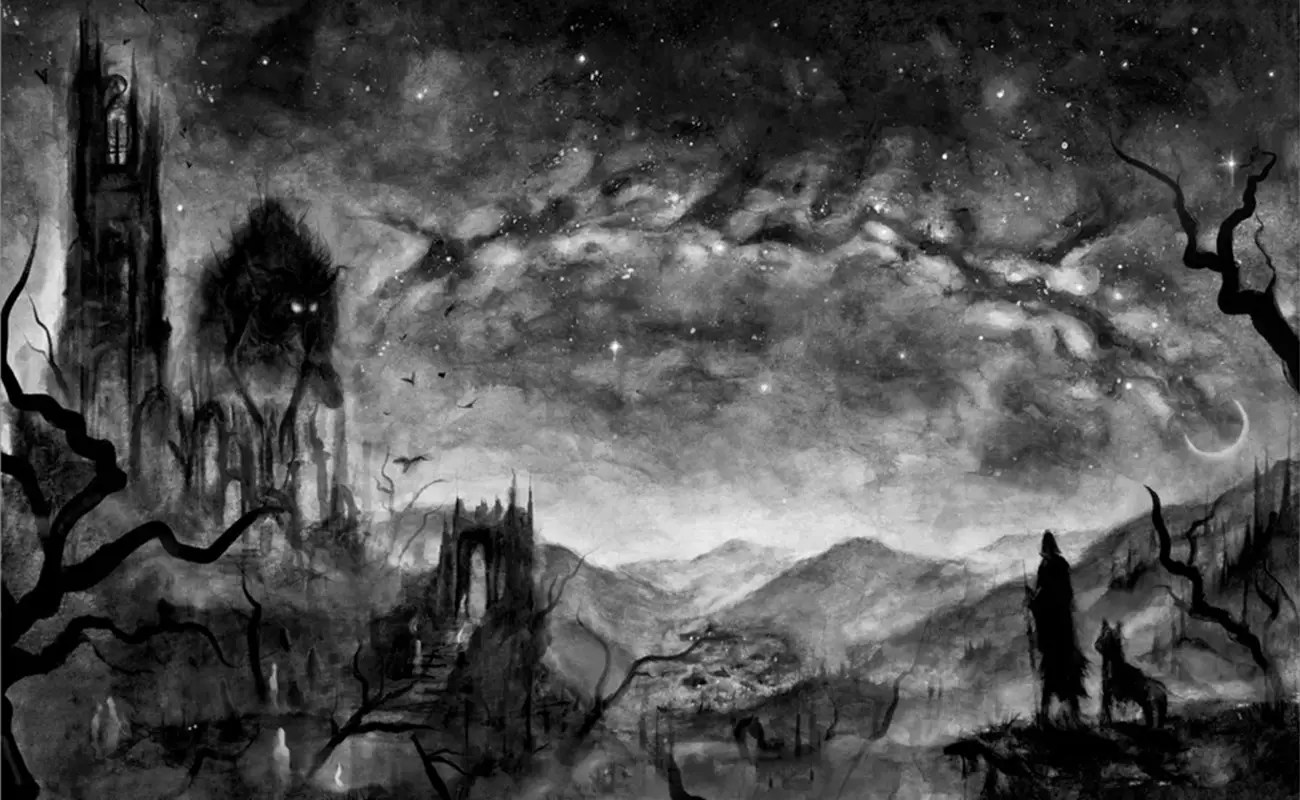
Nature remains inseparable from the supernatural throughout Serway’s practice. Forest animals, nocturnal birds, moths, wolves, raccoons, cats, and opossums frequently appear beside legendary creatures and spectral presences, all occupying richly textured forests beneath expansive celestial skies. These combinations never function as simple illustrations of folklore. Instead, they establish a visual language where wildlife, ancient stories, and the universe appear interconnected. One recurring idea comes from his fascination with the concept that every living thing is made from starstuff, leading him to portray animals whose bodies seem illuminated by galaxies and constellations. This perspective creates images that feel simultaneously comforting and unsettling, revealing beauty within darkness while suggesting that the familiar world still contains mysteries beyond ordinary perception.

Brian Serway: Building Images from Shadows Instead of Certainty
Serway’s creative process is deeply influenced by aphantasia, a neurological condition that prevents him from forming vivid mental images. Instead of beginning with complete visual scenes, he works from emotions, sensations, fragments of atmosphere, written notes, and loose sketches that gradually evolve into finished compositions. This unusual method has become one of the defining strengths of his artistic identity. Rather than reproducing a fully imagined picture, each drawing emerges through exploration, discovery, and repeated refinement. The resulting imagery carries an elusive quality that mirrors its origins, allowing shadows, texture, and subtle transitions of tone to communicate feelings that words alone cannot express. His work demonstrates how creative limitations can become sources of originality, encouraging approaches that differ significantly from conventional illustration practices.
The technical aspects of his practice reinforce this atmospheric direction. Water soluble graphite and watercolor pencil form the foundation of most works, supported by graphite, micron pens, and occasional colored pencil. Multiple materials are layered carefully across paper, with repeated drawing, smudging, erasing, and tonal adjustments producing remarkable depth despite a restrained palette. Serway generally prefers working at relatively small scales because the intimate format suits both his temperament and creative rhythm, although larger commissions occasionally require more expansive compositions. Rich blacks, soft gradients, and carefully preserved highlights create the illusion that forms emerge naturally from darkness. The emphasis remains on mood rather than spectacle, allowing viewers to experience each illustration as a quiet encounter with something simultaneously ancient, mythical, and emotionally familiar.
Fantasy, science fiction, and cosmic horror have also shaped Serway’s artistic language since childhood. An unexplained light witnessed in a Virginia cornfield sparked an early fascination with extraterrestrial life and inspired him to create comics featuring an original fictional hero. That combination of unexplained experience, local geography, and imaginative storytelling still resonates throughout his mature work. Philosophical studies further encouraged him to approach mythology, astrology, folklore, and speculative ideas with curiosity instead of certainty. His illustrations rarely present definitive answers or fixed interpretations. Instead, they create spaces where wonder and uncertainty coexist, allowing viewers to explore personal questions through symbolic imagery. This openness gives his work emotional depth while maintaining the sense of mystery that defines both Appalachian folklore and the broader human search for meaning.

Creativity Beyond the Studio
Serway’s professional life extends well beyond illustration, reflecting a strong commitment to strengthening artistic communities throughout Appalachia. Since becoming a full time artist in 2017, he has steadily expanded his independent practice through exhibitions, commissioned work, online audiences, and self produced editions. His illustrations have appeared in exhibitions across the United States as well as internationally, while his continuing relationship with Arch Enemy Arts has included numerous group presentations and multiple solo exhibitions. Alongside original drawings, he produces prints, enamel pins, stickers, and other accessible artist made objects, creating opportunities for collectors with a wide range of budgets. This approach reflects his belief that meaningful art should remain approachable rather than exclusive, encouraging broader engagement with independent creative practice.
Community building became an even greater priority through the establishment of HollerHouse in historic downtown Bristol, Virginia. Serving as both curator and gallery owner, Serway created a space dedicated to contemporary Appalachian artists whose work challenges conventional expectations of regional art. The gallery presents artists from across the Tri Cities region, East Kentucky, Western North Carolina, and surrounding communities while offering original works alongside affordable prints, postcards, bookmarks, and smaller collectibles. This combination allows visitors to support artists regardless of financial circumstances while discovering the remarkable diversity of creative voices emerging throughout Appalachia. HollerHouse demonstrates that regional identity can remain deeply rooted while embracing experimentation, inclusivity, and contemporary artistic expression.
His role as coordinator of the Tri Cities Nocturnal Art Market further reinforces this commitment to creative networks and regional visibility. Earlier experiences working with Appalachian Sustainable Development and AmeriCorps also shaped his understanding of land, resilience, and community. Helping low income families grow food strengthened his appreciation for local knowledge, self reliance, and meaningful relationships with place. Those experiences continue to influence both his artistic philosophy and curatorial work. Rather than separating creative practice from community engagement, Serway views both as interconnected forms of stewardship. Supporting artists, encouraging collaboration, and creating welcoming cultural spaces become natural extensions of the same values expressed throughout his illustrations of forests, folklore, wildlife, and shared regional identity.

Brian Serway: Reimagining Appalachia Through Contemporary Folklore
One of the defining ideas behind Serway’s work is his vision of Neo Appalachian art, an approach that honors regional traditions while encouraging broader interpretations of what Appalachian creativity can become. Instead of limiting artistic identity to familiar stereotypes, he emphasizes the influence of geography, history, isolation, resilience, generosity, and community across a wide variety of visual styles. This philosophy welcomes artists whose work may appear unconventional while remaining deeply connected to the region through lived experience. HollerHouse functions as an extension of that belief by offering visibility to emerging voices whose perspectives expand public understanding of contemporary Appalachian culture without abandoning its distinctive character.
His illustrations embody this philosophy through carefully balanced contrasts. Darkness exists beside warmth, tenderness alongside unease, and local wildlife within immense cosmic environments. Forest creatures frequently become vessels for celestial imagery, suggesting relationships between earthly existence and the wider universe. Cryptids, ghosts, and legendary figures appear not as sensational subjects but as symbols that connect memory, imagination, and shared cultural heritage. The emotional power of these images comes from restraint rather than excess, allowing subtle compositions to evoke wonder through suggestion instead of explanation. By combining graphite, watercolor, layered textures, and thoughtful symbolism, Serway creates visual experiences that encourage prolonged reflection rather than immediate certainty.
The same thoughtful outlook extends to his relationship with collectors and admirers. He welcomes the use of his imagery as tattoo inspiration while asking that people credit the original artwork and fairly compensate the artist by purchasing a print or tattoo token before bringing the design to a tattoo professional. This request reflects a broader commitment to sustaining independent artistic practice through mutual respect and ethical support. Throughout every aspect of his career, from illustration and printmaking to gallery curation and community leadership, Serway demonstrates that creative work flourishes through meaningful relationships between artists, audiences, and place. His haunting monochromatic visions continue to expand perceptions of Appalachia, presenting the mountains not as static symbols of the past but as living landscapes where folklore, wildlife, memory, and the cosmos remain permanently intertwined.