Between Horizon and Gesture
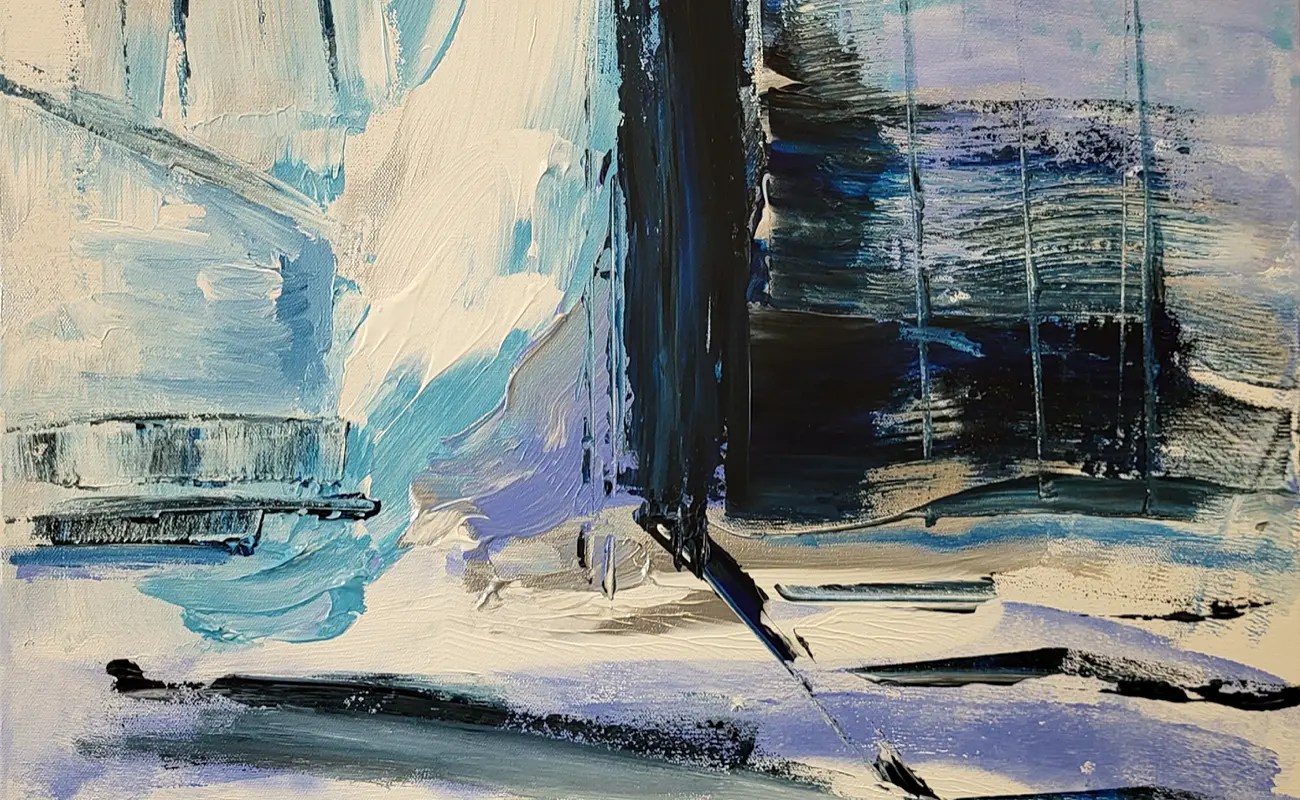
In the expressive work of distinguished artist Vian Borchert, Borchert has developed a painterly language in which landscape is less a subject to be represented than a condition through which perception, memory, and emotion become visible. Her blue abstractions immediately establish this distinction. At first glance, many retain familiar structures associated with sea, sky, cloud, coastline, distant land, or reflected light, yet descriptive information is repeatedly loosened by broad sweeps of acrylic, exposed passages of ground, expanded pigment, saturated bands, and strong dark marks. The compositions oscillate between atmospheric openness and emphatic physical gesture. Horizons may appear, but they go beyond behaving as conventional devices of perspective. Instead, they function as psychological thresholds, separating zones of color while encouraging the eye to move laterally across the picture. Turquoise, ultramarine, pale aqua, violet, white, and occasional black create a chromatic field that is recognizably connected to water and air. Borchert’s work transcends a simple illustration of nature. The significance of these paintings lies precisely in this suspension between recognition and abstraction. Sea and sky remain perceptible, yet their material equivalents, streak, wash, pressure, opacity, and translucency, continually remind the viewer that sensation has taken precedence over description.
The handling of paint is central to Borchert’s expressive authority. Acrylic, which can easily become flat or mechanically uniform, is treated with masterful considerable variation. Some passages are thin and atmospheric, allowing color to seem suspended across the surface; others are dense, scumbled, or deposited in broad directional strokes that preserve the pressure and speed of application. This alternation gives the paintings a physical rhythm that parallels the movement of waves, weather systems, and shifting light without becoming illustrative. In the more expansive seascape compositions, repeated horizontal gestures create a visual tempo through which the viewer experiences the picture almost bodily. Darker strokes act like pauses or accents within a largely luminous register, while white passages often assume a dual function, suggesting foam, cloud, glare, and emptiness simultaneously. Borchert’s preference for blue therefore operates not simply as a stylistic identifier but as a structural principle. Blue organizes space, carries mood, and binds disparate degrees of abstraction into a coherent practice. The strongest paintings emerge when chromatic serenity is interrupted by enough friction, density, or tonal contrast to prevent atmosphere from becoming merely decorative.
Within contemporary painting, this combination of gestural immediacy and landscape memory places Borchert in conversation with several twentieth-century trajectories without reducing her practice to any single precedent. Her emphasis on the expressive autonomy of color recalls aspects of lyrical abstraction and Color Field painting, while the visibly worked surface carries an affinity with Abstract Expressionism. Yet the persistent horizon, together with the retention of sea, cloud, architecture, and reflected light, keeps the work closer to landscape-based abstraction than to nonobjective painting. Comparisons might be drawn with painters such as Helen Frankenthaler, Joan Mitchell, Nicolas de Staël, or Etel Adnan, not because Borchert has similar methods, but because each demonstrates a different way in which landscape can survive abstraction as memory, interval, color, or emotional structure. Borchert’s Mediterranean inheritance gives this negotiation particular resonance. The sea becomes both geographical and psychological, connected to Beirut, Jordan, Greece, Los Angeles, Washington DC, Maryland, travel, displacement, and a broader international outlook. Consequently, the recurring blue field can be understood as more than an aesthetic preference. It becomes a mobile site in which personal history and universal natural experience overlap.

Vian Borchert: The Subconscious as Painted Space
Borchert’s description of painting as “visual poetry” offers an especially productive framework for understanding the relationship between image and subconscious association throughout her practice. Poetry rarely depends upon exhaustive explanation; its force often comes from compression, rhythm, ambiguity, and the collision of suggestive fragments. Borchert seeks a comparable effect through painted means. Colors substitute for emotional registers, repeated marks assume rhythmic functions, and atmospheric transitions operate like pauses between verbal images. The sea is therefore never solely sea, nor is a cloud restricted to meteorological description. Each becomes a flexible sign capable of carrying longing, memory, serenity, melancholy, hope, freedom, or uncertainty. This elasticity is essential to the paintings’ appeal because it leaves interpretive space for the viewer. Rather than constructing a fixed narrative, Borchert offers perceptual cues around which association can gather. Her stated interest in connecting art with the inner subconscious is persuasive where the paintings maintain this openness. The most effective compositions do not explain emotional meaning; they create the conditions in which feeling appears to precede language, allowing color and gesture to register before the mind has translated them into named experience.
Historically, any artistic emphasis on the subconscious inevitably recalls the Surrealists, particularly their interest in automatism and the release of imagery from rational control. Borchert’s approach, however, is significantly different from classical Surrealist strategies. Her paintings do not appear to seek dream imagery, psychic shock, or irrational juxtaposition. Nor does her process correspond to an entirely unedited form of automatic production. She has characterized painting as exploratory and analytical, involving revision, testing, and sustained concentration, even while intuition plays a crucial role. This tension between instinct and examination gives the work greater conceptual depth than a simple equation of spontaneity with authenticity would allow. The subconscious in Borchert’s practice is better understood as a reservoir of accumulated sensation and memory that enters conscious decision-making through painterly action. Her late-night working habits, periods of silence, repeated engagement with series, and reliance on remembered natural environments support such a reading. Painting becomes neither pure impulse nor predetermined composition. It becomes an exchange between material responsiveness and internal recollection, with each layer registering a temporary negotiation between what can be controlled and what emerges unexpectedly.
This philosophical position also distinguishes Borchert’s concept of transcendence from more overtly spiritual abstraction. Wassily Kandinsky famously associated color, sound, and abstraction with inner necessity, while later generations of abstract painters pursued sublimity through scale, chromatic immersion, or reduction. Borchert’s paintings share with those traditions an interest in experiences that exceed literal representation, yet her transcendence remains anchored to recognizable phenomena. Light over water, open sky, drifting cloud, architectural enclosure, and the suggestion of a distant horizon provide sensory foundations from which psychological interpretation expands. This grounding matters because it prevents the philosophical dimension of the practice from becoming detached from lived experience. Her blue paintings seek elevation, but they do so through remembered and observed conditions. The subconscious is not presented as an inaccessible mystical territory; it is approached through things already known by the body, such as atmosphere, distance, movement, and color. In that sense, Borchert’s practice proposes that abstraction can function as a bridge between external perception and internal knowledge, making familiar elements strange enough to become newly available for reflection.

Architecture, Atmosphere, and the Discipline of Contrast
The architectural paintings reveal an important counterforce within Borchert’s predominantly fluid vocabulary. Where the seascapes frequently organize themselves around sweeping horizontal movement, the city-based abstractions introduce verticals, block-like shapes, compressed intervals, and darker structural divisions. Buildings are not rendered as stable architectural portraits. Instead, they appear fragmented into painterly scaffolds, with columns, facades, windows, or passages suggested through abrupt black lines and masses of blue, white, cream, and violet. This shift in compositional logic demonstrates that Borchert’s expressive language is not dependent upon marine imagery alone. The built environment generates a different kind of psychological space, one defined by containment, interruption, and density rather than openness. In several compositions, black functions almost architecturally, creating boundaries against which paler areas push or recede. The tension between thick, dark structures and luminous passages produces a sense of unstable construction, as though the city were being remembered rather than observed. These paintings are particularly valuable within the broader practice because they expose the underlying grammar of Borchert’s abstraction. Horizon, building, cloud, and shore ultimately become arrangements of pressure, interval, rhythm, and balance.
The strongest connection between Borchert’s natural and urban paintings is therefore not subject matter but atmosphere. In both, physical environments are reorganized according to emotional intensity. A coastline may dissolve into bands of turquoise and indigo; an architectural structure may be reduced to an asymmetrical collision of black, blue, and pale cream. The procedure resembles memory itself, which rarely preserves experience with photographic neutrality. Memory selects, exaggerates, compresses, and omits. Borchert’s biography, shaped by early movement from Beirut to Amman and later settlement in the United States, gives particular weight to this process without requiring the paintings to become autobiographical illustrations. Their spaces often feel simultaneously specific and unlocatable. A viewer may sense Mediterranean light, coastal distance, a dense city facade, or an interior threshold, yet precise geographical identification remains unavailable. This ambiguity gives the paintings cultural reach. The work concerns belonging without depicting belonging literally, and displacement can be felt through the instability of place. Borchert’s international perspective thus enters the painting indirectly, encoded in the recurrence of thresholds, passages, horizons, open expanses, and structural interruptions.
A sustained critical question concerns the degree to which Borchert’s signature palette risks becoming too closely identified with a recognizable brand. Blue is unquestionably central to her artistic identity, and such chromatic consistency can be advantageous within both gallery and collector contexts, where visual coherence helps establish immediate authorship. Yet a signature can become restrictive when recurrence begins to substitute for discovery. Borchert’s practice is most compelling when the blue vocabulary is actively challenged from within, either through unexpected darkness, acidic green, lavender, pale pink, yellow, peach, or forceful architectural black. The paintings incorporating warmer coral or golden passages demonstrate how a limited intervention can dramatically alter the emotional temperature of an image. Likewise, the city abstractions create productive resistance to the seductiveness of aquatic color. These variations suggest that blue functions best not as a fixed formula but as a base condition against which disruption becomes meaningful. The ongoing strength of the practice depends on this internal pressure, since serenity acquires greater emotional credibility when it exists beside friction, uncertainty, or chromatic disturbance rather than remaining continuously resolved.

Vian Borchert: From Visual Poetry to Public Presence
Borchert’s professional trajectory gives her painterly language an institutional and cultural context broader than studio production alone. Her education at the Corcoran College of Art and Design places the practice within a formal lineage of Washington, D.C. art training, while her longstanding teaching of drawing, watercolor, acrylic painting, and related disciplines situates her within a regional artistic community built around transmission as well as exhibition. More than one hundred solo and group presentations, together with appearances at venues including the United Nations Public Lobby Gallery, indicate a career shaped by sustained public visibility. The inclusion of paintings in the permanent collection of the Jordan National Gallery of Fine Arts in Amman is significant since it reinforces the relevance of a practice grounded in communication across locations, languages, and cultural histories.
Within the contemporary market, Borchert’s work occupies an accessible yet conceptually credible position between expressive abstraction, landscape painting, and atmospheric interior art. The immediate visual appeal of the blue palette gives the paintings a strong aesthetic presence, especially at the scale of domestic and hospitality environments, but their significance is not exhausted by that function. The stronger compositions reward sustained viewing because spatial ambiguities and material contradictions gradually complicate the initial impression of calm. This dual accessibility is commercially advantageous. Collectors can approach the paintings through color, serenity, or recognizably natural associations, while curators can locate them within broader discussions of memory, migration, landscape, expressionism, and psychological abstraction. Borchert’s solo presentation through Artsy further positions the practice within a digitally mediated art market in which a coherent visual identity is especially valuable. Hence, Borchert’s recurring palette demonstrates her distinct investigations of place, consciousness, and emotional memory.
Borchert’s is recognized for her transformation of familiar natural experience into an arena of inward attention. The paintings do not require viewers to know cities the artist frequented, or any other specific location in order to respond to them. They operate through more elemental recognition: water extending toward distance, clouds accumulating above a horizon, light breaking across darkness, architectural forms pressing against open space. From these sensations, Borchert constructs a language that joins expressionist gesture with poetic suggestion and philosophical inquiry. Her recurring concern with serenity should not be mistaken for simplicity. Calm in these paintings is frequently something produced through layers, interruptions, dark accents, uncertain boundaries, and visible physical effort. That distinction gives the work emotional credibility, since renewal appears not as effortless harmony but as a condition assembled through painterly negotiation. Consequently, Borchert’s abstraction based on her Mediterranean memory, use of color, gestural energy, and interest in the subconscious remain simultaneously present. In such moments, painting becomes not an illustration of transcendence but an active perceptual process through which memory and atmosphere are given form.