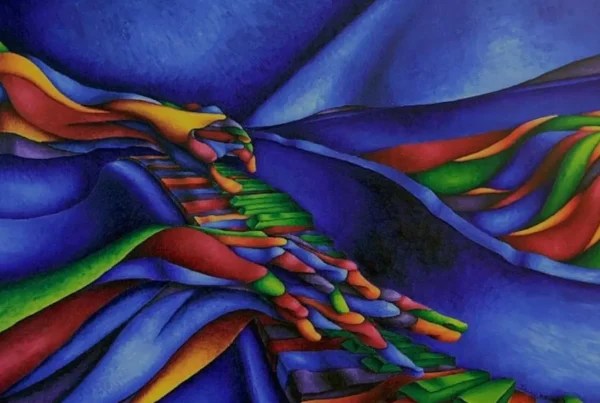
“With touching, subtle picture stories and a fascinating play with colors, I want to revive memories, inspirations and dreams in my paintings.”
From Visual Systems to Inner Images
Heinz Marzohl approaches painting with an unusual combination of visual discipline and imaginative freedom. Across decades of work, the Swiss artist has developed a language in which saturated color, assertive contours, fragmented figures, and abstract structures transform remembered experiences into emotionally charged compositions. Nature, travel, dreams, animals, faces, and imagined characters repeatedly enter his paintings, yet rarely remain literal. They are altered through memory and reorganized as signs, silhouettes, chromatic fields, and symbolic forms. The resulting images move between recognition and uncertainty, allowing a tree, horse, face, coastline, or invented being to become both subject and psychological presence.
Before painting became the central focus of his life, Marzohl spent thirty four years running a successful Swiss company specializing in signage technology, digital printing, and graphic design. With more than thirty employees, the business produced brand logos, signage concepts, and artistic graphics for industrial buildings. This professional environment gave him extensive experience with typography, reprography, screen printing, materials, color theory, and the practical construction of images. Precision was essential, but so was an understanding of how line, contrast, proportion, and color direct attention. Those skills would later remain visible in his paintings, even after commercial communication gave way to a much more personal form of expression.
In 2007, Marzohl transferred the company to his two daughters and committed himself more fully to designing and painting. The transition did not mean abandoning his earlier knowledge. Instead, he redirected it. Graphic clarity became a foundation for ambiguity, while technical control supported images shaped by memory, emotion, and imagination. Commercial design had demanded visual solutions that communicated efficiently; painting offered him the opposite possibility, an image that could remain unresolved and invite association. This tension between structure and intuition continues to define his practice, giving even his most freely imagined compositions a strong internal order.

Heinz Marzohl: Learning from Modernism Without Imitation
Marzohl found important points of reference in Wassily Kandinsky, Franz Marc, Alexej von Jawlensky, Paul Klee, and August Macke, particularly through their association with Der Blaue Reiter. He was not interested in reproducing their surfaces or borrowing recognizable stylistic formulas. Instead, he sought to understand what kinds of thought and feeling had produced such radical approaches to color and form. Kandinsky and Klee became especially important because their writings documented ideas developed through teaching at the Bauhaus. Marzohl studied these texts closely, using them to expand his understanding of how visual elements could communicate beyond straightforward representation.
His interest also reached much further into the history of image making. Prehistoric cave painting fascinated him because of its direct yet mysterious transformation of lived experience into marks and figures. Marzohl became interested in the possibility that an observed event could persist internally before reappearing as an altered image. That idea closely matches his own method. Memories do not function as records to be copied. They become creative material, capable of being compressed, rearranged, intensified, or partially obscured until their emotional character becomes more important than descriptive accuracy.
This investigation had begun long before his professional transition in 2007. Since 1992, Marzohl has produced numerous sketches and color studies that became the foundation for paintings on canvas. Drawing and preparatory experimentation gave him a space to test relationships between form and color before developing them further in acrylic. Over time, the studies supported an increasingly independent visual vocabulary. Early works such as The Tree Buds and The Magic Cauldron already show organic forms dissolving into intense fields of color and dark structures. The recognizable world remains present, but it is transformed into something associative, dreamlike, and open to multiple readings.

Nature Recast as Sign, Rhythm, and Memory
Nature has supplied Marzohl with some of his most persistent visual prompts. Animal bodies, butterfly markings, weathered wood, coastal rock, cracks, shadows, and tidal traces have all entered his field of attention. Rock faces along storm exposed seashores became especially important in later work. Their fissures and irregular patterns suggested faces, angels, imaginary creatures, and figures from stories. Rather than copying those formations, Marzohl allowed them to trigger new pictorial possibilities. Experiences of places including Brittany, Amrum, Alsace, and the Camargue could consequently survive in his paintings without becoming conventional landscapes.
His predominantly acrylic process supports this movement between observation and invention. Preparatory sketches and color studies help establish compositional possibilities, while the canvas develops through layering, adjustment, and changing relationships between chromatic areas. Softer transitions may sit beside strong dark strokes that define a figure or divide the surface. Earlier paintings could appear comparatively smooth, while later works introduced denser and more tactile surfaces. Dotted or granular passages create optical movement across saturated color, while black structures provide depth and sharpen the interaction between adjoining forms. Painterly intuition remains active, but it operates within a carefully constructed visual framework.
A significant shift arrived in 2022, when Marzohl developed a new painting technique and adapted his formal language. Archaic lines increasingly gave way to gestural forms, while abstraction and figuration became more directly intertwined. Strong black structures intensified spatial depth and made luminous colors appear even more pronounced. Figures, animals, boats, eyes, and imagined characters could now emerge from compressed perspectives and sharply contrasted planes. The monumental bull, the melancholy pirate, the staring green eye, and the stylized Camargue horses demonstrate how recognizable subjects become carriers of mood and symbolism rather than simple illustrations.

Heinz Marzohl: Color, Structure, and the Unstable Image
Paintings from 2024 and 2025 push this interplay further. Sweeping networks of line, intersecting geometries, and fragmented bodies increasingly organize the compositions, while blues, violets, reds, yellows, and turquoise create a luminous visual rhythm. Works including The Proud Lady, The Funny Nurse, The Blue Rocket, and Candle in the Wind retain enough recognizable imagery to suggest figures or narratives, yet color and structure carry much of their expressive force. This partial legibility is central to Marzohl’s visual language. A figure can remain present while simultaneously becoming a system of contours, planes, symbols, and chromatic tensions.
Memory, nature, travel, fantasy, humor, melancholy, and inner experience continue to intersect throughout the work. Marzohl describes his intention in terms of reviving memories, inspirations, and dreams through subtle picture stories and an active play of color. This desire explains why his paintings often seem suspended between something recalled and something newly invented. Instead of illustrating a memory, he reshapes it until it acquires another visual identity. Graphic precision gives the composition clarity, while irregular forms, vibrant color, and symbolic ambiguity prevent that clarity from becoming fixed or predictable.
The long development of this approach has also brought international recognition. Marzohl was named Artist of the Year 2025 within the Top 60 Masters program and was included in the associated publication. His artistic journey later became the subject of Painting the Journey Within, a documentary in the Art Titans: Masters of the New Era series. Those distinctions accompany a practice built through decades of sustained experimentation. Across more than fifty documented paintings spanning roughly three decades, his vocabulary has continued to change through richer surfaces, stronger contrasts, gestural forms, and increasingly assertive symbolism, while the transformation of remembered experience into color and structure remains at its core.