Bodies at the Edge of Recognition
John Sillince occupies a compelling position within contemporary British figurative painting, where the human body remains recognizable yet refuses to behave according to ordinary physical or psychological laws. Working primarily in acrylic on canvas, Sillince constructs scenes through thick passages of flesh, abrupt chromatic contrasts and figures whose proportions appear vulnerable to continual rearrangement. The scale of many recent canvases, approximately one metre square and presented without frames, gives these encounters a direct bodily presence. Their surfaces do not imitate the slow density of oil painting; instead, acrylic permits speed, revision and sudden shifts between opacity and exposed underlayers. That immediacy serves a practice concerned with the unstable experience of seeing. Faces appear partially remembered, limbs intersect without fully joining, and theatrical personae occupy spaces that seem simultaneously public and private. Sillince’s importance lies not in reviving post-war figuration as a fixed style, but in using its expressive freedoms to examine a contemporary condition in which identity, social confidence and visual certainty are repeatedly unsettled.
The Falling Actor establishes many of the tensions that animate Sillince’s practice. Its vertical composition is crowded by disembodied heads, enlarged hands and a central figure in a red-orange costume who seems to stagger, descend or perform an exaggerated collapse. A pale figure crosses the upper body with the improbable lightness of an acrobat, angel or projected memory. The painting’s instability arises less from any single distortion than from the conflicting directions of its forms. Hands point inward, bodies tilt downward, and the background breaks into irregular fields of green, ochre, grey and violet that offer no secure architectural setting. The central actor is therefore suspended between accident and spectacle. His gesture may communicate distress, but the costume converts distress into performance, making sincerity difficult to separate from theatrical display. This uncertainty generates emotional intensity without requiring a definitive narrative. The surrounding faces neither clearly assist nor condemn him; they operate more like intrusive witnesses, fragments of an audience or competing versions of consciousness.
A related disruption governs The Predator’s Dance, although its near-black ground and limited palette give the scene a more concentrated violence. An inverted nude, a striped zebra and a snarling hybrid figure are arranged as a triangular collision rather than a coherent event. The body’s inversion turns anatomy into rhythm, while the zebra’s graphic pattern introduces an almost emblematic clarity against loosely brushed flesh. Sillince’s contrasting visual languages are crucial here. The animal’s stripes, the exposed pink body and the predator’s mask-like face do not fuse smoothly, yet their incompatibility creates the painting’s perceptual charge. Similar compression appears in Sparks From Forgotten Images, where a reclining figure, an enlarged hand and partially dissolved faces emerge from a field of turquoise, violet and muted green. There, spontaneity is held together by recurring diagonals and chromatic echoes rather than conventional depth. The most convincing compositions do not conceal their improvisation. They make improvisation structural, allowing separate images to retain their strangeness while participating in a larger emotional rhythm.

John Sillince: Theatre, Memory and the Unstable Self
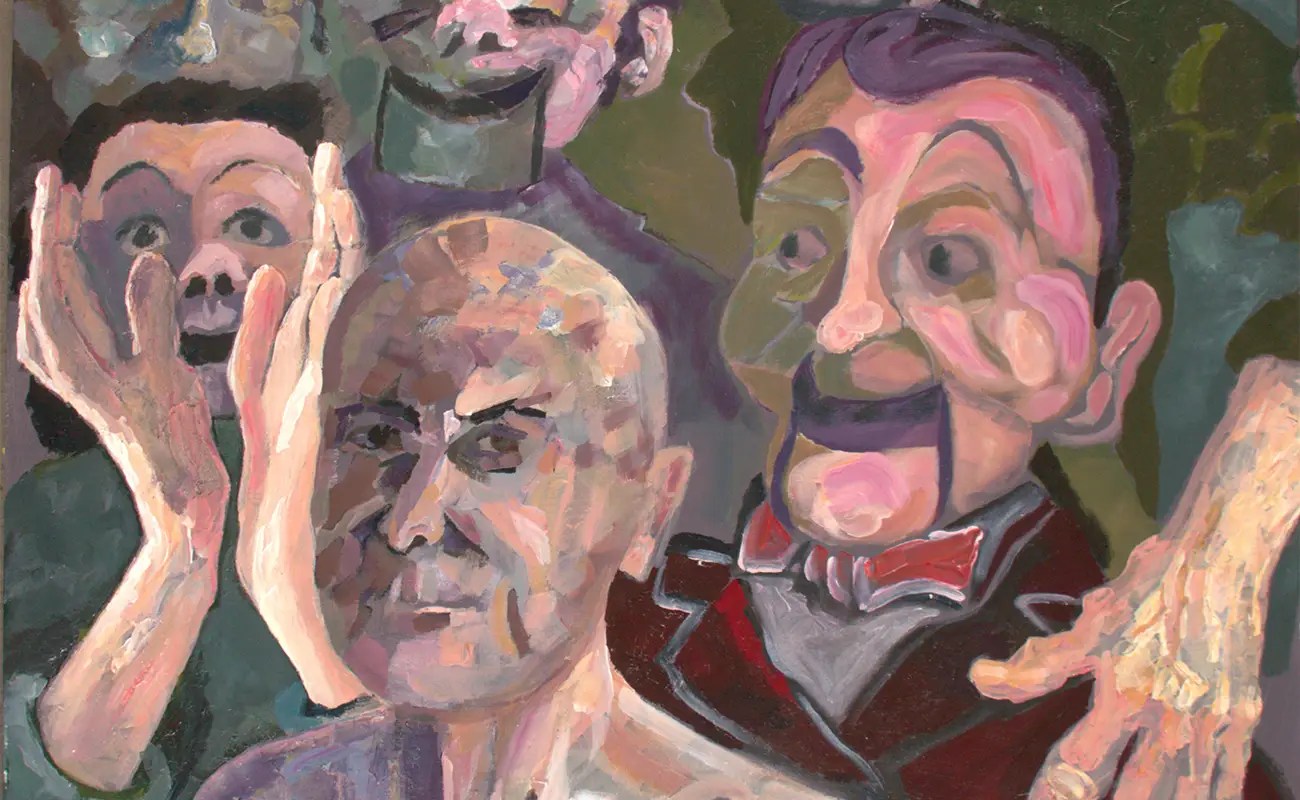
Performance in Sillince’s paintings is not merely a subject; it is a condition through which identity becomes visible and unreliable. The Mocking Demons compresses a group of heads and upper bodies into a narrow pictorial space, producing the claustrophobic atmosphere of a backstage room, a hostile audience or an internal tribunal. A figure clutching his cheeks echoes the exaggerated vocabulary of comic shock, while a bow-tied character beside him recalls an entertainer, ventriloquist’s dummy or ceremonially dressed observer. Behind them, faces drift between human portraiture, caricature and demonic mask. The central bald figure appears comparatively subdued, yet his stillness does not grant him authority. Instead, he seems exposed to the surrounding performances, perhaps participating in them while remaining unable to determine their meaning. The scene’s emotional force derives from this imbalance. Several figures display emphatic expressions, but their intentions remain obscure. Laughter could be ridicule, anxiety or disguise. Shock could be staged or involuntary. Sillince makes the face a social instrument whose signals are abundant but never fully trustworthy.
The recurring self-portrait operates within this theatrical system as a mobile role rather than a stable autobiographical anchor. In some paintings, the self-like figure appears central yet passive, a bodily site upon which surrounding characters project menace, desire or absurdity. In The Ape Chorus Oracle, the seated nude is physically prominent but psychologically difficult to locate. His pale body occupies the foreground, while two apes lean together behind him like confidants, commentators or judges. A contorted figure enters from the left, and a dark partial face presses against the right edge, transforming the composition into a gathering without shared attention. The seated figure may be an oracle, the subject of an oracle or simply another performer awaiting interpretation. His extended arm suggests contact, but the surrounding bodies remain emotionally discontinuous. This is where Sillince’s self-portraiture becomes most productive. The self is neither sovereign observer nor straightforward protagonist. It becomes one unstable image among others, implicated in the scene yet unable to organize it into certainty.
Clockwork Theatre Of Desire extends that ambiguity through imagery associated with puppetry, machinery and spectacle. An orange, simian or bearded figure stands beside a mechanical form resembling a microphone, control device or sculptural prop, while a smaller green figure extends an arm toward a suspended or jointed element. Above them, a large grey face and pale curving form dominate the red ground like an oversized mask, apparition or stage effect. The title introduces desire as something regulated, repeated or mechanically performed, but the painting resists explaining who controls whom. Bodies appear assembled from incompatible systems: flesh, costume, animal features, theatrical equipment and abstract curves. This generates a convincing feeling of psychological instability because no single visual code becomes dominant. Yet the density of symbolic motifs also identifies a recurring challenge within Sillince’s practice. When every figure carries an emphatic sign of strangeness, the unknown can begin to look predetermined. The strongest passages are those in which an ordinary gesture, such as a hand reaching or a body waiting, remains unresolved amid the spectacle.

Painted Collisions and the Ethics of Looking
Sillince’s engagement with mythological and classical imagery introduces a historical register without submitting to the authority of inherited ideals. Athena And The Watching Owl brings together a helmeted or sculptural figure, an enlarged owl, a skeletal form and a contemporary female presence holding a rectangular object. The bodies are not arranged according to classical harmony. Their scales conflict, their contours overlap and their gazes fail to meet in a stable circuit. The owl, traditionally associated with Athena and wisdom, becomes an intrusive physical presence rather than a discreet attribute. Its pale mass crowds the upper left of the composition, while the female figure on the right looks across the scene with an expression that could suggest apprehension, curiosity or guarded recognition. Between them, the skeletal figure introduces mortality into a setting already divided between antiquity and the present. Sillince does not simply parody classical representation. He places idealization beside bodily fragmentation, testing whether inherited symbols can retain authority when perspective, anatomy and social meaning have become unstable.
The relational tension becomes more physical in Family Drama With Fowls. Muscular bodies bend, suspend and turn around a central cluster of chickens, producing a scene in which domestic comedy and potential violence remain uncomfortably close. The figures’ gestures appear consequential, yet their exact actions are difficult to determine. One body leans downward, another turns away with an arm raised, and a lower figure seems caught beneath or among hanging lines. The fowls introduce an absurd counterpoint, but they are not merely comic accessories. Their vulnerable bodies echo the exposed flesh of the human figures, collapsing distinctions between family hierarchy, animal handling, ritual and spectacle. The muted blue field prevents the scene from settling into a specific location, so relationships must be inferred through posture alone. This is one of Sillince’s most effective strategies. Bodies share the same pictorial space without establishing emotional consensus. Each figure appears absorbed in a separate intention, and the resulting disconnection allows the painting to evoke exclusion, dependency and social uncertainty without illustrating a single anecdote.
Within post-war British figuration, Sillince’s compressed spaces and psychologically pressured bodies invite comparison with Francis Bacon’s staged isolation, while the mixture of theatricality, menace and dark humour has affinities with Paula Rego. The comparison concerns pictorial problems rather than direct dependence. Sillince’s surfaces are generally more chromatically discontinuous, and his scenes accommodate a larger collision of masks, animals, sculptural references and comic figures. Cubist fragmentation can be sensed in the rearranged anatomy and simultaneous viewpoints, while Pop Art appears indirectly through heightened colour, graphic contour and the collision of culturally distinct images. Expressionism remains the strongest organizing principle because colour and distortion are used to register emotional states rather than optical facts. In institutional contexts, this combination positions the paintings within renewed interest in figurative practices that treat identity as performative and unstable. For galleries and collectors, the work’s distinction lies in its refusal of polished naturalism. Its value depends instead on sustained visual pressure, bodily unease and the persistence of images that remain difficult to classify.

John Sillince: Ambiguity as a Structural Force
Ambiguity in Sillince’s paintings is most convincing when it arises from relationships rather than from obscurity alone. Atmosphere In The Auditorium demonstrates this through a crowded field of figures whose bodies are linked by colour but divided by attention. Electric pinks and blues trace faces, garments and limbs across a darkened ground, while an animal form with a pointed snout occupies the centre-left like an unexpected participant. The auditorium is presented not as a clearly described interior but as a psychological environment in which spectatorship becomes unstable. Some figures appear to look outward, others sideways, and several faces seem masked by their own colour. The title implies collective attention, yet the painting offers no visible performance capable of uniting the group. The audience itself becomes the event. Sillince’s altered perspective and overlapping forms work particularly well here because they intensify social uncertainty without requiring dramatic physical distortion. The emotional tone emerges through proximity without intimacy, a condition in which bodies are crowded together but remain inaccessible to one another.
Across the body of work, Sillince’s compositional success depends on the tension between impulsive image-making and carefully maintained pictorial hierarchy. Thickly painted flesh frequently acts as the main carrier of emotional weight, but the surrounding colour fields determine whether that flesh becomes vulnerable, theatrical or grotesque. In The Mocking Demons, the descending arrangement of faces and hands directs attention toward the exposed central body, giving the apparent chaos a persuasive structure. In Sparks From Forgotten Images, by contrast, forms dissolve more extensively into one another, producing an atmosphere closer to recollection than confrontation. Both approaches sustain ambiguity, although they operate at different levels of intensity. A recurring risk appears when emphatic facial distortion, animal symbolism and theatrical costume all insist simultaneously on psychological meaning. Such passages can verge on descriptive surrealism, where strangeness becomes immediately legible as strangeness. Sillince avoids that limitation when visual contradictions are allowed to remain quiet, particularly when a restrained face or ordinary hand gesture interrupts the louder symbolic machinery.
The paintings ultimately establish Sillince as a figurative artist concerned less with depicting stable characters than with staging failures of recognition. The recurring self-image functions alternately as participant, witness, body-double, object of scrutiny and uncertain intermediary between the scene and its audience. This mobility prevents self-portraiture from becoming confessional in a conventional sense. Instead, identity appears distributed across performers, demons, animals, masks and remembered fragments. The unframed canvases reinforce that openness by allowing painted space to meet the surrounding environment without ceremonial separation. Their strongest impact is cumulative: one image unsettles another, and humour repeatedly borders on fear, while spectacle conceals vulnerability without eliminating it. Sillince’s originality resides in this fusion of post-war psychological figuration with magical realism, circus imagery and the fragmented social theatre of contemporary life. The work is most persuasive when it withholds resolution at the level of gesture, gaze and spatial relation, allowing emotional intensity to remain immediate even when meaning refuses to become fixed.