“The central question is no longer only where life comes from, but what responsibility we carry when life is placed under threat.”
Roots That Continue to Grow
Anna Mamchur is a Ukrainian painter whose artistic language has been shaped by an enduring relationship between cultural inheritance and lived experience. Born in the village of Nihyn in the historic Podillia region of Ukraine and now based in Saint-Laurent-de-Cerdans in French Catalonia, she has developed a practice that reflects both continuity and transformation. Rather than separating past from present, her paintings bring them into conversation through symbolism, colour, and carefully structured compositions. Childhood experiences surrounded by nature, folk traditions, embroidery, pysanka decoration, iconography, and botanical motifs established an early understanding that art could preserve memory while connecting generations. These formative influences became more than visual references. They evolved into a lasting framework through which she considers belonging, renewal, and cultural identity. Today, her paintings continue to draw strength from Ukrainian traditions while responding to the landscapes, architecture, and luminous atmosphere of southern France, allowing two distinct cultural environments to coexist within a single artistic vision.
Her artistic development followed a disciplined educational path that strengthened this personal foundation. Early studies at the Kamianets-Podilskyi Children’s Art School introduced her to exhibitions and competitions, where recognition for painting and works inspired by Ukrainian pysanka traditions confirmed the cultural significance of artistic expression. She later studied decorative painting and monumental art at the Kosiv College of Decorative and Applied Arts of the Lviv National Academy of Arts. There she refined her understanding of rhythm, symmetry, ornamental composition, frontality, and the symbolic use of colour. Continuing her education at Kyiv National University of Construction and Architecture, where she earned a Master’s degree in Fine Arts, expanded her knowledge of composition, perspective, proportion, colour theory, and spatial organisation. Each stage contributed technical precision while reinforcing the belief that every formal decision serves a conceptual purpose within the finished work.
Relocating to France in 2022 introduced an entirely new visual environment without diminishing her connection to Ukraine. Instead, Mount Canigou, the Pyrenees, flowering gardens, Catalan architecture, and the distinctive southern light gradually entered her creative vocabulary alongside inherited symbols from her homeland. This experience of establishing new roots while preserving cultural memory became central to her evolving practice. Her paintings increasingly examine how identity adapts without losing its origins, presenting nature and place as active participants in personal transformation. Rather than presenting relocation as rupture, Mamchur portrays it as a gradual process of renewal in which familiar symbols acquire fresh meanings through new surroundings. This dialogue between Ukraine and French Catalonia continues to define both the emotional depth and visual richness of her work.

Anna Mamchur: Symbols That Speak Across Cultures
Mamchur works primarily in acrylic on canvas, creating paintings that remain connected to the observable world while moving beyond direct representation. For her, painting is not an attempt to duplicate reality but an opportunity to organise colour, rhythm, light, scale, texture, silhouette, and form into an expressive visual structure. Landscape, decorative art, figurative imagery, and symbolic composition are not separate categories within her practice but interconnected approaches that investigate recurring ideas. Cultural memory, renewal, belonging, humanity’s relationship with nature, and the continuity of life appear repeatedly, each explored through different visual strategies. Decorative traditions from Ukraine remain particularly influential, not as historical quotations but as living elements capable of carrying contemporary meaning. Her compositions transform familiar motifs into visual narratives that invite reflection while remaining grounded in careful craftsmanship and balanced design.
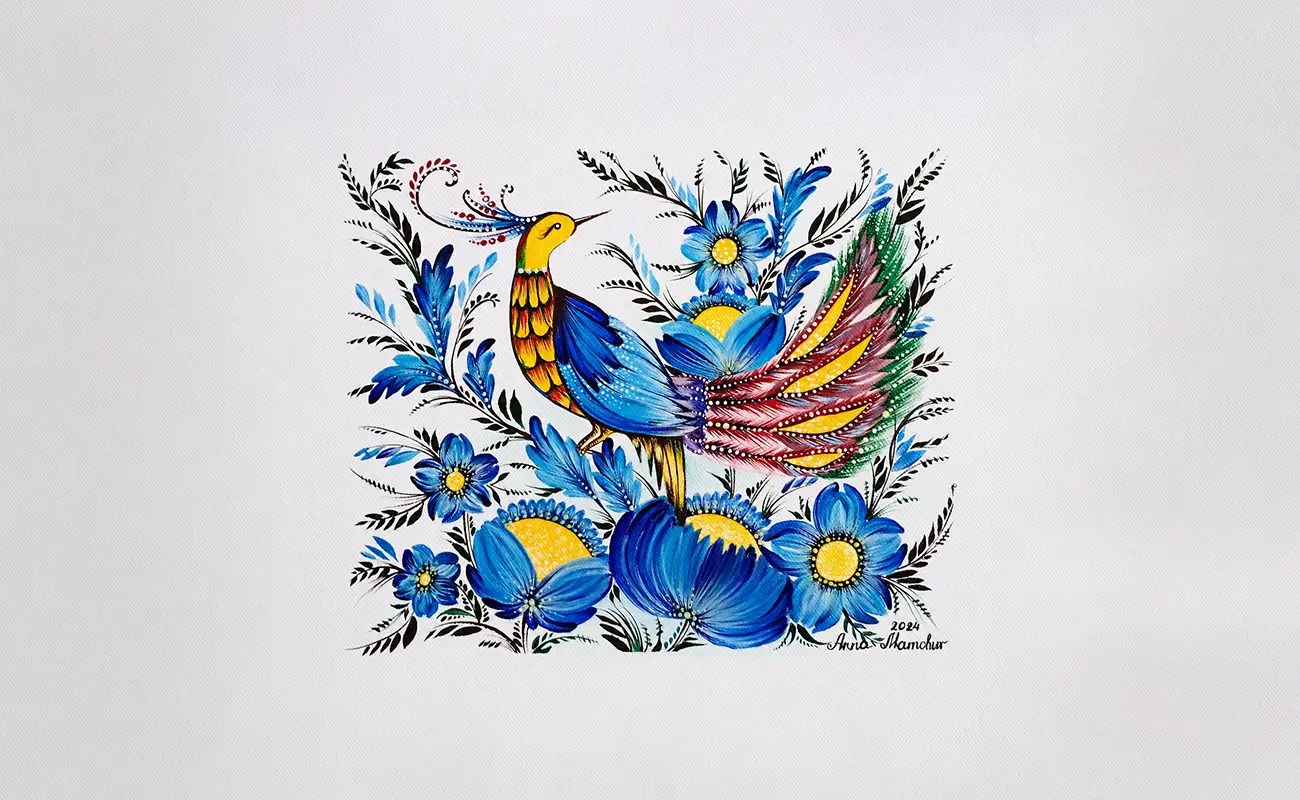
Several works demonstrate this evolving symbolic language with particular clarity. Bird of Renewal presents a fantastical bird surrounded by ornamental botanical forms inspired by Petrykivka painting, creating a vibrant image of vitality, inner freedom, and regeneration. Source of Life shifts toward a more universal visual vocabulary through a central oval form, double spiral, solar signs, and symbols of continuity that address inheritance, transformation, and origin. Berehynia Spirit reinterprets the traditional Ukrainian motanka doll as a contemporary embodiment of feminine strength, cultural protection, and intergenerational connection. Alongside these symbolic works, paintings inspired by French Catalonia, including scenes centred on Mount Canigou and Saint-Laurent-de-Cerdans, reveal how landscape becomes a vehicle for exploring identity rather than merely recording geography. Throughout each series, visual harmony arises from repeated rhythms, measured colour relationships, and carefully considered composition.
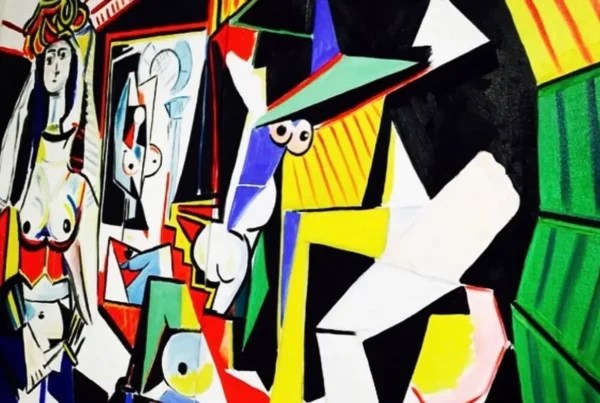
Her influences extend well beyond individual artists. Museums, architecture, travel, education, and changing environments all contribute to the development of her artistic thinking. Visits to the Louvre strengthened her appreciation for composition, light, colour, and the physical presence of painting, while Paris itself sharpened her awareness of perspective, architectural rhythm, and spatial organisation. Encounters with the work of Pablo Picasso and Salvador Dalí revealed contrasting possibilities for artistic reinvention and imaginative freedom. Journeys through Rome, Florence, Venice, Pisa, and Milan deepened her interest in the relationship between architecture, sculpture, painting, and urban space. Rather than identifying a single artistic model, Mamchur describes museums, cities, natural landscapes, cultural heritage, and lived experience as her enduring teachers. Together they reinforce an approach in which technical discipline and symbolic expression remain inseparable.

Responsibility, Renewal, and the Human Condition
One of the most significant works in Mamchur’s recent practice is Life Triumphs Over Death (2026), an acrylic painting on canvas measuring 50 × 70 centimetres and the opening work of her series Emergence Through Ruin. The composition centres on a young woman wearing a wreath of wildflowers while gently holding a transparent egg containing a fragile sprout. Her eyes remain closed, conveying concentration rather than resignation. Mamchur intentionally avoids dramatic heroism, presenting strength instead as an act of quiet responsibility. The restrained gesture invites viewers to consider care as an active choice rather than a passive emotion. Through this central figure, the painting establishes an ethical question that extends far beyond the immediate narrative and speaks to universal concerns about preservation, vulnerability, and the future.
The surrounding composition reinforces this tension through two contrasting environments. One side reveals daylight, green land, construction cranes, and a city taking shape, suggesting reconstruction, labour, and possibility. The opposite side presents darkness, fire, and destruction, representing war and the forces that threaten the continuation of life. Positioned between these opposing realities, the transparent egg protects the sprout while simultaneously exposing its fragility. The woman’s hands become the visual and symbolic balance point between hope and devastation. Ukrainian cultural memory remains present through the floral wreath, yet the egg, sprout, moon, fire, and rebuilding city communicate meanings that transcend national boundaries. Rather than offering certainty, the painting asks viewers what they are prepared to safeguard when the future becomes uncertain and fragile.
This work also marks an important stage in the evolution of Mamchur’s artistic ideas. It extends themes introduced in Source of Life, where questions of origin and continuity first emerged, while also developing the protective symbolism explored in Berehynia Spirit. Within Life Triumphs Over Death, however, these concepts enter a distinctly contemporary ethical context. The emphasis shifts from asking where life begins toward considering the responsibilities people assume when life faces danger. This progression reflects broader developments throughout her practice, where concerns about cultural memory and belonging increasingly intersect with questions of care, responsibility, and conscious choice. By combining symbolic imagery with carefully structured composition, Mamchur creates paintings that remain deeply personal while inviting broad human reflection.

Anna Mamchur: Painting Between Memory and Tomorrow
Mamchur’s creative process begins with inquiry rather than imagery. New paintings often emerge from a question, an emotional tension, or a collection of written associations before visual form appears. Preliminary sketches gradually identify a central symbol capable of carrying the work’s conceptual weight. This form may be a tree, bird, egg, mountain, hourglass, human gesture, or another meaningful object. Around this focal point she constructs an interconnected visual system in which every supporting element contributes to the larger narrative. Landscape paintings rely on direct observation and photographic references gathered throughout French Catalonia, where attention to light, architecture, foreground, distance, and tonal rhythm allows places to communicate emotional presence instead of simple description. Decorative works develop through rhythmic brushwork, repeated colours, botanical motifs, and balanced transitions that create visual movement while maintaining compositional harmony.
Her current artistic direction centres on two interconnected series. Time of Responsibility explores moments when profound transformation has not yet occurred but responsibility has already begun. Its first painting, Before the Beginning, depicts an expectant couple standing before a hospital while roots, flowering branches, birds’ nests, storks, and an hourglass transform an everyday scene into a meditation on family, preparation, and the passage of time. Emergence Through Ruin examines how life survives and regenerates after destruction, with Life Triumphs Over Death establishing the emotional and conceptual foundation for the series. Together these bodies of work address complementary stages of existence, one preceding new life and the other following catastrophe, while continuing the artist’s long-standing interest in origin, protection, cultural continuity, belonging, and conscious responsibility.
Looking ahead, Mamchur intends to complete both series before presenting them as a unified exhibition devoted to life, vulnerability, memory, and ethical choice. Alongside these symbolic projects, she remains committed to painting the landscapes of Mount Canigou and Saint-Laurent-de-Cerdans, believing that sustained observation of light and place remains essential to her development. Her practice demonstrates that tradition can remain dynamic when interpreted through present experience rather than preserved unchanged. Ukrainian visual heritage continues to provide the symbolic foundation of her paintings, while French Catalonia offers new perspectives through its environment, architecture, and atmosphere. The result is a body of work that bridges cultures without diminishing either one, presenting painting as a thoughtful space where memory, renewal, responsibility, and hope coexist through carefully crafted visual language.