“Photography is not simply a means of recording appearances but a system whose mechanisms, assumptions, and limitations can themselves become subjects of investigation.”
Finding Order in the Accidental
Michael G. Prais approaches photography with the curiosity of someone accustomed to asking how systems work. Based in Geneva, Illinois, he photographs industrial remnants, deteriorating structures, machinery, suburban houses, streets, harbors, and other environments where intentional design encounters neglect, reuse, nature, and chance. These subjects provide more than visual material. They allow him to examine a question that has followed him throughout his life: why do certain arrangements of objects command attention? His photographs move between recognizable observation and structural disruption, turning overlooked places into investigations of perception, context, and the assumptions viewers bring to an image.
That analytical instinct developed long before photography became a serious practice. Prais grew up in suburban Dearborn, Michigan, during the post World War II height of the automobile industry. He studied chemistry and mathematics at the University of Chicago before earning a doctorate in chemical physics from the University of California, San Diego. His research involved mathematical models of interactions and vibrational behavior at crystal surfaces, demanding sustained engagement with derivations, calculations, and abstract systems. He later taught chemistry at Roosevelt University, then brought his knowledge of information and communication technologies into academic computing and instructional technology, including a role directing Academic Computing Services at Northern Illinois University.
Teaching, science, and photography might appear to occupy separate territories, yet Prais connects them through his desire to understand complicated mechanisms and make them intelligible. A self-described visual person, he has long moved comfortably between concrete phenomena and abstract explanations. His involvement with digital imaging began when he was asked to support an Adobe Photoshop installation for an art department, and in 1996 he started making photographs seriously. His technical investigation of the medium eventually resulted in the publication of Photographic Exposure Calculations and Camera Operation. In retirement, he continues to work as a STEM tutor while analyzing how photographs and other images operate, carrying the habits of the scientist and educator directly into his visual practice.

Michael G. Prais: Wilderness Inside Civilization
Prais is particularly attentive to places where people have created arrangements without considering their eventual visual effect. Abandoned sites, farms, junkyards, industrial landscapes, vacant spaces, and peripheral areas become a kind of wilderness within civilization, shaped by human activity but no longer governed entirely by its original intentions. Buildings deteriorate, vegetation advances, machinery becomes obsolete, and unrelated objects accumulate beside one another. Prais finds significance in these unplanned relationships. Instead of reorganizing a scene for the camera, he preserves what he encounters, treating the environment as a found still life whose composition has emerged through use, abandonment, coincidence, and time.
This interest reaches back to his persistent fascination with the tension between the designed and the organic. He looks for human constructions within nature as well as arrangements created unintentionally by human hands. The resulting photographs depend on close attention to balance: structure competes with disorder, recognizable purpose with visual ambiguity. Prais first evaluates these relationships at the site, then considers how they change once contained by the photographic frame. His subjects may be ordinary, damaged, or overlooked, but their placement creates visual problems that invite prolonged looking. The photograph becomes a way to isolate those relationships while simultaneously questioning what that isolation does to their meaning.
His approach draws on photographic histories without simply repeating them. Stephen Shore, Walker Evans, William Eggleston, and Lee Friedlander have influenced his selection of subjects and his attention to everyday arrangements. Roy DeCarava, Jeff Wall, Cindy Sherman, and Lucas Samaras have informed aspects of how he treats images after observation. Prais also finds a useful precedent in twentieth century Modernism and its attention to structure and detail, while his own concerns extend toward contemporary questions about photographic construction. The camera records what stands before it, but for Prais that initial exposure is only one stage. Once the image exists, its internal order can be examined, challenged, and rebuilt.

When Recognition Begins to Fracture
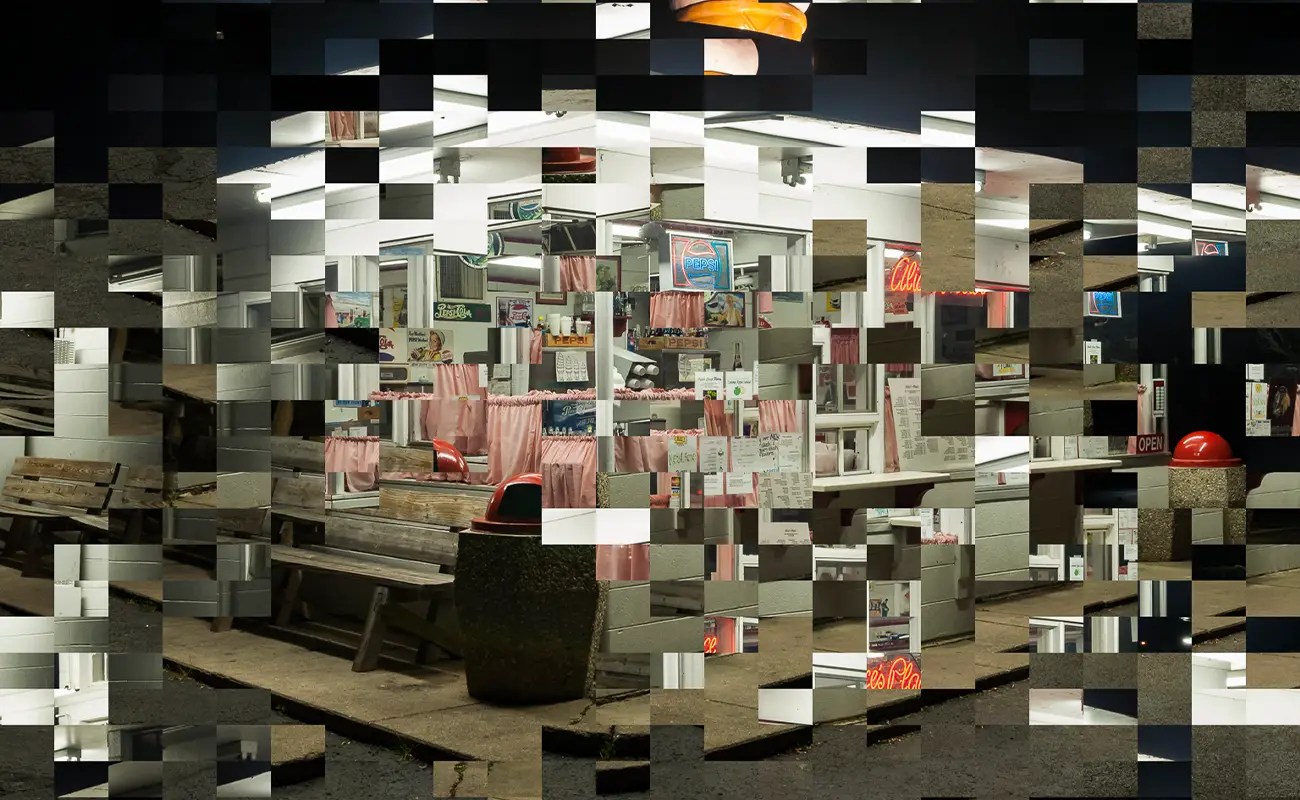
That challenge becomes explicit in Context & Chaos and the related development of Out of Context into Out of Context into Chaos. Prais digitally cuts photographs into hundreds of small rectangular images and randomly reassembles them. Pieces of buildings, lettering, machinery, roads, walls, vegetation, and sky are separated from their original positions and placed beside fragments that could never physically meet. Details remain identifiable, but the spatial logic connecting them has been compromised. What began as a single photograph bounded by one frame effectively becomes an image composed of hundreds of smaller frames, each preserving a portion of visual information while weakening the authority of the whole.
The degree of fragmentation is crucial. Prais does not want the source photograph to disappear into complete abstraction. Breaking an image down to individual pixels would eliminate the recognizable objects that keep viewers searching for connections. Larger rectangles instead maintain a productive tension. A viewer may recognize part of a vehicle, a section of architecture, a patch of sky, or a piece of text, yet the expected relationships between those elements no longer hold. The eye repeatedly attempts to reconstruct a coherent place from evidence that resists reconstruction. His algorithms therefore do more than produce a digital effect. They compromise photographic structure in a controlled way, testing how much disruption an image can sustain before recognition loses its grip.
This method also exposes something Prais sees in conventional photography itself. A photograph can appear to preserve reality because the objects pictured resemble things that existed before the camera, but framing has already separated those objects from their broader circumstances. Fragmentation makes that separation difficult to ignore. Prais asks how much recognition resides in the photograph and how much depends on prior knowledge carried by its viewer. The same distinction shapes his thinking about photographs and memories. Emotional significance, in his view, is not physically embedded in photographic material. Meaning develops through associations supplied by the person looking, making every encounter with an image partly dependent on experience beyond its borders.

Michael G. Prais: Images Against Certainty
In Out of Context into Chaos, disrupted continuity also opens onto deterioration, loss, impermanence, and the disappearance of constructed things. These concerns are already present in Prais’s choice of abandoned machinery, aging buildings, vacant spaces, and remnants of former use. Fragmentation intensifies them by making even the photographic representation unstable. Structures that have already been altered by time are subjected to another transformation through the image itself. The series extends across three related books, where photographs and texts are fragmented and reorganized so that the principle shaping individual pictures also affects the publications containing them. Form and subject become inseparable parts of the same inquiry.
Alongside these works, Prais has developed another project from scenes that recall what caught his attention when he was younger. Here, sunlight and shadow falling across houses in older neighborhoods become the focus. He plans to extend this line of observation to storefronts in Chicago, cottages on inland lakes, and collections of household items. Though these subjects differ from deteriorating industrial sites, they continue his sustained examination of visual arrangements and the forces that make them compelling. He is also studying abstract painting for possible ways to disturb photographic structure further, seeking treatments that can challenge familiar expectations without surrendering the recognizable traces that make his fragmented images active perceptual puzzles.
Prais’s work has appeared through A Smith Gallery’s Photographic Performance program and in exhibitions associated with Praxis Photo Arts Center, Blue Sky Oregon Center for the Photographic Arts, Atlanta Photography Group, and the Los Angeles Center of Photography. Lenscratch has also presented the series in depth. Across these settings, his practice remains rooted in an unusual convergence of scientific analysis, technological knowledge, teaching, and sustained visual observation. Photography gives him a means to record the arrangements he encounters, while digital reconstruction allows him to interrogate the medium that recorded them. Instead of treating photographic resemblance as certainty, Prais keeps testing what happens when context shifts, continuity fails, and viewers must decide for themselves how the remaining pieces belong together.