Light Without a Surface
Christopher Bauder has spent more than two decades giving digital systems a physical presence. The German light and media artist works with illumination, movement, sound, spatial design and technological invention, building environments in which light does more than reveal an object. It becomes the object, the structure and often the atmosphere itself. Beams stretch through darkness, illuminated spheres rise and fall, mechanical fixtures shift position, and synchronized sound changes how those forms are perceived. Born in Stuttgart in 1973 and based in Berlin, Bauder has developed a practice that makes computational logic tangible without sacrificing the fleeting character that gives light its emotional force.
His interest in illumination began long before digital media entered his vocabulary. Growing up near Lake Constance left a lasting impression, while childhood collections of candles, matches and lighters developed into experiments with bulbs and handmade lamps. His education initially moved in another direction through literature and dramatics in Munich. He later studied visual communication and experimental media design at the Berlin University of the Arts, alongside further study in digital media at the School of the Art Institute of Chicago. Programming and three-dimensional software introduced pixels, polygons and virtual structures, but the screen eventually felt less like a destination than a limit.
That frustration produced a defining question: what would happen if the basic components of a digital image could leave the display and occupy real space? Bauder began treating the pixel as a three-dimensional unit that could be positioned, illuminated and moved. His student work TONE LADDER turned an ordinary household ladder into an interactive instrument, with individual rungs triggering sounds and related light responses. In that early experiment, several ideas that would shape his later work were already present: modular systems, synchronization, interaction and the translation of invisible computation into events that viewers could encounter directly.

Christopher Bauder: Engineering Movement Into Light
Turning those ideas into larger installations required machinery as much as visual imagination. Bauder developed computer-controlled cable systems capable of moving individual lights and illuminated objects vertically through space. Engineering was not an auxiliary stage added after the artistic concept; it became part of how the work could be conceived. In 2004, he founded WHITEvoid in Berlin as an interdisciplinary studio bringing together interaction design, media design, architecture, engineering, software and fabrication. He later established KINETIC LIGHTS to develop and manufacture the motorized systems needed to choreograph light as a moving spatial material.
ATOM, created with composer and electronic musician Robert Henke, demonstrated the expressive potential of that approach. Internally illuminated helium balloons were suspended in an array and moved independently by computer-controlled winches, producing a spatial matrix whose geometry continually changed in relation to sound. The installation resisted familiar categories. It was not a static sculpture, and it did not behave like an image projected onto a surface. Instead, light sources themselves became movable coordinates. Presented internationally, including at the Centre Pompidou in Paris, ATOM established a framework in which electronic music, motion and illumination functioned as parts of one responsive composition.
Bauder and Henke expanded that logic in DEEP WEB. The installation paired 175 motorized spheres with twelve high-powered lasers, using the moving spheres as endpoints for beams that would otherwise continue indefinitely. As their positions changed, the lasers produced shifting three-dimensional vector drawings in the air, effectively transferring a principle of computer graphics into physical architecture. The technical precision is essential, but it serves a sensory purpose. Depth is measured by the body rather than simulated on a monitor; movement unfolds around the viewer; sound shares the same space. The digital system becomes visible precisely by escaping the screen.

Rhythm, Darkness and Emotional Geometry
Electronic music has long supplied both structure and emotional charge to Bauder’s installations. After moving to Berlin, he became closely connected to the city’s techno culture, and its influence remained embedded in his approach to duration, repetition, intensity and rhythm. Software can connect sonic shifts directly to changes in light and movement, creating tightly integrated audiovisual systems. His collaborations with Henke and Kangding Ray grew through iterative exchange, with sound and visual material developing together instead of one discipline serving as accompaniment for the other. The result is a form of composition in which spatial change can be heard as much as seen.
Architecture also determines how that composition is experienced. Bauder favors industrial settings over neutral museum spaces, using former factories, power stations and other large structures for their scale, texture and multiple viewpoints. Their material weight creates a productive contrast with light, which can define a volume without becoming solid. Darkness performs an equally active role. By reducing surrounding visual information, it allows beams, reflections and luminous objects to establish temporary boundaries. Forms can seem almost touchable for a moment, then dissolve when the system shifts.
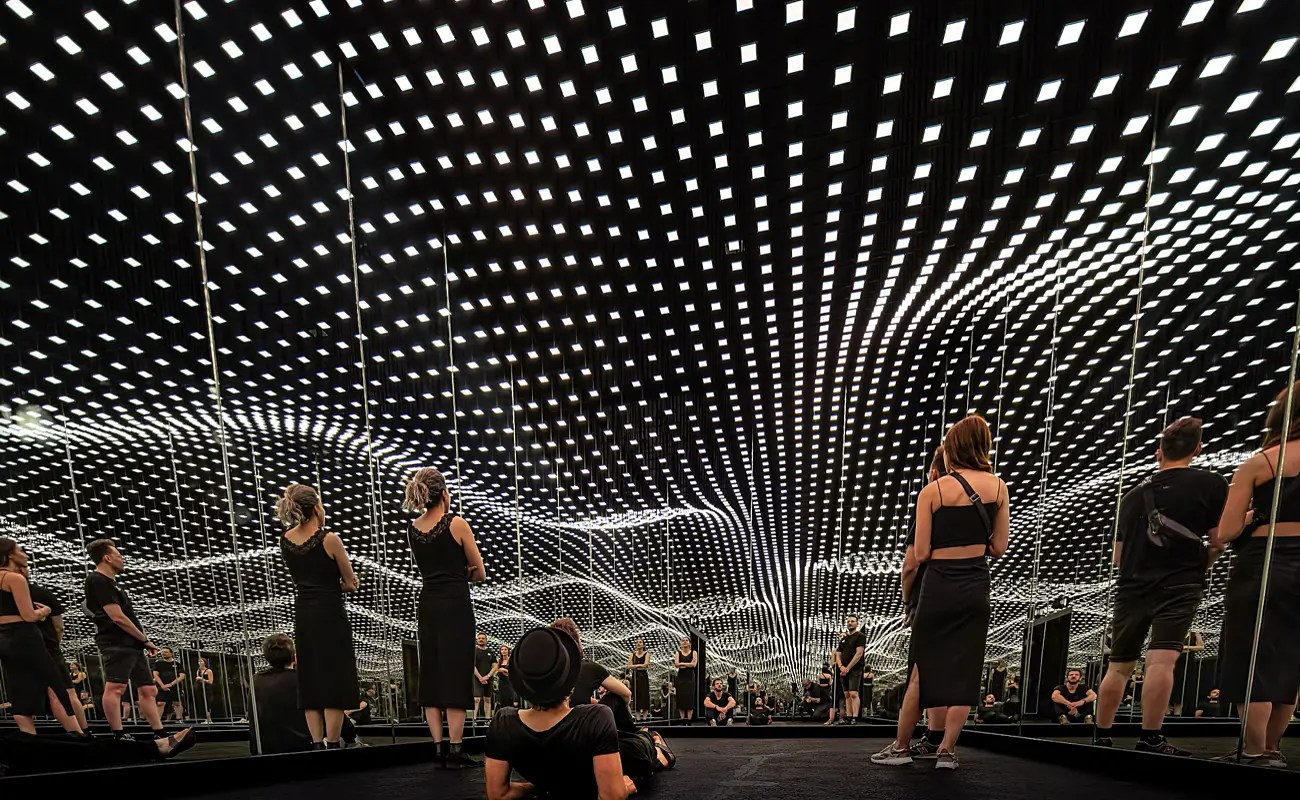
SKALAR, created with Kangding Ray, directed these tools toward the psychology of perception. Using kinetic mirrors, moving lights, color and multichannel sound, the large-scale installation explores emotional states through abstraction. Its structure refers to psychologist Robert Plutchik and his theory of eight primary emotions, but Bauder does not translate those states into recognizable scenes or figures. Brightness, hue, direction, motion and sound become the vocabulary. The work asks how precisely controlled technological forms can generate responses that are bodily and psychological, allowing emotion to emerge from changing conditions rather than narrative imagery.

Christopher Bauder: Memory Drawn in Luminous Lines
Bauder’s ability to connect abstraction with collective memory reached a different scale in LICHTGRENZE, conceived with his brother, filmmaker Marc Bauder, for the twenty-fifth anniversary of the fall of the Berlin Wall in 2014. Thousands of illuminated balloons followed more than fifteen kilometers of the former border through central Berlin. The work temporarily restored the line of division while transforming its material meaning. Concrete, barriers and fortification were replaced by a fragile luminous trace, making absence visible without recreating the physical violence of the Wall. The project became a major milestone and was later recognized with the Order of Merit of the State of Berlin.
DARK MATTER gave Bauder a permanent Berlin setting for the ideas he had developed across decades. Installed in a converted industrial site, it brings together intimate light works, interactive structures and room-scale audiovisual installations while keeping exhibition, engineering, fabrication and artistic development in close proximity. The project also reflects his commitment to direct experience. Specialized knowledge is not required to enter the work. Rather than prescribing a fixed interpretation, Bauder allows visitors to decide what the shifting combinations of light, space, movement and sound produce for them.
With VEKTOR, that sensory language became more explicitly autobiographical. Bauder combined moving lasers with a three-dimensional soundtrack he composed himself, drawing on memories and references from his life, including childhood environments and electronic music culture. The project extended his authorship into sound after years in which music had been central to collaborative works. Yet autobiography still appears through abstraction rather than conventional storytelling. Across VEKTOR and the wider practice, lasers, LEDs, moving fixtures and illuminated objects retain their distinct physical and emotional qualities. Code supplies precision, but perception remains the destination: motion becomes structure, structure becomes sensation, and light briefly gives digital thought a body.