Colour Against the Grid
Arne Quinze has spent much of his career testing what happens when unruly colour enters spaces designed for order. Born in Ghent, Belgium, in 1971, he first became involved with graffiti in the 1980s, working in a visual language that did not wait for permission from established cultural spaces. His subsequent work in painting, sculpture and large public installations retains something of that directness. Even at its most elaborate, it begins with a simple proposition: art can interrupt the habits through which people experience a city, altering not only what they see but how they meet their surroundings.
The contrast between the natural landscape of his early surroundings and the built environment of Brussels became a lasting concern. Quinze has described an ambition to turn cities into open-air museums, places where encounters with art belong to daily life rather than a separate institutional visit. It is a vision concerned as much with human relationships as with visual spectacle. A structure that crosses a street or occupies a square changes the space available to pedestrians, brings different people into a shared experience and challenges the apparent neutrality of urban design.
His vivid palette has roots in street art, while the restless rhythms of his forms have also been linked to experimental electronic music, underground culture and manga. Yet those sources are not assembled as a nostalgic record of the 1980s. They help account for an artistic language that refuses clean boundaries between structure and improvisation. Wooden slats collide and cross; sculptural forms reach outward rather than close around a single centre. Quinze has repeatedly placed this visual energy in direct contact with the disciplined geometry of streets, buildings and plazas.

Arne Quinze: Structures for Encounter
An important early example was Uchronia, the vast wooden installation made for the Burning Man festival in Nevada in 2006. Its interwoven construction expanded the vocabulary of sculpture toward a temporary environment, something understood through movement beneath and around it. Scale mattered, but so did the precarious appearance of the whole. A large number of individually simple wooden elements combined into a form that seemed to grow beyond any conventional architectural outline. The structure offered a model for Quinze’s subsequent engagement with the unexpected social possibilities of public space.
Brussels provided another setting for these experiments. Cityscape placed a sprawling wooden construction in the urban environment, while The Sequence, installed in 2008, extended across the street between buildings of the Flemish Parliament. The latter made an unusually literal connection between architecture and civic life: its twisting orange-toned framework spanned a thoroughfare associated with political institutions. Rather than designing a monument to be viewed from a prescribed distance, Quinze introduced a structure that pedestrians had to negotiate visually and physically. The work’s intricate crossing lines complicated the familiar perspective of the street.
Wood was especially significant in this phase, including salvaged material, because repetition allowed Quinze to build a remarkable feeling of movement from ordinary components. The resulting installations could appear simultaneously constructed and spontaneous, both emphatically artificial and suggestive of branching natural systems. Smaller bodies of work, including the shelter-like structures of My Home My House my Stilthouse, took questions of habitation in another direction. Their references to homes, boundaries and separation made visible the social arrangements that architecture can reinforce. Behind the bright surfaces lay persistent questions about how communities share space and how much distance people place between themselves.

The Garden as a Working Studio
Over time, Quinze’s attention to social space became increasingly inseparable from an interest in biodiversity. At his home near Ghent, he replaced conventional garden order with an extensive planting of wildflowers and grasses. Rather than holding every plant in a fixed composition, he has spoken of allowing growth to take its own course after making his selections. The garden changes with the seasons, introducing accidents, competition, renewal and decay. It is a daily source of observation, not simply a picturesque backdrop, and it gives physical substance to his argument that nature should remain present within human environments.
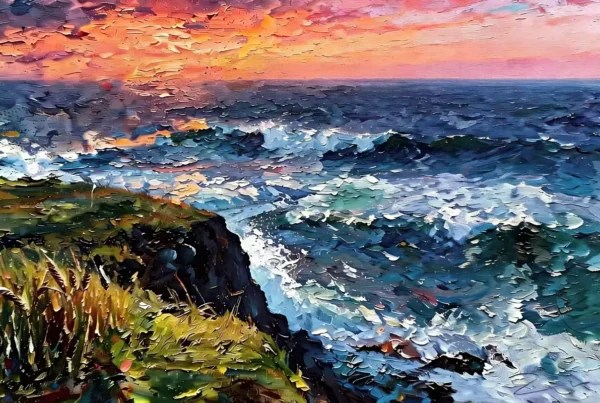
This close examination of plants helps explain the relationship between his paintings and his sculptures. In oil paintings shown in Hidden Beauty at the Ludwig Museum in Koblenz, expansive areas of colour and layered gestures evoke natural processes without reducing them to botanical illustration. Forms overlap, dissolve and press against one another. The energy of a flowering garden is conveyed through movement and chromatic contrast rather than through a tidy arrangement of specimens. Quinze’s admiration for the Impressionists, especially the attention of Claude Monet to changing natural conditions, has become an important point of reference for this direction.
His canvases also insist that vitality cannot be separated from fragility. A flower’s brilliance is temporary; new growth depends on conditions that can be easily disturbed. Paint makes those tensions legible through shifts in density, light and rhythm. Works such as the oil painting Bipinatus and the later paintings presented in Hidden Beauty belong to a practice in which abstraction emerges from sustained looking. There is no need to identify each petal or stem. The central concern is how a living environment can be experienced as an interdependent field of forces rather than a collection of isolated decorative objects.

Arne Quinze: Material Experiments in Living Form
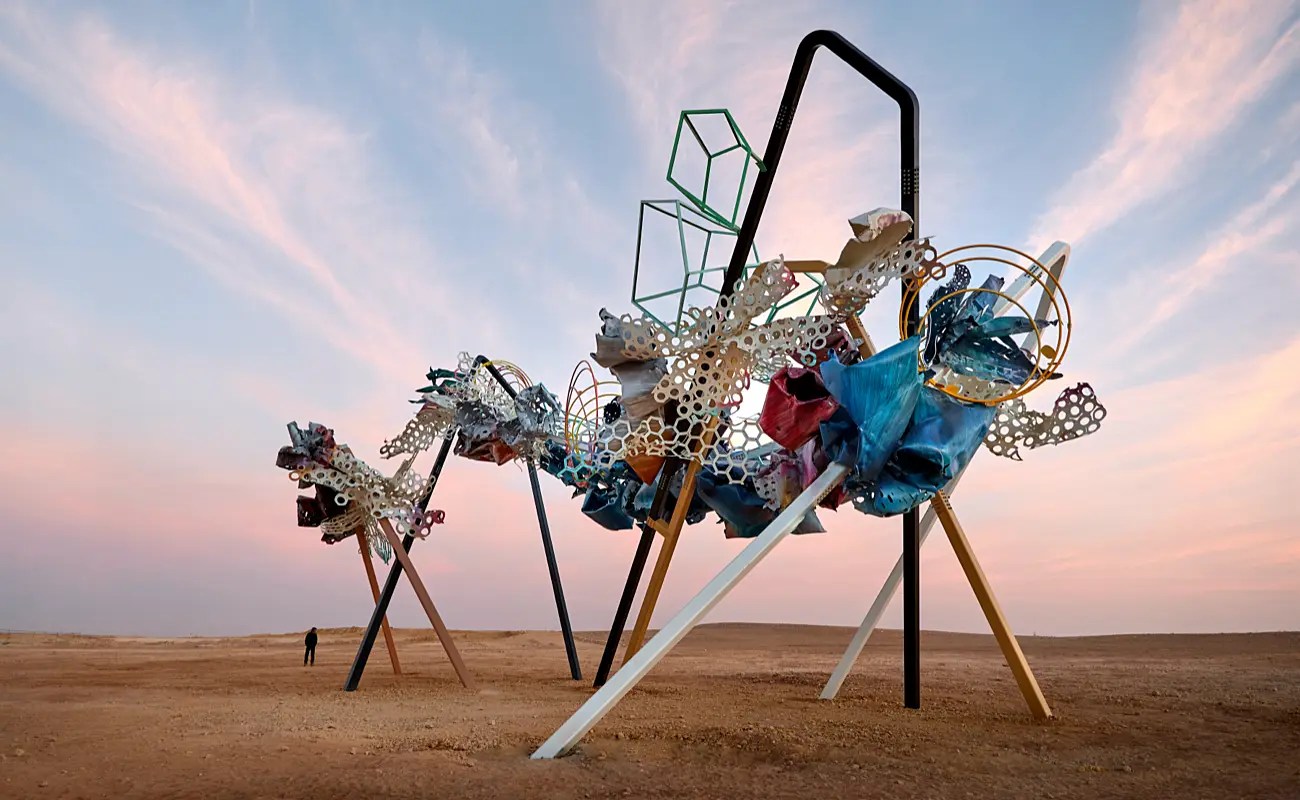
Quinze’s more recent sculpture brings the botanical impulse into dialogue with metal and other demanding materials. His lupine-inspired forms, including works made in painted aluminium, translate the apparent flexibility of plant growth into durable constructions. The contrast is productive: metal can hold a gesture that recalls folding, twisting or opening, while saturated surfaces preserve the visual intensity associated with a flower in bloom. These sculptures do not function as enlarged scientific models. Instead, their shifting silhouettes treat natural forms as starting points for spatial invention, allowing a single organism to suggest a much larger network of relationships.
The installation Are We The Aliens, presented in Venice in 2024, opened this exploration to glass, ceramics and sound. Quinze worked with the glass specialists of Berengo Studio and the ceramic makers of Atelier Vierkant, while music producer Swizz Beatz contributed soundscapes. The project used differences between materials to make the encounter more complex: glass offers transparency and vulnerability, ceramics register earth and heat, and sound creates an atmosphere that cannot be confined to a solid object. The exhibition’s question turned human exceptionalism around, asking viewers to reconsider who, in a damaged relationship with the natural world, might truly be out of place.
Raw Paradise, shown at KÖNIG Galerie in Munich in 2025, extended that vocabulary through bronze, aluminium, Murano glass, ceramics, oil painting and video. Instead of presenting each medium as a separate discipline, Quinze brought them together to explore the tensions between strength and delicacy, human invention and organic change. His practice continues to move between the intimacy of observing a wildflower and the ambition of reshaping public perception on an architectural scale. What joins those activities is a sustained attention to the structures of living things, and to what cities might become if they made room for more of that complexity.