“Through my work, I wish to captivate the viewer with the quiet power and energetic beauty that our Earth offers.”
Where Stillness Becomes a Way of Seeing
Thomas Hartstang, also known as Tom H., photographs places where landscape, human presence, and atmosphere meet without competing for attention. His subjects range from the Schlei fjord and Baltic Sea in northern Germany to Hamburg’s port, Iceland’s volcanic terrain, the Alps, and Kazakhstan’s mountain expanses. Ports and industrial scenery sit naturally beside coastlines and open country in his practice. What connects them is not geography but a sustained interest in looking carefully, finding visual order, and revealing the beauty of environments that he believes deserve preservation.
Hartstang considers landscape photography both observation and personal interpretation. His images are not intended to romanticize a scene, yet neither does he approach a place as a neutral documentarian. He works between those positions, combining recognizable reality with atmosphere. Precise composition often anchors the result: clear lines, balanced areas, purposeful perspective, and a measured relationship between foreground and background. At the same time, he is willing to disregard familiar compositional formulas such as the Rule of Thirds or Golden Ratio when the image calls for another solution.
That independence also defines his choice of tools and visual language. Hartstang photographs in color and black and white, using a professional camera, smartphone, and drone, and he has received national and international recognition across these formats. He describes himself at different moments as a minimalist, urban photographer, or nature and landscape photographer, while resisting a fixed stylistic category. The constant is a focused, observational approach that favors tranquillity over spectacle and seeks what he calls the quiet power and energetic beauty of the Earth.

Thomas Hartstang: From a Voigtländer to a Deliberate Practice
Photography entered Hartstang’s life through an old Voigtländer camera he found at his grandfather’s house. He asked if he could try it, beginning a relationship with the medium that continued even as the technology changed. He later moved to digital photography to avoid working with chemicals, but an important habit from the earlier process remained. Before pressing the shutter, he gives considerable attention to preparation and typically makes only a small number of photographs of any subject.
That restraint is central to how he works. Rather than relying on volume, Hartstang considers the scene before capture and then makes another important decision in post processing: whether the final photograph belongs in color or black and white. There is no universal rule. Each image is treated on its own terms, with the final visual language shaped by what best carries its atmosphere, structure, and emotional weight. The same flexibility allows him to move between cityscapes, coastlines, harbours, mountains, and aerial views without forcing them into a single aesthetic formula.
His broader photographic life extends into institutions and community projects. Hartstang serves as a Vice President of the Schleswig Fotoclub, which he describes as the fourth largest club in the Deutsche Verband für Fotografie. He also curates five to six photography exhibitions each year at the Schleswig City Museum. More recently, he organized the first Norden Foto Cup, open to participants using any type of camera and presented under the theme “Our beautiful True North.” These activities place his personal practice within an active culture of exhibitions, competitions, and shared photographic exchange.

A Lighthouse Suspended Between Sea and Abstraction
Hartstang’s connection to the Schlei and Baltic Sea region gives him a landscape he can revisit rather than merely encounter once. Familiarity sharpens his attention to changes in weather, reflections across water, and the visual role of a shoreline cutting through a frame. Travel works differently, introducing unfamiliar forms and perspectives. Drone photography has become one way to translate that experience, exposing patterns, textures, and relationships between land and water that can push a recognizable place toward abstraction.
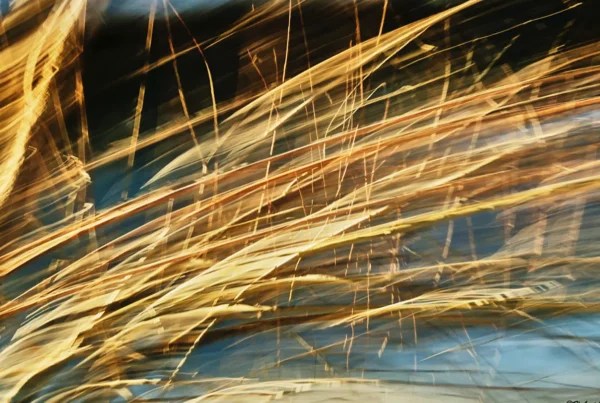
A particularly meaningful image emerged at Zingst on the Baltic Sea while Hartstang was preparing for an Iceland trip later in 2025. He reached the well known pier at around 3:45 in the morning, before sunrise, when the colors across the scene were unusually vivid. Roughly 33 kilometers away, the Lighthouse Am Dornbusch cast a point of light over the calm water. Hartstang chose to use intentional camera movement, timing the exposure for the last moment he could see the beam and moving the camera during the shot. The breakwater dissolved while the distant light remained a small, distinct point.
The resulting photograph, “Lighthouse Am Dornbusch,” occupies a threshold between landscape and abstraction. Warm coral and rose tones meet the cooler blue of the Baltic Sea, while soft transitions give the scene a painterly character. Dark groynes fade into the image, establishing a gentle rhythm and a visual reference against the surrounding openness. The tiny light on the horizon intensifies the sense of distance. The photograph earned a top place at the German Photo Championship and was selected as an Editor’s Choice by Global Lens, recognition for an image whose significance to Hartstang is also closely tied to his current state of mind.

Thomas Hartstang: Dialogue, Travel, and the Next Horizon
Personal experience has shaped Hartstang’s way of seeing beyond photography itself. He grew up in a midsized city, in a neighborhood he says would now be described as a social hotspot, despite his parents earning a decent income. Later, he and his wife experienced both the joy surrounding the births of their two sons and periods involving fights for life. He does not turn those experiences into a simple explanation for his images, but he identifies the circumstances of one’s upbringing and life as important influences on artistic perspective.
A continuing creative exchange with his wife, painter Stephanie Hartstang, has become another important part of his practice. Their shared project, “Painting and Photography – A Dialogue,” asks each of them to approach the same subjects independently through their respective media. The process makes composition, color, and viewpoint subjects of active consideration rather than automatic choices. Hartstang also learns through travel with internationally known landscape photographers, including Danish photographer Mads Peter Iversen and, especially, Italian photographer Isabella Tabacchi. Those experiences help him return to familiar surroundings with renewed attention and notice possibilities he might previously have missed.
There is no fixed daily routine governing this work. During a recent stay south of Frankfurt, Hartstang and his wife used the location to develop new dialogue pairs based on Frankfurt subjects. He was also completing post processing from an East Kazakhstan trip in May and writing their book, “Painting and Photography – A Dialogue,” scheduled for release in November. A planned journey through West Kazakhstan had to be postponed, and completing that trip has become his most important upcoming undertaking. Alongside it, the pair hope to present two or three further Dialogue exhibitions next year, ideally extending the project to an international setting.