“It might feel like things are too late or that you’re behind, but you’re not.”
The City After Its Ordinary Rhythms
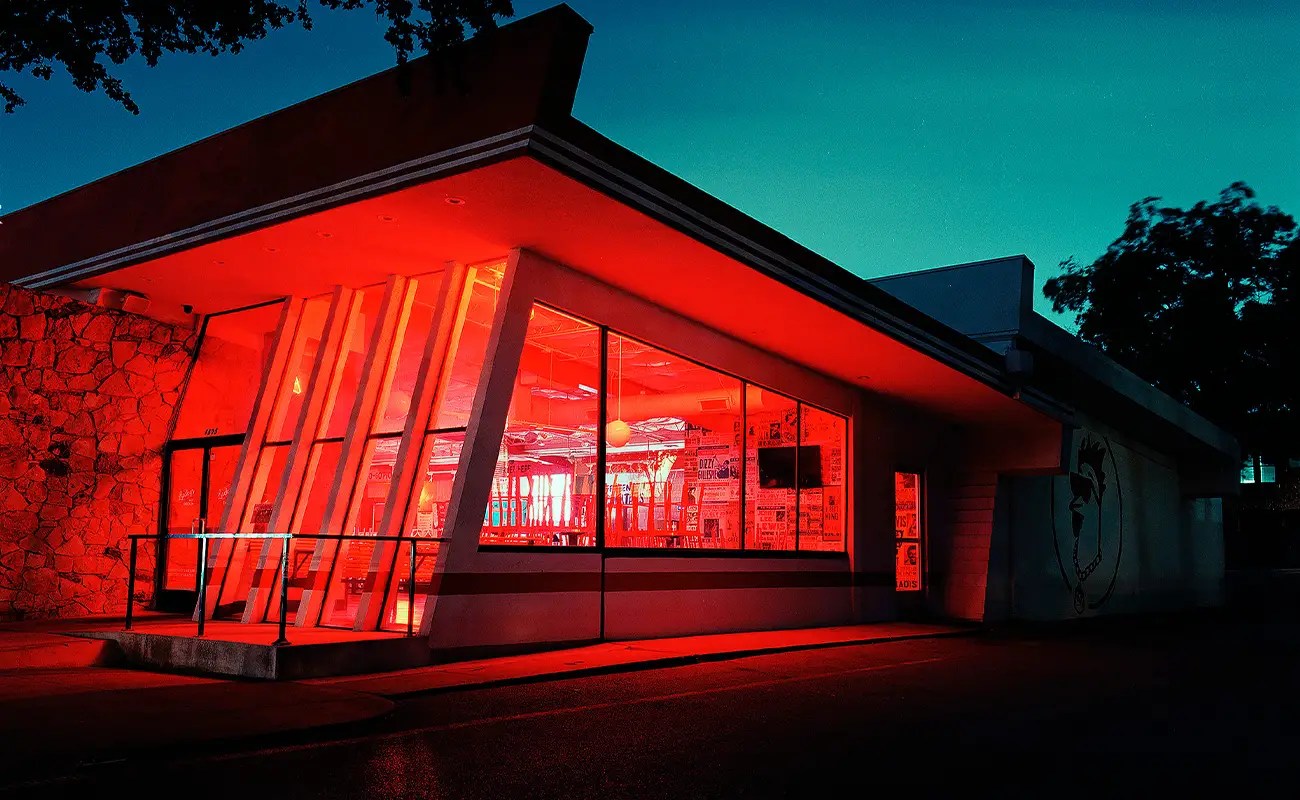
Laidric Stevenson photographs the American city when much of its daily activity has disappeared. Based in Dallas, Texas, the mostly self-taught photographer turns his attention toward spaces that are easy to pass without noticing: vacant storefronts, parking lots, utility poles, commercial signs and modest institutional buildings. Night gives these subjects a different presence. Fluorescent interiors and isolated streetlights interrupt large fields of darkness, while empty pavement and quiet facades acquire an atmosphere that daylight might obscure. Stevenson is interested less in recognizable landmarks than in the structures and fragments through which a place gradually discloses itself.
That attention to place is closely connected to a childhood defined by movement. Stevenson lived across four states, Oregon, Idaho, Oklahoma and Texas, and the experience complicated his understanding of home. A location could be home in practical terms without producing a lasting sense of belonging. It was simply where he happened to be at a particular moment. Photography eventually gave him a way to respond to that instability. After discovering the medium in high school, he began using the camera as a reason to investigate his immediate surroundings and venture farther beyond them.
His photographs now transform that impulse to explore into sustained observation. Signs, boarded doors, deteriorating surfaces, empty windows and traces of commercial life become evidence of how cities accumulate histories. Rather than presenting an exhaustive portrait of Dallas or the contemporary American city, Stevenson works through fragments. A glowing sign or anonymous building can carry as much weight as a celebrated piece of architecture. This approach allows documentary specificity and emotional uncertainty to coexist. The places remain identifiable as physical environments, yet their silence makes them feel temporarily detached from ordinary time.

Laidric Stevenson: Learning to See Through Photobooks
Stevenson’s understanding of photography shifted considerably when he returned to college in 2004 to pursue a second bachelor’s degree. Until then, his relationship with the medium had lacked a clear direction. He had abandoned an earlier ambition to become a photojournalist, and his primary references for photography were newspapers and publications such as National Geographic. College introduced another possibility: photographs could form an artistic language of their own rather than serving primarily as illustrations accompanying a writer’s text. Although he had to leave school the following year to take a full time job, that brief period left a lasting mark on his practice.
One encounter proved especially important. Stevenson discovered the photobook as a form in which photographs could carry an entire publication. He began collecting and studying books by historical and contemporary photographers, developing an interest that continues to expand as publishers release new titles and individual artists establish independent imprints. The attraction is not simply to individual images. A book offers rhythm, sequence and relationships between photographs, allowing meaning to develop through accumulation and juxtaposition.
That fascination eventually led Stevenson to produce zines and artist books from his own work. Publishing also changed what happens before he presses the shutter. He now considers how a single photograph might function within a future sequence, rather than treating every frame as a completely autonomous object. The anticipated zine can therefore influence the act of photographing itself. His city images gain another life when placed beside one another, where repeated architectural forms, artificial colors, signs and stretches of darkness can build a larger sense of location without requiring a conventional narrative.

Artificial Light, Accidental Poetry
Night is both an aesthetic choice and a practical condition for Stevenson. His office job occupies most of the day and runs until 7 p.m., so photographing afterward fits naturally around the demands of employment. More importantly, nighttime gives him the peace and quiet he values while working. With fewer interruptions and less activity around him, he can observe city spaces in relative solitude. Photographing becomes a way to wind down after work while entering a slower mode of attention.
Artificial illumination is central to the resulting visual language. Fluorescent interiors, streetlights and glowing signage cut through nocturnal darkness, sometimes producing intense areas of green, cyan or red. Long exposures, frontal viewpoints and the frequent absence of people contribute to a suspended quality. Broad expanses of pavement and carefully organized architectural planes make ordinary structures feel unusually present. The photographs remain rooted in real places, but color and darkness can push those locations toward something psychologically ambiguous, caught between straightforward description and a more cinematic experience of the city.
Language also enters the frame through the urban environment itself. Phrases and signs such as “8:45 P.M.” and “OPTICAL CLINIC,” along with graffiti, a glowing heart or an abandoned beer sign, lose some of their everyday commercial purpose when isolated within a photograph. They become visual clues, bits of accidental poetry embedded in architecture. Stevenson is similarly attentive to indirect signs of people rather than human activity itself. Improvised markings, obsolete typography and worn facades suggest histories without explaining them, leaving human presence just beyond the visible scene.

Laidric Stevenson: Experiment, Pace and the Open Road
Stevenson’s influences extend well beyond photography. Movies, music and the work of other artists all provide potential points of departure, particularly when he encounters techniques that challenge his established habits. Seeing someone experiment with a process such as Polaroid emulsion lifts can prompt him to move outside familiar patterns and play with a method he has not tried before. Experimentation matters because it can remain exploratory without needing an immediate outcome. A technical curiosity may simply be enjoyable, or it may develop into an idea substantial enough to pursue further.
Social media has intensified that exchange by making other photographers’ processes and experiments continuously visible. Stevenson values the access, but he also recognizes its psychological pressure. A steady stream of new work can create the impression that everyone else is producing more quickly, traveling more often or progressing faster. He consciously resists measuring his own practice against that pace, recognizing that artists work within different circumstances. His position is concise and significant: “It might feel like things are too late or that you’re behind, but you’re not.” For an artist balancing photography with a full time office job, maintaining an individual rhythm is a practical necessity as much as a creative principle.
The project currently occupying his imagination is straightforward in concept: a road trip with cameras and plenty of film. Stevenson wants the freedom to get into a car, travel and photograph whatever he encounters, extending the exploratory impulse that has shaped his relationship with the camera since high school. Behind the scenes photographs and travel images shared by other photographers on Instagram have strengthened that desire. Texas weather has affected the timing, with an unusually hot summer bringing weeks above 100 degrees, so he has been considering a fall trip instead. The prospect fits naturally within a practice formed through movement. For Stevenson, the road offers another opportunity to examine how unfamiliar surroundings become legible through photographs, one fragment at a time.