Landscapes Built from Distance and Memory
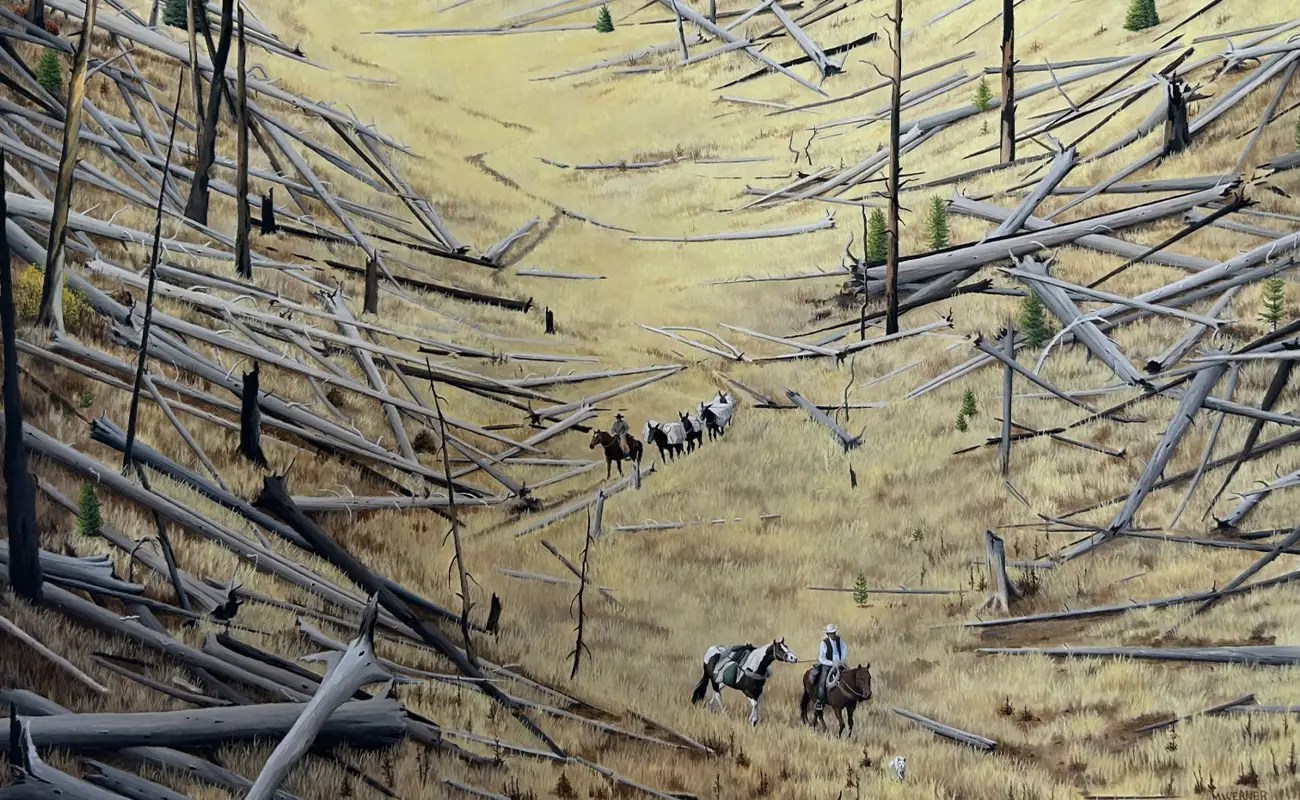
Max Werner’s landscapes occupy a productive space between descriptive realism and psychological reconstruction, a position that gives familiar terrain an unexpectedly unstable character. Trained in Fine Art at the Slade School of Fine Art and formed through years of etching before turning increasingly toward acrylic on canvas, Werner brings to landscape painting an unusual combination of graphic discipline and expansive spatial thinking. Mountains, burned forests, plains, animals, riders, fences, water, and weather remain immediately legible, yet they rarely function as straightforward records of place. The eye is instead drawn into carefully staged relationships between vast environmental fields and relatively minor incidents. In Through the Burned Forest, dead trunks stand and fall across the terrain while mounted figures move through the aftermath, their presence physically small but narratively decisive. The landscape becomes less a backdrop than an active condition through which movement must be negotiated. Such compositions position Werner within contemporary representational painting while distancing his practice from simple topographical description. His subject is not scenery alone, but the emotional structure created when memory, atmosphere, and human or animal presence intersect within immense space.
The distinction between recording and constructing becomes especially visible in Werner’s handling of scale. His environments often extend well beyond the psychological reach of the figures that inhabit them. Riders, cattle, wildlife, distant trees, and isolated architectural details appear almost incidental at first glance, yet their very smallness amplifies their importance. A figure crossing a devastated forest or an animal moving beneath a massive weather system becomes the event against which the entire landscape is measured. The compositional method recalls the historical language of landscape painting, in which human presence can establish scale, but Werner frequently makes that convention narratively ambiguous. The figures do not merely explain how large a mountain or plain might be. They imply passage, labor, pursuit, interruption, or an event whose beginning and ending remain unseen. Following the Oregon Trail is particularly suggestive within this framework because its title invokes historical movement without requiring the painting to become historical illustration. Instead, the idea of passage becomes folded into Werner’s broader interest in roads, tracks, distances, and the persistence of human movement across landscapes that appear indifferent to individual presence.
Werner’s reliance on recollection rather than literal transcription is central to the atmospheric coherence of paintings such as Yellowstone Lake and Late Summer Rain. His practice begins with observation, sketches, photographs, and notes, yet the studio becomes the place where those materials are reorganized according to emotional and compositional necessity. This approach allows an observed location to retain credibility while acquiring the slight estrangement that Werner associates with imagination. Weather is especially important to this transformation. Clouds do not merely describe meteorological conditions; they alter the proportions and psychological pressure of the image. In several landscapes, sky occupies far more pictorial space than land, turning atmosphere into a dominant visual presence. Elsewhere, mist reduces distant mountains to near-monochromatic silhouettes, while rain, snow, or shifting light compresses depth into veils of tone. Late Summer Rain therefore belongs to a wider structure within the practice in which weather acts almost as a narrative agent. It changes visibility, alters scale, and transforms ordinary terrain into a space of expectancy. What remains identifiable is never entirely settled.

Max Werner: The Graphic Intelligence of the Painted Surface
Werner’s long engagement with etching continues to shape the painted surface even where printmaking itself is absent. Fifteen years of sustained work in etching established habits of line, tonal separation, spatial economy, and controlled accumulation that remain visible in the acrylic paintings. Burned trunks crossing a hillside become linear vectors; fences divide fields into measured bands; roads and trails operate as directional devices; distant animals punctuate broad expanses much as small marks activate open paper. This graphic inheritance is particularly evident in landscapes of fire-damaged forest, where blackened verticals and pale fallen trunks create a network of intersecting lines against quieter fields of grass. The result is not simply descriptive detail. Werner organizes disorder so that the devastation of the forest becomes a compositional structure. The tension between fallen diagonals and standing verticals creates visual rhythm without softening the subject’s sense of rupture. That same ability to give modest motifs structural importance informs works such as Two Horses and a Goat and Cattle on a Ridge, where animals can become compositional anchors within much larger stretches of terrain.
Acrylic serves Werner’s mature practice particularly well because it enables broad spatial fields and precise definition to coexist. The paintings can move from carefully observed grasses, trunks, livestock, and riders into areas of remarkable visual restraint. Rather than treating every part of the landscape with equal intensity, Werner establishes hierarchies of attention. Foreground objects may possess crisp silhouettes and stronger tonal contrasts, while mountains dissolve through atmospheric perspective or clouds merge into broad, closely related greys. In one alpine scene, a procession of animals crosses a low band of stony terrain beneath a sky whose enormous scale nearly overwhelms the land. The animals remain legible, but the atmospheric mass above them becomes the painting’s principal force. Such restraint allows Werner to avoid the crowded descriptive excess that can burden highly representational landscape painting. Paintings including Deer Creek Pass and Over the Pass belong to a mature vocabulary in which recognition is immediate but pictorial attention remains carefully rationed. The achievement lies less in the multiplication of details than in determining which details deserve to control the viewer’s experience of distance.
The development from print studio to architectural and painted scale also gives Werner’s career an internal continuity that is more significant than a simple change of medium might suggest. His participation in the Entre Campos station project for the Lisbon Metro transferred techniques associated with etching into limestone panels and a permanent civic environment. Working with Bartolomeu Cid dos Santos and John Aiken, Werner encountered an image-making context in which line, surface, historical reference, and architectural scale were inseparable. That experience anticipates the later expansion of his pictorial language into large acrylic landscapes. Even when the subject shifts from engraved public panels to open terrain, the work remains governed by strong structural decisions. Werner’s commission for the Household Cavalry, commemorating the Presentation of Standards and Guidons Parade in Whitehall, further demonstrates his ability to translate observed ceremony into organized pictorial narrative. These episodes broaden an understanding of his practice beyond regional landscape painting. They reveal an artist whose mature representations of Wyoming are supported by decades of technical thinking about how marks, figures, intervals, and surfaces can carry meaning across radically different scales.

Narrative, Weather, and the Unresolved West
Narrative enters Werner’s landscapes through restraint rather than theatricality. His paintings rarely explain events fully, and the absence of explanation becomes one of their most effective devices. Riders appear in motion through burned terrain, pack animals traverse difficult ground, cattle cross paths, and migratory birds arc across a broad sky. These elements establish action without delivering a complete story. The visual experience therefore depends on inference. Something may have happened just beyond the edge of the image, or the figures may be moving toward a destination that remains invisible. Werner’s titles occasionally intensify that ambiguity. Heavy Traffic in Wyoming introduces a note of humor by applying the language of congestion to a region culturally associated with expansiveness and sparse population. Such wit connects directly with Werner’s acknowledged admiration for René Magritte, not because the paintings imitate Surrealist imagery, but because ordinary reality is shifted slightly out of equilibrium. Werner’s most persuasive narratives depend upon that modest displacement. An otherwise convincing landscape becomes strange because of scale, juxtaposition, viewpoint, or a title that encourages the viewer to reconsider what initially seemed self-evident.
This understated strangeness is equally strong in paintings where human activity is absent or reduced to traces. A wide prairie beneath a luminous blue sky can appear almost emptied of incident until the long trajectory of birds turns the upper portion of the composition into a moving diagram. The curving formation animates an enormous area of open blue, while cattle dispersed near the horizon remain tiny and nearly static. The contrast produces two distinct temporalities, one aerial and migratory, the other grounded and agricultural. Another landscape reduces the visible world to beach, sea, heavy cloud, and a sparse sequence of upright remnants crossing the sand. The dominant storm front presses downward while the small vertical forms create a fragile human or constructed measure against environmental immensity. Such paintings demonstrate Werner’s ability to make emptiness active. Open space is not pictorial vacancy. It generates duration, silence, and anticipation. By reducing incidents rather than multiplying them, Werner allows the viewer’s attention to move slowly across distance, making looking itself part of the narrative structure.
Animals occupy a particularly important position within this system because they function simultaneously as observed subjects, measures of scale, and carriers of movement. Cattle, horses, wildlife, and birds rarely dominate through sheer size. Their importance emerges through placement and relation. A line of animals beneath a mountain can turn the horizontal base of a composition into a procession; cattle moving between mounted riders can activate an otherwise quiet agricultural plain; pack animals passing through fallen timber suggest both vulnerability and persistence. Cattle on a Ridge and Two Horses and a Goat indicate how often Werner’s titles direct attention toward seemingly modest encounters, while the surrounding terrain expands those encounters into larger meditations on coexistence and distance. His years in Argentina, where cattle culture, gaucho life, working horses, and rural activity became major subjects, clearly established a vocabulary that later found a different environmental setting in Wyoming. The continuity matters. Werner’s American West does not appear as an abruptly adopted iconography, but as an extension of long-standing attention to rural labor, animal presence, open terrain, and the narratives produced when movement is framed by space.

Max Werner: Positioning Observation Between Tradition and Invention
Werner’s paintings inevitably enter into dialogue with the long history of Western landscape imagery, yet their most interesting quality lies in how they resist the heroic certainty traditionally associated with monumental landscape. Mountains are imposing, plains are expansive, and skies can approach the sublime in scale, but Werner rarely converts nature into uncomplicated spectacle. Burned forests, rough weather, muddy passages, dead timber, empty roads, and transitional light introduce instability into the apparent grandeur. The Western landscape becomes a place of movement, environmental change, work, memory, and occasional absurdity rather than a pristine emblem. This distinguishes Werner from purely nostalgic forms of contemporary Western realism. His pictures remain accessible to audiences accustomed to representational painting, yet their strongest moments depend on withheld information and spatial disquiet. The Secret Door makes this relationship between credibility and invention explicit. A real landscape can become a stage for an imagined proposition, demonstrating that Werner’s realism is ultimately conditional. Reality supplies the visual grammar, but imagination alters the syntax. Magritte’s influence is therefore conceptual rather than stylistic, encouraging a believable world whose meaning can shift through a single unexpected adjustment.
That balance also explains Werner’s ability to move between institutional, public, and market contexts without abandoning the central logic of his practice. The exhibition Imágenes argentinas y aguafuertes at the Centro Cultural Recoleta documented an important period in which Argentine landscape and printmaking converged, while the Entre Campos Metro project placed his graphic abilities within permanent public architecture. Later recognition in Wyoming, including the strong reception of Deer Creek Pass at the Buffalo Bill Art Show & Sale and the Judges Award of Excellence for Over the Pass, indicates how convincingly his work has entered the culture of contemporary Western art. Such acceptance is understandable, since Werner shares the genre’s investment in land, wildlife, ranching culture, weather, and regional identity. Yet the paintings retain enough compositional restraint and conceptual ambiguity to support broader readings. They can operate within a Western art context while also engaging questions familiar to contemporary landscape discourse: how memory reconstructs place, how human figures occupy environmental scale, how images convert observation into narrative, and how apparently natural scenes are shaped by selection and invention.
The principal strength of Werner’s mature practice lies in this sustained tension between precision and openness. His technical control can produce a compelling sense of observed reality, but the paintings become most distinctive when that control does not close interpretation. The strongest compositions leave substantial visual or narrative space around their subjects, allowing a rider, road, weather front, animal, or standing tree to resonate beyond descriptive function. The potential challenge of such accomplished representation is that clarity can occasionally tempt a landscape toward illustration, particularly when narrative elements become too readily legible. Werner’s broader body of work repeatedly avoids that limitation by using scale, emptiness, atmosphere, humor, and unconventional placement to complicate recognition. Titles including Yellowstone Lake, Late Summer Rain, Following the Oregon Trail, Heavy Traffic in Wyoming, and The Secret Door demonstrate how varied his narrative register can be, from geographic specificity to meteorological observation and conceptual play. Across Britain, Argentina, and the American West, Werner has developed an image-making language in which the landscape remains convincing enough to enter, yet unresolved enough to continue operating in memory after the scene itself has been left behind.