A Studio of Motion and Discovery
Jean-Baptiste Besançon was born in Bordeaux in 1985 and continues to live and work in the city that shaped his early connection to visual creation. Introduced to art while still young, he later pursued studies in design, yet his development as a painter remained largely self-directed. That independence became central to his identity, allowing him to build a practice driven less by doctrine than by experience, repetition, and risk. Over many years, he has committed himself to abstract painting as an open-ended search rather than a fixed destination. His output reflects sustained discipline and constant renewal, with each canvas approached as a fresh problem to solve rather than a variation of a formula. This commitment to continuous inquiry places him within a lineage of painters who trust action as a route to understanding. Instead of beginning with rigid plans, he begins with movement, material, and sensation, allowing images to arise through process and reflection.
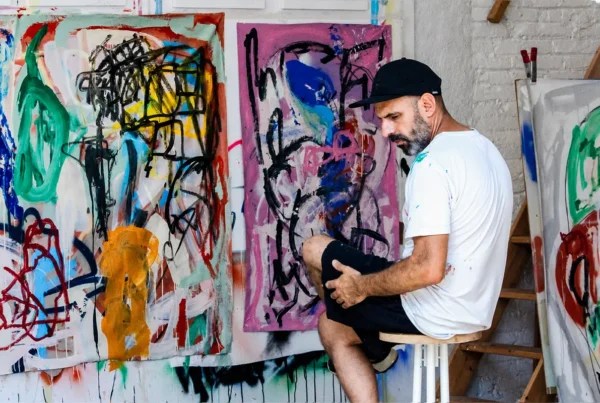
The rhythm of Besançon’s studio practice reveals much about his paintings. He often works on several canvases at once, placing them horizontally and slightly elevated from the floor so he can move freely among them. This arrangement encourages physical engagement and rapid shifts of attention. One surface may call for a certain colour, another for a decisive stroke, and another for patience. He paints with brushes, sponges, and spatulas, applying acrylic in dense layers that sink deeply into untreated cotton or linen. He then scrapes, smooths, brushes, or thins the surface, exposing hidden passages and creating new tensions. Traces left by tools are not removed, because they remain evidence of the painting’s history. Every mark records a decision, hesitation, or surprise. What emerges is not a polished mask but a visible sequence of encounters between hand, pigment, and support, each stage preserved within the final image.
This approach explains why Besançon often speaks of making as a necessity before understanding arrives. He has described the need to explore every possibility, even when he does not yet know what he seeks. Action becomes the trigger for clarity. That outlook closely echoes Pierre Soulages, an artist he admires, who famously stated that making teaches the artist what to look for. Besançon’s work demonstrates this principle in practical terms. He does not paint to illustrate a prior idea, but to discover one through contact with the canvas. Sometimes the process feels confrontational, sometimes conversational, and sometimes unexpectedly luminous from the first gesture. Yet even in moments of immediacy, careful thought follows. He reflects continuously on what appears before him, testing whether a painting has found its own balance. Through that combination of impulse and scrutiny, his abstract language remains alive, searching, and responsive.

Jean-Baptiste Besançon: The Language Beyond Words
Besançon has repeatedly suggested that painting functions as language for him, a statement that helps explain both the power and restraint of his work. He has said he is less comfortable with words and more capable of thinking through paint itself. This preference is visible in his decision to avoid descriptive titles. Rather than assigning narrative names that direct interpretation, many of his works remain untitled or are identified only by the dimensions of the canvas. Such choices refuse to place verbal explanation above visual experience. The viewer is invited to meet the painting directly, without predetermined storylines or symbolic instructions. In front of these surfaces, meaning arises through colour, rhythm, density, and pause. Sensation comes first, followed by thought. By removing language from the frame, Besançon creates a space where viewers may encounter something more immediate, where personal memory and emotional response can emerge without external pressure.
The compositions themselves encourage this active looking. Some works contain an area that acts almost like an entrance, a zone where the eye settles before moving across the rest of the surface. Others are energized by sweeping diagonals that introduce force, direction, and instability. Elsewhere, forms appear spontaneously, hovering between recognition and abstraction. None of these devices are decorative. They organize movement, attention, and mood. A viewer may feel drawn inward by chromatic depth, then redirected by a sharp passage of contrast, then slowed by open ground where the weave of fabric remains visible. Besançon understands that seeing unfolds in time. His paintings are not consumed in a glance but discovered gradually. Because no single reading is imposed, each person may navigate them differently. One observer may sense calm, another turbulence, another introspection. The work remains generous enough to hold these varied encounters without collapsing into certainty.
This refusal of fixed explanation also reflects Besançon’s belief that painting should be understood on its own terms. He does not frame his canvases as direct responses to private biography or isolated life events. Instead, he allows the work to exist as an independent field of relations, where form and feeling interact without literal confession. Yet he also acknowledges that part of himself is present within every painting. That presence is not delivered through anecdote, but through decisions of pressure, timing, colour, and endurance. He has expressed the hope that viewers will be guided by shape, dynamism, and hue, then discover a part of themselves there as well. This aspiration transforms the gallery encounter into exchange rather than display. The painting carries traces of the maker, but it is completed through the attention of others. In that sense, Besançon’s silence is not absence. It is an invitation to deeper participation.

Materials, Water, and the Drama of Surface
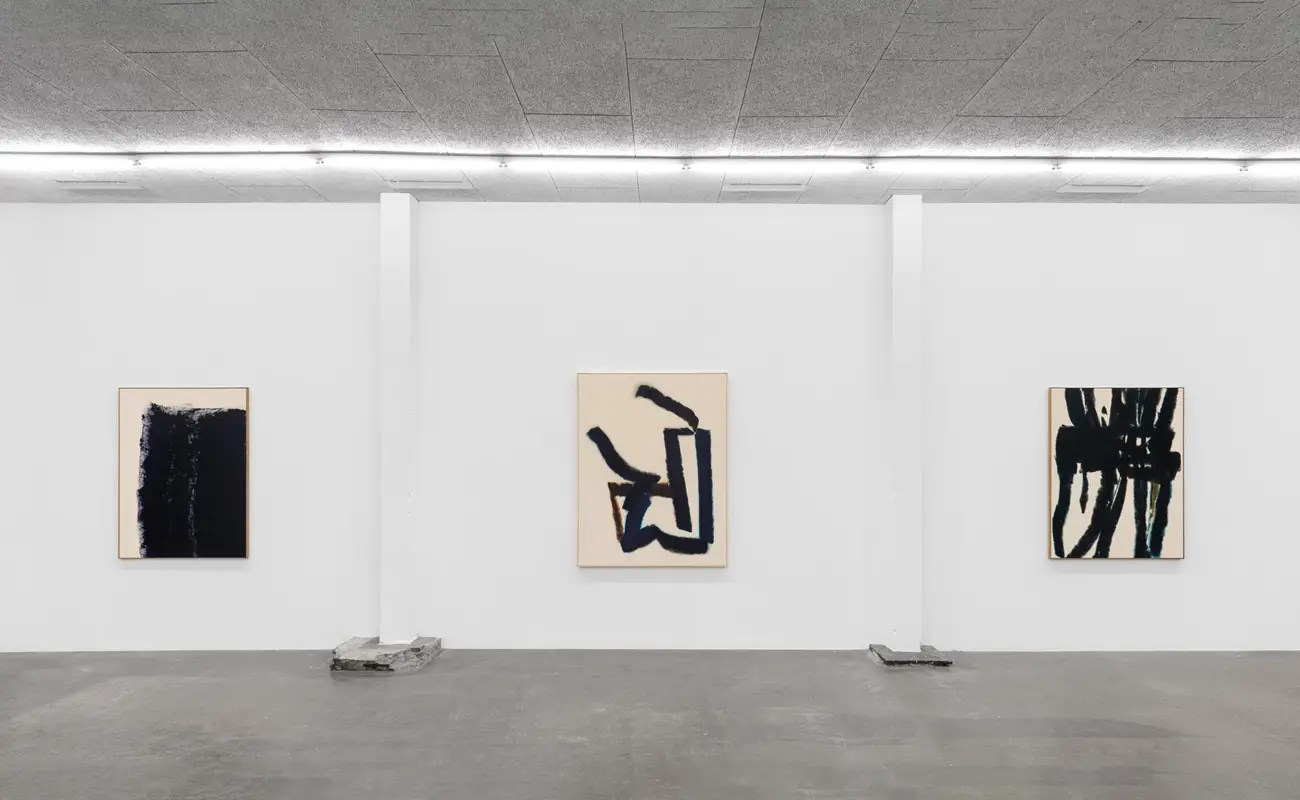
A defining strength of Besançon’s practice lies in the way he treats materials as collaborators rather than obedient instruments. He often chooses unprimed cotton or linen, allowing the raw support to remain active within the image. The ecru tone of fabric and the visible weave of threads are not hidden beneath opaque coatings but integrated into the final composition. Acrylic paint is applied heavily, then pushed, spread, diluted, or removed so that absorption and resistance become part of the result. Water plays a central role in this cycle. Like a painter using washes, he soaks sections of the canvas to trigger chromatic shifts, soften boundaries, and release unexpected transitions. Pigment may bloom, recede, stain, or gather in edges. These reactions introduce elements no sketch could predict. Instead of treating chance as a threat, Besançon welcomes it as a productive force that broadens what the hand alone might achieve.
His palette further strengthens the emotional charge of the work. Blacks, Payne grey, Prussian blue, selected greens, English reds, sienna, and ochre recur within his paintings, creating atmospheres that can feel dense, luminous, or meditative. Dark tones are especially significant, linking him to the example of Soulages while never reducing his work to imitation. In Besançon’s hands, black is not merely absence or severity. It can absorb light, sharpen neighbouring colours, or establish profound depth. Blue may cool the surface or generate distance. Earth tones can steady more volatile passages. Because colours are mixed directly on the canvas through successive additions, they retain complexity and variation. No area feels mechanically filled. Even broad fields contain shifts in transparency, pressure, and undertone. This gives the paintings a breathing quality, where the surface seems to change according to angle, duration of looking, and surrounding light.
Besançon also investigates print-based methods related to monotype or engraving, extending his interest in transfer, pressure, and unpredictability. Such experiments reveal that his concerns are broader than any single medium. He studies what happens when matter is moved, pressed, or partially withheld, and then carries those lessons back into painting. Across all techniques, the same balance appears: precision of gesture joined with uncertainty in outcome. A scrape may reveal more than intended. A diluted passage may create the exact softness the composition needed. A transferred mark may introduce structure where none was planned. These moments are valuable because they cannot be fully scripted. Besançon builds from them, editing and responding until the work reaches internal coherence. What viewers encounter, therefore, is not randomness but negotiated order, where accident has been recognized, shaped, and given lasting form through attentive judgment.

Jean-Baptiste Besançon: Presence Across Europe and the Digital Age
Although rooted in Bordeaux, Besançon’s work has reached audiences well beyond his home city through exhibitions and a strong online following. His paintings have appeared in solo and group presentations across Europe, demonstrating sustained interest in his evolving abstract language. Earlier exhibitions include The Blue Hour in Bath in 2019, a notable presentation that introduced many viewers to the contemplative force of his canvases. He has also shown at the Institut Culturel Bernard Magrez in Bordeaux, Nationale 8 Gallery in Dilbeek, and Geukens & De Vil in Knokke. These venues reflect a growing recognition that his work speaks across regional contexts. Whether encountered in France, Belgium, or the United Kingdom, the paintings communicate through sensation rather than translation. Their lack of narrative dependence allows them to travel easily, while their material richness rewards direct physical viewing. Each exhibition extends the conversation his studio practice begins.
Digital platforms have also played an important role in widening his audience. Besançon has built a substantial following on Instagram, where viewers can witness fragments of process, surfaces in progress, and the physical atmosphere of the studio. For an artist whose work depends so strongly on gesture and transformation, this visibility matters. Audiences who may never have visited a gallery can still observe the evolution of a canvas from wet density to resolved image. Yet the online presence does more than promote finished objects. It offers insight into labour, repetition, and uncertainty, reminding viewers that abstraction is not accidental decoration but earned structure. In an era when many encounter art first through screens, Besançon uses the medium effectively without allowing it to flatten the work. The posts suggest process, while the paintings themselves continue to demand in-person scale, texture, and time.
What ultimately distinguishes Besançon is the way he combines technical control with openness to surprise. He studied design, which likely sharpened his sensitivity to proportion, balance, and visual clarity, yet he chose painting because it offered a freer and more direct mode of expression. That decision continues to shape his career. His canvases carry discipline without stiffness, spontaneity without chaos, and introspection without sentimentality. They stand within modern abstract traditions informed by figures such as Jackson Pollock and Pierre Soulages, while retaining a voice that is unmistakably his own. Each work remains an individual experiment rather than part of a formulaic series. Through this insistence on renewal, Besançon continues to expand the possibilities of contemporary abstraction. His paintings do not ask viewers to decode messages. They ask them to look longer, feel more carefully, and trust what emerges in silence.