“As necessary and critical as influences are for artists to love, the artist’s struggle is to wrestle with them and quiet them enough to hear their own voices and engage their own talents.”
Where Representation Starts to Break
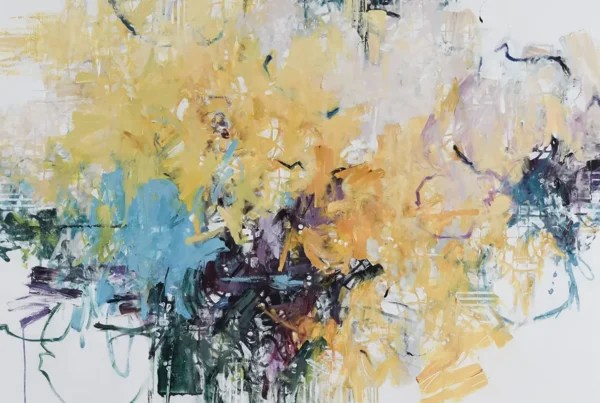
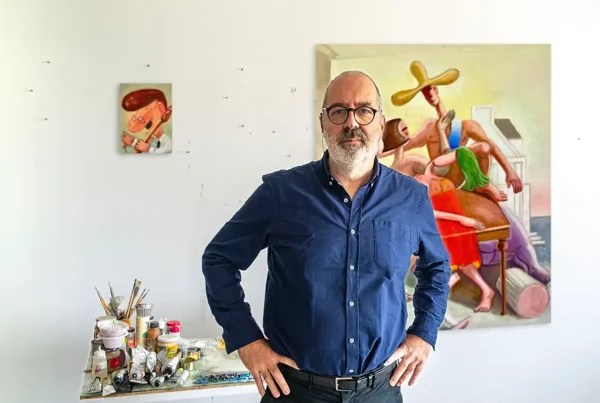
Marvin Perry Mann’s paintings occupy an unsettled territory where landscape, abstraction, memory, and myth repeatedly collide. His current oil works draw on the emotional force of mid-century Abstract Expressionism while retaining a connection to the numinous qualities of the natural world. Horizons, turbulent seas, strange skies, buried figures, and sudden eruptions of color allow recognizable forms to emerge before slipping away again. This tension is the result of a long artistic history rather than a sudden stylistic decision. Mann has made pictures throughout his life, moving through comics, graphic novels, furniture design, traditional figure painting, landscape, Tonalism, and abstraction while learning that his creative temperament requires both momentum and challenge.
For much of his adult life, comics and graphic novels were his principal artistic outlet. Managing twenty issues of Dark Sister magazine demanded far more than drawing. Mann wrote, acquired basic digital coloring and lettering skills, coordinated other contributors, and finished work that other artists declined to complete. The prolonged production cycle taught him patience, organization, and persistence, qualities that might seem at odds with the speed and physical immediacy of his later painting. Yet those disciplines became essential when oil painting eventually shifted from an interest into his full-time career.
Mann had experimented with oils in his early teens, but superheroes and barbarians commanded more of his attention. Roughly a decade ago, the idea that painting could wait until he was older became less convincing. He returned to oils with considerable experience in making images but little practical knowledge of the medium itself. After several difficult years, books by Juliette Aristides on classical painting and drawing provided direction. A workshop with Aristides followed, then sustained study primarily with Bay Area painter and teacher Noah Buchanan. Years of comic drawing gave Mann an advantage in quickly blocking accurate figures, allowing him to move efficiently from drawing into paint.

Marvin Perry Mann
Lapis Veritatis
Oil painting
2026
Marvin Perry Mann: Finding Abstraction Beyond the Figure
Academic figure painting strengthened Mann’s technique, but it could not answer every question he had about what painting might become. The pandemic added a practical obstacle by making access to live models extremely difficult. Landscape offered an alternative, although conventional plein air painting never felt entirely natural to him. Instead, the landscapes emerging from his imagination grew progressively less literal. His work moved from a loose realism through Impressionism and Tonalism, while skies and clouds acquired increasingly peculiar marks. Forms resembling angels or aliens seemed to converse overhead. Abstraction had entered the paintings almost without invitation.
That development connected with interests that had existed alongside Mann’s classical training all along. Abstraction, Surrealism, and Expressionism appealed to him, while a lifelong engagement with comics, science fiction, fantasy, and mythology supplied another vocabulary of symbols and ideas. Joan Mitchell became an important point of reference, and Cy Twombly made a particularly strong impression. Mann nevertheless resisted imitation. Just as reproducing the manner of Frank Frazetta or Jeffery Catherine Jones would not produce an authentic voice, adopting the recognizable gestures of Mitchell or Twombly offered no solution. He was also wary of making non-representational Abstract Expressionism that could become too easy or glib in his own hands.
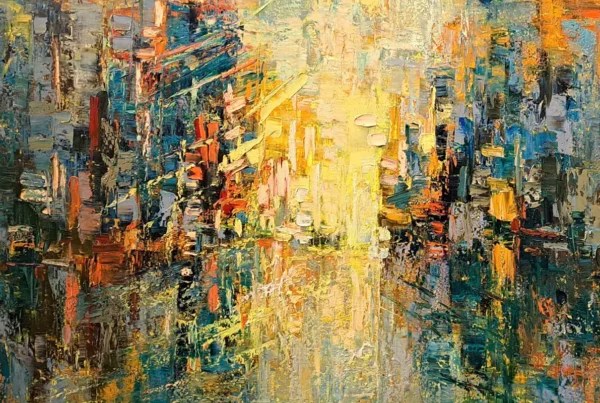
The greater problem was personal: after decades devoted to drawing bodies, Mann realized that the human figure had vanished from his paintings. Finding a route back became an ongoing concern. Landscape eventually supplied a structure capable of holding competing impulses together. The horizon line, already important during his Tonalist period, became an organizing device for paintings suspended between abstract landscape and expressive abstraction. Mann still moves between those positions rather than declaring either one definitive. In his 2026 stormy seascapes, even that dependable boundary has begun to disappear, with obscured horizons creating a new point of tension between recognizable space and painterly turbulence.

Thrush
Oil painting
2026
Color, Mystery, and the Weight of Influence
Two American painting traditions provide major foundations for Mann’s current work: Tonalism and Abstract Expressionism. From Tonalism comes a preference for contemplative atmosphere, muted greys, somber earth colors, and an underlying sense of spiritual mystery. Abstract Expressionism supplies a contrasting physical and emotional charge. Against quieter foundations, orange can arrive as a shout, red dots can hover in open space, white can move like a river, and violet and deep blue can turn shadows into active presences. Rather than treating these histories as separate stylistic references, Mann uses their differences to create friction within a single painting.
His visual education extends far beyond those two traditions. James Allen St John’s black-and-white Tarzan illustrations and the muted palette of Jeffery Catherine Jones offered different routes into imagined worlds of longing and mystery. John Singer Sargent demonstrated how loose final touches could electrify highly controlled portraiture, while Argentine comics artist José Muñoz showed how raw Expressionism could enter graphic storytelling. Mann values the physical encounter with Mark Rothko’s paintings in museums, an experience he considers fundamentally different from seeing reproductions in books. He admires Frazetta’s ink drawings, Picasso’s Neoclassical and Surrealist work of the 1920s, and Rodin, even while regarding Michelangelo as the greatest sculptor.
For Mann, however, influence creates a problem as productive as it is necessary. Artists absorb images continuously, and admired voices can easily become louder than their own. His task is not to deny those sources but to contend with them until something individual becomes audible. That pursuit also explains his resistance to straightforward imitation and his persistent movement between approaches. Mystery remains central to the process. The natural world can provide a recognizable structure, mythology can suggest an emotional or symbolic charge, and abstraction can destabilize both. Mann’s paintings operate most actively when none of these elements completely controls the image.

Vernalis
Oil painting
2026
Marvin Perry Mann: A Figure Beneath the Sea
Tiamat marked a significant shift in Mann’s recent work and became the starting point for a new series. His search for a way to restore the figure without abandoning what he had discovered through landscape and abstraction led him to begin the painting with a female form. Its title refers to Tiamat, the female Mesopotamian deity associated with the primordial seas. The original woman is now buried beneath an ocean of paint, yet her concealed presence remains structurally important. Decisions about covering the body became part of the painting itself, allowing the figure to survive not as a conventional subject but as an unseen foundation.
The process has also changed how Mann constructs space. Where many earlier landscapes began with a horizon, Tiamat uses the human form as its initial grounding device. From top to bottom, a narrow strip of sky and a crashing wave retain semi-representational qualities in viridian and white. Below them, muted violet and umber establish depth for freer, more expressive slashes of paint. Mann works primarily in oil and sometimes combines oil with cold wax. Palette knives and blue shop towels are active tools in his process, while the many brushes kept nearby are used less frequently. The resulting surface reflects his preference for bold, rapid action without eliminating the periods of judgment that follow.
That rhythm carries into his working life. Mann generally paints in concentrated bursts of about an hour, then stops to consider what the work requires next. Painting may not happen every day, but art-related activity does. During 2026 he has participated in ten exhibitions with two more planned, worked within a cooperative gallery, organized exhibitions at another local venue, and joined a community arts organization’s curatorial committee for a restaurant exhibition space. His major upcoming project is Let the World Be: Fiat Mundi, Confusa Ruina, and Nidus Ad Terram Cecidit, developed with gallerist Andrew Ritcheson. Mann created twenty-two new works and selected fourteen for the three-part solo exhibition at Colloquia Gallery in Woodstock, Virginia, running November 21 through December 20. Ritcheson characterizes its movement as “ruin to radiance.” Lapis Veritatis and Thrush are both included in the exhibition, with Lapis Veritatis forming part of the grouping titled Confusa Ruina and Thrush belonging to a group of six small paintings titled Nidus Ad Terram Cecidit. Empress of the Burnished Grove is also among the included works. Four exhibitions are already scheduled for early 2027, including an important May exhibition at C-lective Fine Arts, LLC’s Studio 124, a key part of Mann’s support ecosystem, extending a practice that continues to test how much can disappear before an image finds another way to hold together.