“Sometimes its ambiguity is the photograph.”
A Language Hidden in Plain Sight
London-based photographic artist Catalin N. develops and presents his work through Cispontine Studio, the platform closely associated with his long-running photographic practice. For more than twenty years, he has focused on events that barely announce themselves, working exclusively in black and white to isolate fleeting details within public space. His principal project, Silent Hand Language, centers on spontaneous hand gestures encountered in streets, crowds, transport spaces and other shared environments. A hand raised against glass, an arm extending through a crowd or fingers momentarily separated from the person to whom they belong can become, within his frame, something closer to a sign.
Photography became Catalin’s way of extracting such details from the continuous movement of everyday life. Rather than constructing scenes or directing people, he walks, watches and waits for relationships that cannot be planned. London has consequently become both setting and major influence. Its crowds continually produce temporary encounters between strangers, bodies, architecture, reflections and surfaces, often lasting only a fraction of a second. The camera allows him to preserve one of these configurations while leaving its circumstances unresolved. What matters is not simply the presence of a hand, but the moment when its gesture changes the structure and emotional charge of the photograph.
That distinction is central to Silent Hand Language. Catalin is not creating a catalogue of hands or attempting to translate gestures into fixed definitions. He is interested in the point at which a movement becomes detached from a stable identity and begins to operate independently within the image. The conversation, intention or emotion behind it may remain inaccessible, and he does not try to reconstruct what the photograph cannot confirm. Ambiguity is part of the work. Viewers recognize that something is being communicated, yet the image leaves space for uncertainty, turning an ordinary fragment of public life into a sustained study of how much the body can express without words.

Catalin N.: Waiting for the Unrepeatable
Catalin describes his daily method with striking economy: he walks, observes and waits. That apparent simplicity conceals the concentration required by a practice dependent on events that cannot be requested or repeated. He looks for the instant when a gesture alters the photograph through its relationship with another body, a reflection, architecture or an element he cannot fully explain. His approach therefore depends on receptiveness rather than control. The city supplies an unstable field of possibilities, while the photographer must recognize the visual event quickly enough to preserve it before the bodies and relationships inside the frame change.
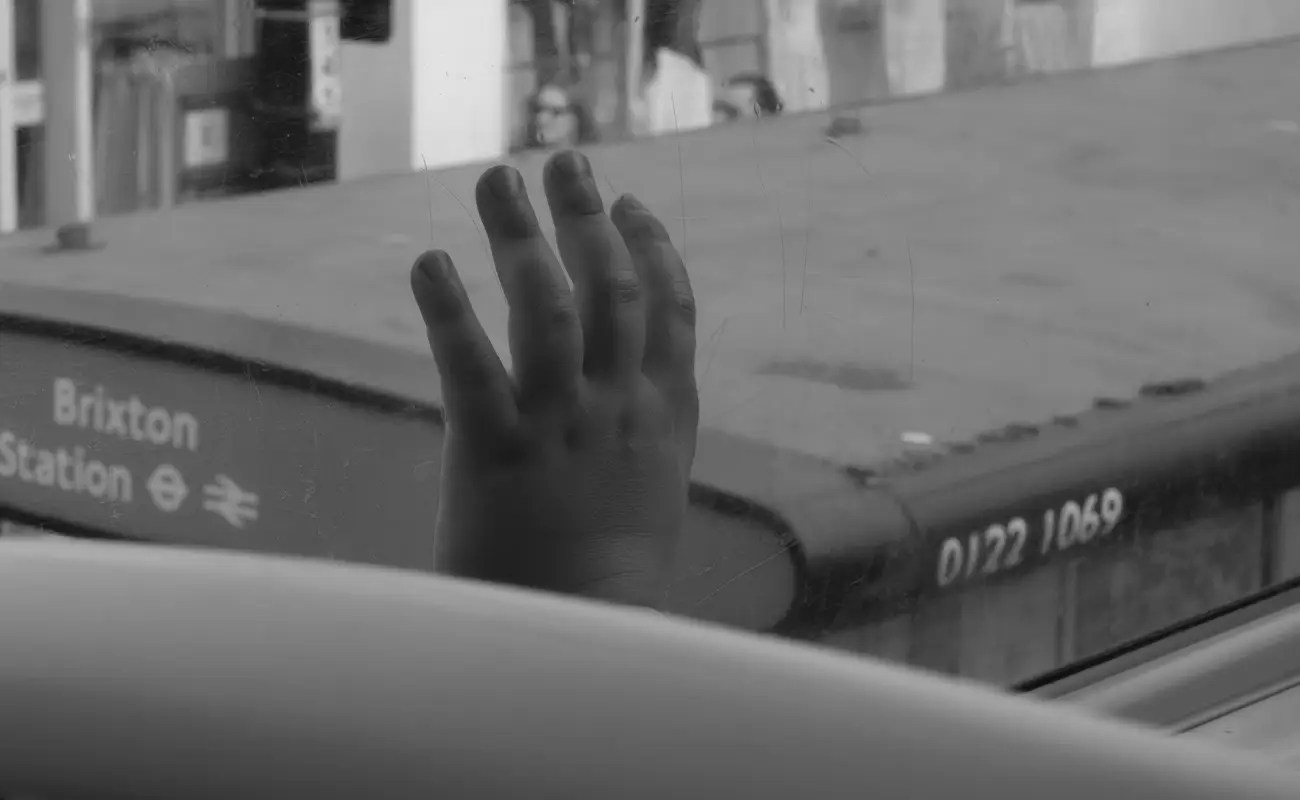
Specific photographs show how this attention operates across different urban situations. In W1-7321, a man crossing a crowded street extends an arm while bodies behind him move in other directions. W1-2201 catches another emphatic gesture within dense pedestrian activity, while W1-5530 shifts the observation indoors, recording a figure with both hands pressed toward the sides of the face. In SW9-0072, a hand rises against a window with Brixton Station visible beyond. None depends on an extraordinary event. Their force comes from the decision to isolate a gesture that could otherwise vanish into the larger visual noise of the scene.
Catalin considers the meaningful moment of Silent Hand Language to be present in each photograph rather than concentrated in one definitive work. The project is concerned with what exists now and is gone in the following second. This makes transience not simply a subject but a condition of the photographic process. Every frame fixes a physical action whose precise configuration has already disappeared by the time it becomes an image. Across more than two decades, those individual interruptions accumulate into a sustained study of bodily communication, yet each photograph retains the uncertainty of the instant from which it came.

London Reduced to Gesture, Light and Form
Black and white gives that study its visual continuity. Catalin has worked exclusively in monochrome for more than twenty years, removing color from scenes already dense with competing information. Tonal contrast directs attention toward shape, light and spatial relationships: a hand can emerge against clothing, glass, architecture, signage or the darker mass of a crowd. London remains recognizable as an active environment rather than becoming a neutral backdrop, but monochrome helps reorganize its complexity. Streets, interiors and transport infrastructure provide the conditions against which gestures become legible before their meanings can be settled.
This interest in overlooked information extends beyond the human hand. The continuity lies in Catalin’s way of seeing. Whether observing a physical mark or a passing movement, he concentrates on information that habitual looking tends to filter out. The black and white photograph interrupts that habit by giving a marginal detail enough visual presence to command attention.
Yet Silent Hand Language pushes this observational instinct toward the unstable territory of human communication. The photographs record real people and real places, but Catalin resists turning those facts into complete anecdotes. A raised palm could interrupt, greet, signal or simply belong to a movement whose purpose is impossible to recover from the frame. That uncertainty keeps the viewer active. Rather than supplying an answer, the photograph preserves evidence of an action and asks how much can genuinely be known from it. The city becomes readable through fragments, while the body communicates without surrendering all of its context.

Catalin N.: Building an Archive of Vanishing Time
The duration of Silent Hand Language has transformed a practice of momentary observation into an extensive archive. Photographs are identified with alphanumeric titles including W1-0478, W1-7321 and SW9-0072, while geographic coordinates record where each image was made. This system establishes a precise connection to place without pretending to explain what happened there. Location can be fixed; meaning remains more elusive. That contrast mirrors the project itself, which is documentary in its encounter with actual public life but intentionally open in what it asks viewers to conclude from the gestures it preserves.
The physical treatment of the photographs reinforces the importance Catalin places on singularity. Works released through Cispontine Studio are produced as archival pigment prints on Hahnemühle Photo Rag 308 gsm at 60 × 90 centimetres. Each is issued as a unique 1/1 work, signed and stamped on the reverse and accompanied by a certificate of authenticity. Once an image has been released in this form, there is no second edition of the same photograph. A separate selection is retained within the artist archive for exhibition and documentation, distinguishing the continuing historical body of the project from individual works entering collections.
After more than twenty years, Catalin does not regard Silent Hand Language as complete. He wants to bring its accumulated material into a more concentrated form through an exhibition and, eventually, a book. Both would change the experience of an archive built photograph by photograph across years of walking through London, allowing individual gestures to enter new relationships through sequence and proximity. The central discipline, however, remains unchanged: watching rather than directing, and recognizing the brief instant when an ordinary movement becomes visually autonomous. His photographs give permanence to these passing signs without forcing them into explanation, preserving precisely the uncertainty that first made them worth noticing.