Nature, Recalled Rather Than Reproduced
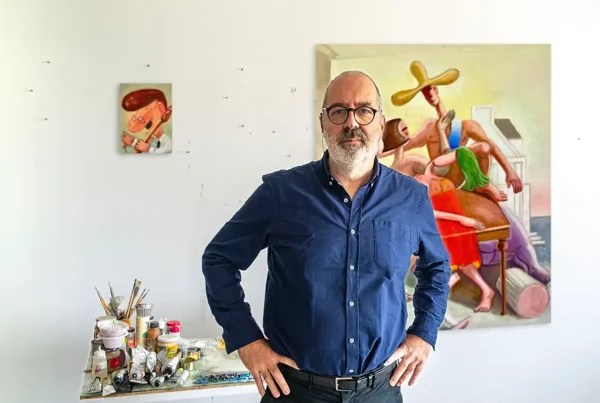
Carlos Ramirez builds large-scale abstract paintings from what remains after an encounter with nature has passed. Born in Cuba and raised in Miami, the painter draws on a lifelong relationship with the outdoors, translating remembered sensations into fields of color, ink, line, and gesture. Leaves, petals, branches, stones, and shifting light may briefly become recognizable, but they rarely settle into literal description. His paintings are concerned instead with the residue of experience: the colors that persist, the physical sensation of moving through a landscape, and the fragments the mind retains long after leaving a place.
Drawing has accompanied Ramirez throughout his life, although becoming a professional artist was far from a predetermined path. The only child in an immigrant family, he was encouraged to pursue a structured profession. In college, he focused on drawing and drafting with plans to study architecture, then applied to law school at his father’s urging. A full scholarship brought him to the University of Miami Law School, where he performed well academically. By his final year, however, Ramirez recognized that professional success in law would not resolve his deeper creative interests, and he left the program.
That decision redirected his abilities toward fashion. At twenty-three, Ramirez founded the label Liancarlo and began a long career as a designer while continuing to paint. The two practices gradually strengthened one another. Sketching garments, creating prints and embroideries, and making constant decisions about color sharpened instincts that would later become essential to his canvases. Both fashion collections and paintings begin with drawing, often with shapes borrowed from plants and other natural forms before being transformed into increasingly abstract structures.

Carlos Ramirez: From Structure to Freedom
Fashion gave Ramirez an intensive education in line, proportion, composition, and color, but it also operated within practical constraints. Clothing had to answer functional and commercial demands. Painting offered another kind of space, one where an idea could change direction without needing to satisfy those conditions. Rather than abandoning the discipline acquired through design, Ramirez carried it into his studio. His abstractions balance spontaneous gestures with an underlying architecture, creating surfaces that feel energetic without becoming arbitrary.
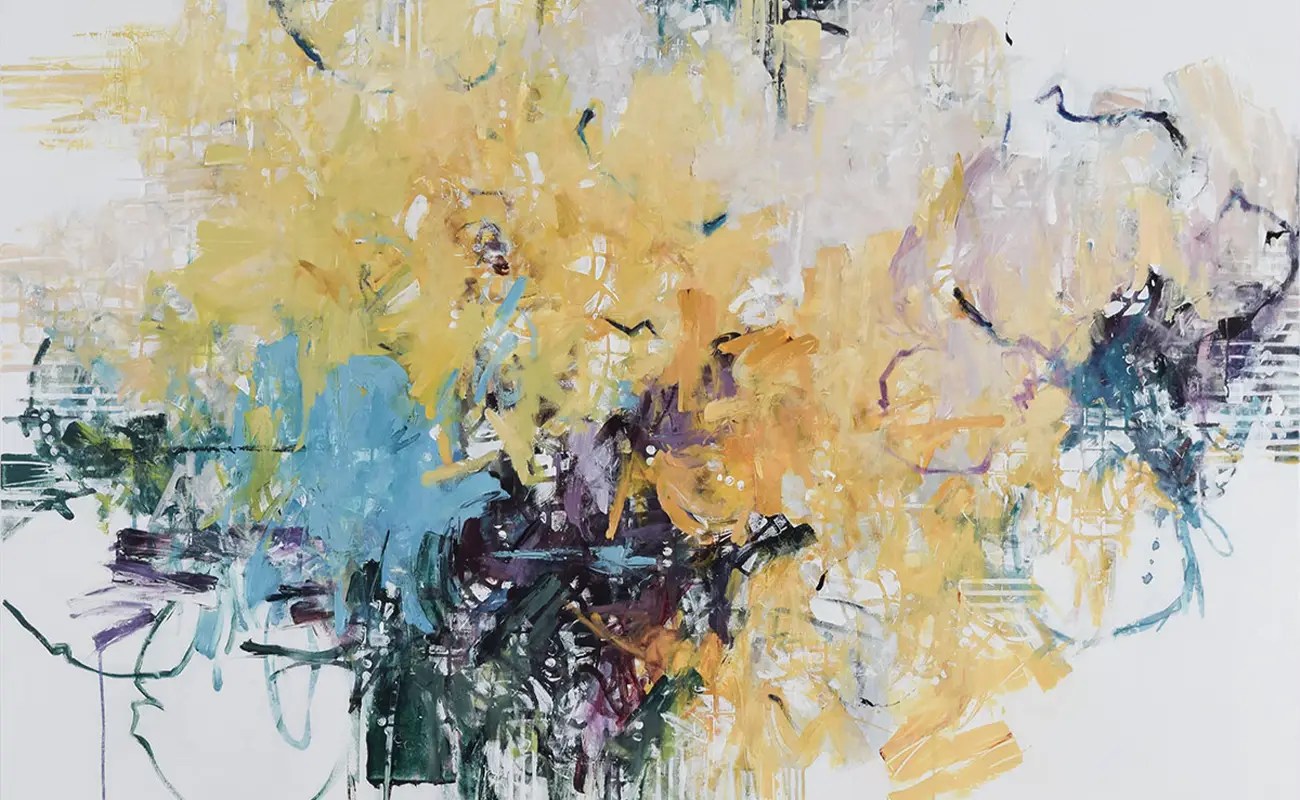
The drawing underneath each painting plays a crucial role in maintaining that balance. Ramirez often begins with bold black ink and organic shapes, establishing a rhythm before introducing color. Portions of these first marks may eventually disappear beneath paint, while others remain exposed or reappear between later passages. He repeatedly shifts between drawing and painting rather than treating one as preparation for the other. Transparent washes can meet thick impasto, dense accumulations can open suddenly into quieter areas, and visible lines can interrupt or connect fields of broken color.
This process has allowed Ramirez to move from the precision of a lifelong draftsman toward a more intuitive approach. He does not need to know a painting’s destination before beginning it. Several canvases may remain visible in his studio, although he concentrates on one at a time and periodically leaves the work alone before returning with greater distance. That separation is part of the process. It gives him an opportunity to reassess the relationships between marks, colors, and spaces without remaining attached to the decisions that produced them.

What the Body Remembers Outdoors
Nature supplies Ramirez with his central visual vocabulary, yet he resists treating landscape as something to copy. An avid hiker and outdoorsman, he collects impressions rather than descriptive information. The immense scale of a landscape, a sudden contrast between earth and sky, the sensation of being surrounded by vegetation, or light flickering across a surface can become more important than the identity of a particular site. Once filtered through memory, those experiences provide material for paintings that retain a connection to the natural world without illustrating it.
His tools can make that relationship unusually direct. Ramirez has used branches and broken twigs found on the ground to draw, preferring their irregular contact with the surface to the predictable precision of conventional instruments. Slot Canyons at Tent Rocks demonstrates how this physical approach can interact with memory. Ramirez created ink marks with a broken twig, allowing them to move through open areas of color and space. The method introduced irregularities that could not be completely controlled, giving the drawing a character tied to the material itself.
The painting’s connection to a particular landscape emerged only later. After stepping away from Slot Canyons at Tent Rocks, Ramirez recognized in its atmosphere his memory of walking through red stone canyons in New Mexico beneath an expansive blue sky. The experience had entered the painting before he consciously identified its source. This delayed recognition reveals an important aspect of his practice: a landscape does not have to be deliberately reconstructed to shape the work. Memory can surface indirectly through color, spacing, gesture, and the physical movement of a line.

Carlos Ramirez: Color After the Landscape
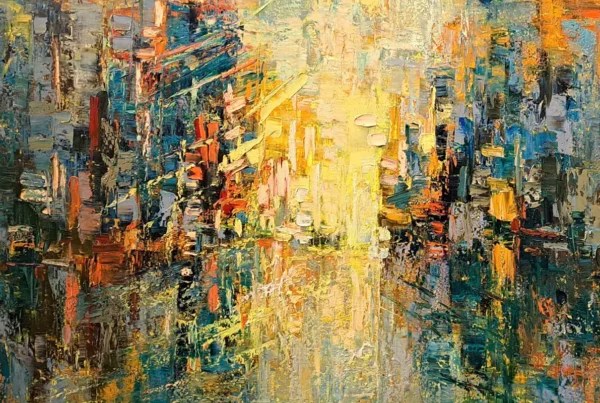
Color carries its own history in Ramirez’s paintings. He connects his sensitivity to it both to decades in fashion and to growing up in a tropical environment. Blues, yellows, pinks, purples, greens, and earthy browns can move across his canvases with considerable intensity, but color is never merely an ornamental addition. Observed hues are altered, restrained, redistributed, or amplified according to the developing composition. A palette associated with a hike, garden, or particular vegetation may survive, even as the forms connected to those original observations become abstract.
This tension between recognition and ambiguity gives viewers room to participate. A loose mark might suggest a petal, leaf, branch, or stone without requiring that interpretation. Familiar forms arrive as fragments inside compositions that remain fundamentally abstract. Ramirez connects this visual condition to the workings of memory itself. After time outdoors, specific details can fade while the broader sensation of scale, beauty, light, color, or happiness remains unexpectedly vivid. His paintings give those incomplete recollections a physical presence without forcing them back into precise images.
Ramirez continued painting throughout his fashion career, often working at night and expanding his practice through workshops. Painter Wolf Kahn was an important influence, encouraging him to move beyond rigid assumptions about artistic rules and to consider painting as an emotional experience capable of generating desire and attachment. In 2014, Ramirez was accepted into the Master Artists Series workshops for abstract painters led by Steven Aimone at the Atlantic Center for the Arts. His work has progressively moved away from representation toward ambitious abstraction, while drawing remains its structural foundation. Across thick and thin paint, exposed ink and buried marks, he brings together the eye of a designer, the discipline of a draftsman, and the memories of an outdoorsman, returning nature to the canvas not as a fixed view but as the sensation of having moved through it.