A Different Route into Painting
The American painter Lynn Alker came to art through an unexpected sequence of experiences rather than a conventional early career. Based in Raleigh, North Carolina, she began painting around the age of sixty, after years spent pursuing other interests and raising a family. She had long collected abstract art and was deeply interested in design, but making paintings herself was a new undertaking. Classes at a local arts center introduced her to traditional techniques, along with materials and possibilities she had not previously explored. What began as an extension of an existing curiosity soon became a sustained studio practice.
Before painting, Alker had completed a volunteer farming internship and established a small commercial flower-growing business. Working with flowers involved daily decisions about color, arrangement, texture, and the changing character of natural materials. She has described that environment as visually stimulating, even as the physical demands of flower farming became difficult to maintain. Painting allowed her to continue an engagement with color and composition under different conditions. Her early training introduced oils and formal approaches to representation, but she found that abstraction offered the freedom she wanted: the possibility of beginning without knowing exactly where an image would lead.
That openness remains central to how she works. Alker does not treat a painting as the execution of a complete image already formed in her mind. Instead, marks accumulate, unexpected relationships appear, and a direction becomes recognizable through the act of making. A composition may remain abstract or move toward a figure. Her background as a collector gave her an appreciation for paintings that resist a single explanation, while continued workshops in abstraction, figurative work, and experimental media helped her develop the means to follow those uncertainties. The studio became a place where choice and surprise could operate together.

Lynn Alker: The Surface as a Record
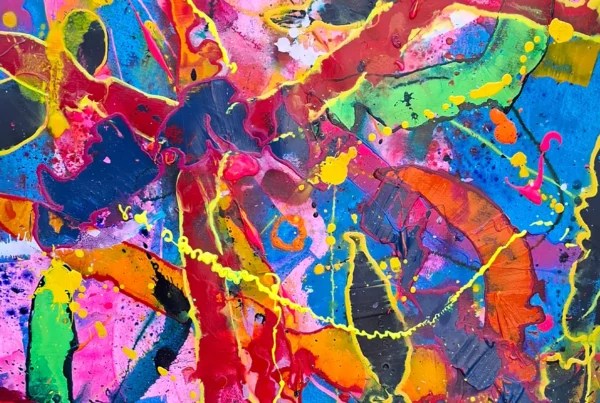
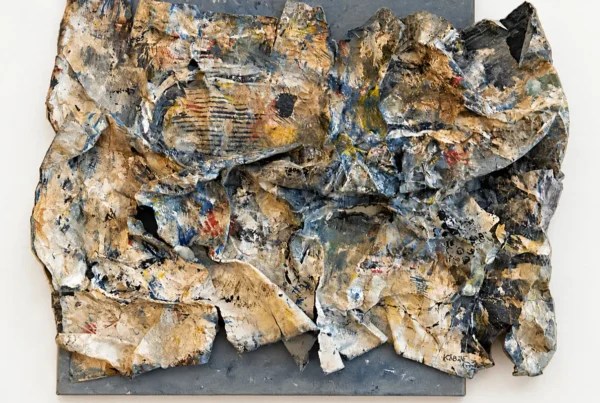
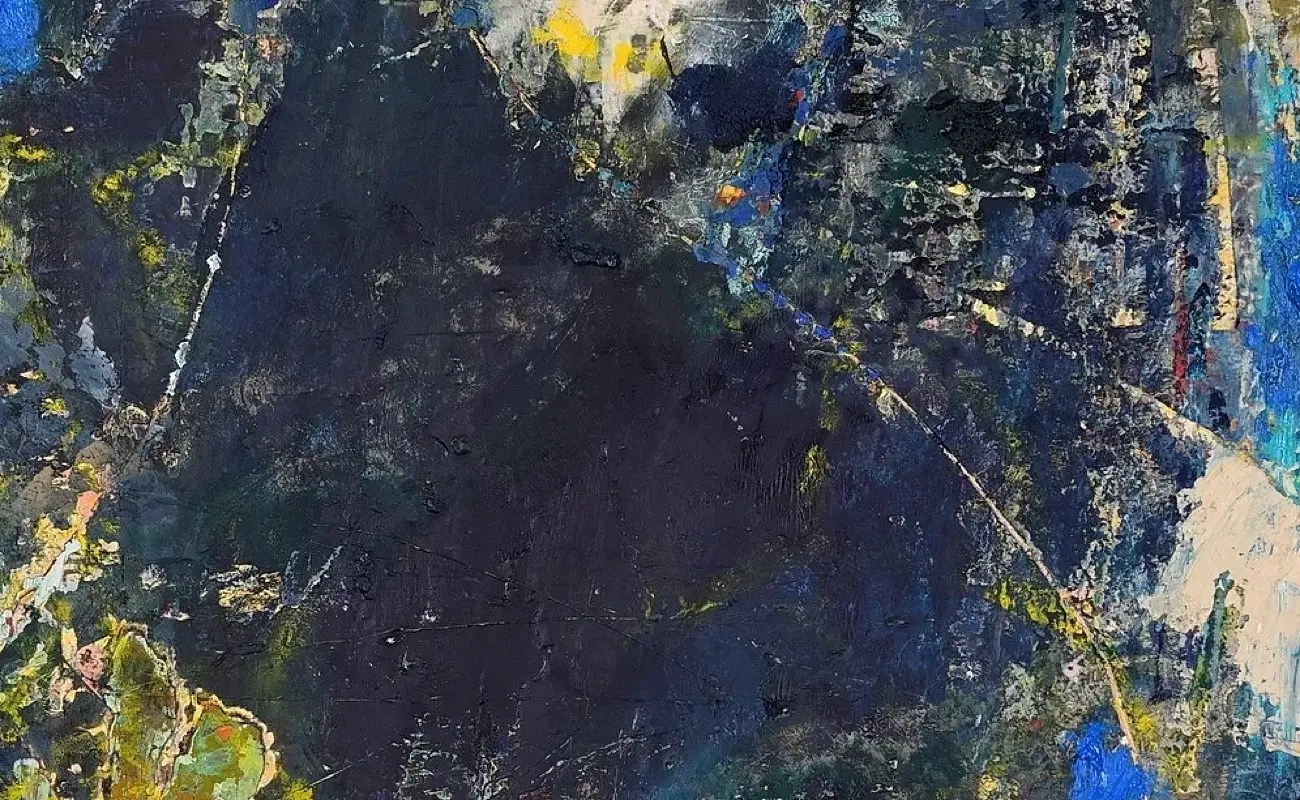
Alker often begins with quick marks, occasionally introducing symbols, words, or short phrases before larger areas of paint are established. Color is selected in response to what is happening rather than according to a fixed preliminary scheme. She works in oil and acrylic, sometimes combining paint with collage or other media, and favors surfaces that can withstand substantial intervention. Wood panels are especially important because they permit her to carve, scrape, and cut into layers already laid down. A line may therefore be both something newly drawn and the exposure of something underneath, making the history of a painting physically present.
Her experiments extend beyond conventional paint. Pasting mediums, coffee, and dirt can help build textured foundations, while drawing implements and other tools leave contrasting kinds of marks. She has spoken of the pleasure she takes in thick paint and active line work, two elements that can remain visible even when the initial marks have been partly covered. The process is not simply additive. Removing material can be as consequential as applying it, and the surface changes through each new decision. This movement between concealment and revelation gives her paintings a sense of development that cannot be reduced to their final colors.
Scale changes the kinds of decisions available. Many of her oil and mixed-media works are made on wood board, while substantial canvases use acrylic, charcoal, pencil, and, at times, house paint. She has worked with large brushes, rags, and her hands, allowing gestures to vary in width and pressure. Her portfolio organizes paintings into groups such as Organics, Geometrics, Kinetics, and Figurative, reflecting the range of structures that emerge from this approach. The categories do not eliminate overlap: a work may carry an irregular, almost bodily line through a more deliberate arrangement of shapes, or allow apparently spontaneous marks to acquire a recognizable rhythm.

The Human Questions Inside Abstraction
Although Alker welcomes chance, her work is not detached from experience. Growing up in the American South during the racial turmoil of the 1960s shaped her awareness of injustice. That sensitivity has continued to inform her interest in mental health, ecological responsibility, and the pressures experienced by women. She does not always set out to illustrate one of these subjects. At times a connection becomes apparent only after the painting has developed. This distinction matters: the paintings are not diagrams of a predetermined position, but spaces where personal feelings and public concerns can enter through material decisions.
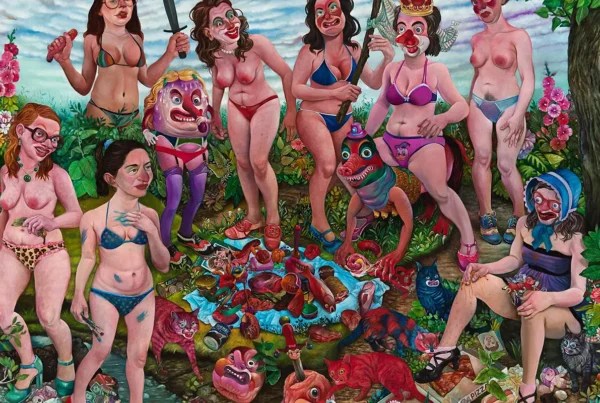
Her painting Threshold offers a particularly clear statement of that relationship. Made with oil, cold wax, and oil pastel, the work was included in a Raleigh Fine Arts Society exhibition catalogue. Alker describes it in terms of abstract figures and their relationships, with forms scratched into the surface to suggest aspects of their stories. She connects that imagery to the complexities of female experience across family life, politics, sexuality, and ageism. The drawn or excavated figure is therefore more than a formal interruption of an abstract field. It provides a way to suggest a human presence without insisting on a literal portrait or a fully narrated event.
The relationship between figuration and abstraction runs throughout her portfolio. Works such as Three’s a Crowd, an intimate mixed-media painting on wood board, sit alongside much larger canvases including Waiting Room. The latter, a four-by-five-foot acrylic painting, received first place in Gallery 906’s North Carolina Artists Exhibition in 2025. Their different formats show the breadth of her practice without implying that a single scale defines her concerns. In earlier interviews, Alker described how a painting can become figurative in the course of being made. She accepts that turn rather than treating it as a failure of abstraction, allowing the image to determine how much of a person or situation becomes visible.

Lynn Alker: The Discipline of Taking Risks
The freedom visible in Alker’s paintings is supported by sustained work. She has described moments of fear and self-doubt in classes, exhibitions, and the studio, especially when facing a painting whose next step is unclear. Over time, repeated encounters with uncertainty helped her grow more confident in her judgment and more willing to make forceful marks. She works from a home studio and has pursued continued training rather than relying on a single method. The late beginning of her career is relevant not because it supplies a simple story of reinvention, but because she understands age as a source of permission to commit fully to a creative life.
Her professional development has unfolded within and beyond North Carolina’s arts community. She has exhibited in Raleigh and elsewhere, including juried presentations in New York, and her painting Music Man entered the permanent public art collection of UNC Health Rex Hospital in Holly Springs. Her work has also moved into other contexts: Passage was used for the cover of David A. Brondos’s book The Parting of the Gods. More recently, her exhibition history has included a solo presentation titled Fragments to Form at Raleigh’s Satellite Gallery and a featured show with Carolina Fine Art in Charlotte. These activities trace an expanding audience while the work remains rooted in experimentation.
Alker has also spoken about the importance of opportunities for others to experience art, particularly children who might otherwise lack access to creative instruction. In a 2021 interview, she argued that making art deserves a meaningful place in education because its emotional benefits extend beyond technical skill. That concern is consistent with her understanding of painting as an expressive resource, one in which fear, joy, frustration, and conviction can all be worked through without a prescribed vocabulary. Back in the studio, those possibilities are tested directly on wood and canvas, where another layer can change the direction of a painting and a scraped line can disclose what was there before.