“Everything is one. The most important aspect here is the underlying interconnectedness, like a kind of web of life. If one thread is pulled loose, the entire fabric unravels.”

Seeing Beyond Certainty
Margriet van Engelen approaches art as an ongoing investigation into change, perception, and the invisible connections that bind people together. Working as a visual artist with a constructive approach, she creates works in which materiality carries conceptual weight rather than serving as a purely aesthetic element. Her practice grows from the conviction that nothing remains fixed, whether individual identity, collective history, or cultural understanding. Every experience becomes part of an evolving conversation about how people interpret the world and how those interpretations influence relationships with others.
At the center of her current practice is Hen Panta, meaning “Everything is one.” For Margriet van Engelen, the phrase expresses the underlying coherence between people, experiences, cultures, and environments. She compares this interconnectedness to a web of life or a woven fabric: when one thread is pulled, the entire structure is affected.
This sense of continuous change also shapes the way she works with materials. Rather than beginning with a fixed visual solution, Margriet van Engelen selects materials in response to a theme and then explores their possibilities playfully. The resulting works reflect her belief that reality is layered rather than unambiguous. Art becomes a space in which different perspectives can coexist, inviting viewers to reconsider what they see and how their own experiences influence perception.

Margriet van Engelen: Questioning What We See
Questions about truth and perception gained particular significance for Margriet van Engelen after attending a lecture at a discussion center of the University of Amsterdam. Historians spoke about debates surrounding the creation of a canon for the European Union and the question of which historical events should be considered important to its unification. The discussion prompted her to reflect on how history is selected, interpreted, and carried into the present.
She began to consider history not as a closed account of the past, but as something that continues to shape contemporary perception. This became the starting point for Framework of History 1 and 2 and for a broader visual investigation into what she calls the “essence of seeing.” How, she wondered, can we approach truth when every observer encounters an event from a different position?
Margriet van Engelen compares this process to a court hearing, where multiple witnesses may be needed to build a fuller understanding of what has occurred. In her artistic experiments, she placed an art object in relation to changing backgrounds, mirrors, light, and shadow. The object remained, yet the experience of seeing it shifted. Through these changing conditions, uncertainty itself became visible. Rather than offering a definitive answer, the work demonstrates how perception can remain fluid and dependent on context.

Personal Histories, Shared Connections
Encounters with different histories and cultures have given Margriet van Engelen’s investigation of perception a deeply personal dimension. A visual correspondence with a colleague of Indonesian descent introduced her to another cultural perspective and encouraged her interest in the ways cultures influence contemporary society. During travels through European border regions, she also met people who shared experiences of dictatorship, war, and discrimination. Their stories left a lasting impression and continue to inform her work.
Teaching language classes to refugees further expanded this awareness. As she learned more about the circumstances surrounding displacement, she encountered complex and interconnected causes, including conflict and climate change. These experiences strengthened her conviction that social and environmental changes cannot always be understood separately from one another.
For Margriet van Engelen, connection therefore becomes both an artistic theme and a way of approaching a society in transition. She believes in creating bridges that encourage trust, communication, and greater understanding between people. Art has a particular role within this process because imagination can make room for possibilities that everyday life may overlook. Like music, art can affect people before everything has been explained in words. It can invite reflection while leaving space for individual interpretation.
Her visual language has also been shaped by artists and architects who demonstrate the expressive possibilities of form, space, and light. Zaha Hadid impressed her through her extraordinary imagination and her determination to establish a distinctive position within a field historically dominated by men. Tadao Ando’s minimalist treatment of light and space offered another important influence. The changing interaction of illumination, shadow, material, and surrounding space corresponds closely with Margriet van Engelen’s own fascination with the instability of perception.

Margriet van Engelen: Ubuntu and a Shared Future
These ideas find one of their clearest expressions in Ubuntu, the installation Margriet van Engelen considers her most important work. Inspired by the South African philosophy of Ubuntu, often expressed through the phrase “I am because you are,” the work centers on the idea that humanity develops through recognition of and connection with others.
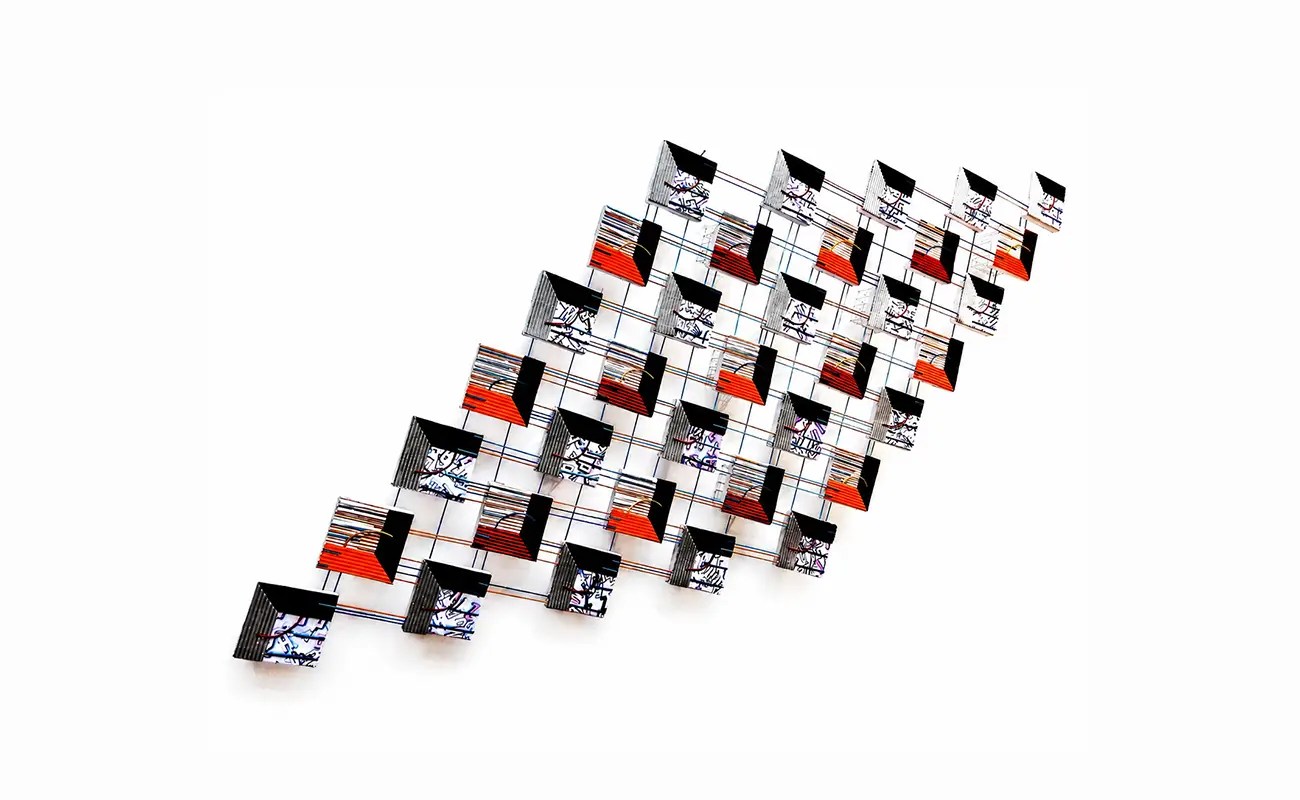
Margriet van Engelen created the installation from triangular elements of stainless steel mesh interwoven with tape in the colors of the rainbow. She arranged them in a circle, resembling people gathered for a meeting. The structure gives each element an equal position, transforming the circle into a visual metaphor for communication based on openness and mutual respect.
The installation reflects Ubuntu’s emphasis on recognizing the humanity of others and seeking consensus within a community. Rather than presenting these principles as an abstract philosophy, Margriet van Engelen translates them into material, color, and spatial relationships. The work asks viewers to consider what becomes possible when people approach one another with a willingness to listen.
Ubuntu ultimately brings together the central concerns running throughout her practice: the uncertainty of perception, continuous change, cultural encounter, and the connections between individual and collective experience. From Framework of History 1 and 2 to Hen Panta, her work resists the idea of reality as something fixed or singular. Instead, it offers space for multiple perspectives and for reflection on how each part relates to a larger whole.
For Margriet van Engelen, this is where art finds its connective potential. It does not need to provide a single answer. It can instead encourage people to look again, consider another perspective, and recognize the relationships that shape a shared world.