“My work is less about creating ‘beauty’ than about asking questions: Does art have to be pleasing? Does it have to be easily understandable and tidy? Or does its quality lie precisely in the fact that it allows for ambivalence?”
From Berlin Streets to a Distinct Contemporary Voice
Berlin has long been a place where artistic experimentation thrives, and for Kai “Raws” Imhof, it became the foundation of a creative journey that began with graffiti. Picking up a spray can at the age of fourteen in 2004, he discovered an expressive language that taught him far more than lettering alone. Graffiti introduced him to typography, composition, colour relationships, and the dynamic balance between contrast and movement. More importantly, it revealed the impact of creating work directly within public space, where art immediately enters into conversation with its surroundings and its audience. Those formative years established principles that continue to influence every aspect of his artistic practice today, even as his work has evolved into increasingly refined contemporary forms.
The next defining stage arrived in 2012 through formal studies in Graphic Design. Academic exploration exposed him to art history, design theory, and conceptual approaches that dramatically broadened his understanding of visual culture. Rather than replacing his graffiti background, this education provided new intellectual frameworks through which to interpret it. The spontaneous instincts developed on city walls gradually merged with greater conceptual precision, allowing him to examine not only how images function aesthetically but also how they communicate ideas. This combination of instinct and reflection became a lasting characteristic of his work, giving equal importance to visual impact and thoughtful artistic inquiry while encouraging continual experimentation across paintings, murals, and digital formats.
Choosing an independent artistic career became a natural consequence of this development. After graduating, he faced the familiar crossroads between commercial design and personal artistic ambition. By that point, commissioned murals and graffiti inspired paintings were already attracting collectors and clients, making the conventional agency path increasingly difficult to justify. Committing fully to art allowed him to concentrate on cultivating a distinctive visual identity instead of adapting his creativity to commercial design demands. Social media, particularly Instagram, became an essential platform for introducing that evolving language to audiences across the world, transforming an intensely personal practice into an internationally recognised career while opening opportunities for exhibitions, collaborations, and creative partnerships.

Kai “Raws” Imhof: The Language of Controlled Disorder
Although graffiti remains the foundation of his artistic identity, Imhof has gradually transformed its vocabulary into something far more reflective. Rather than reproducing traditional street aesthetics, he investigates the essential qualities that define graffiti as an artistic language. Central to this exploration is the reduction of form to its most basic components, especially the expressive potential of the line, the intensity of colour, and the unmistakable presence of the spray can as both tool and cultural symbol. These elements are no longer simply associated with urban intervention but become vehicles for questioning broader artistic values and examining how perception changes within contemporary culture.
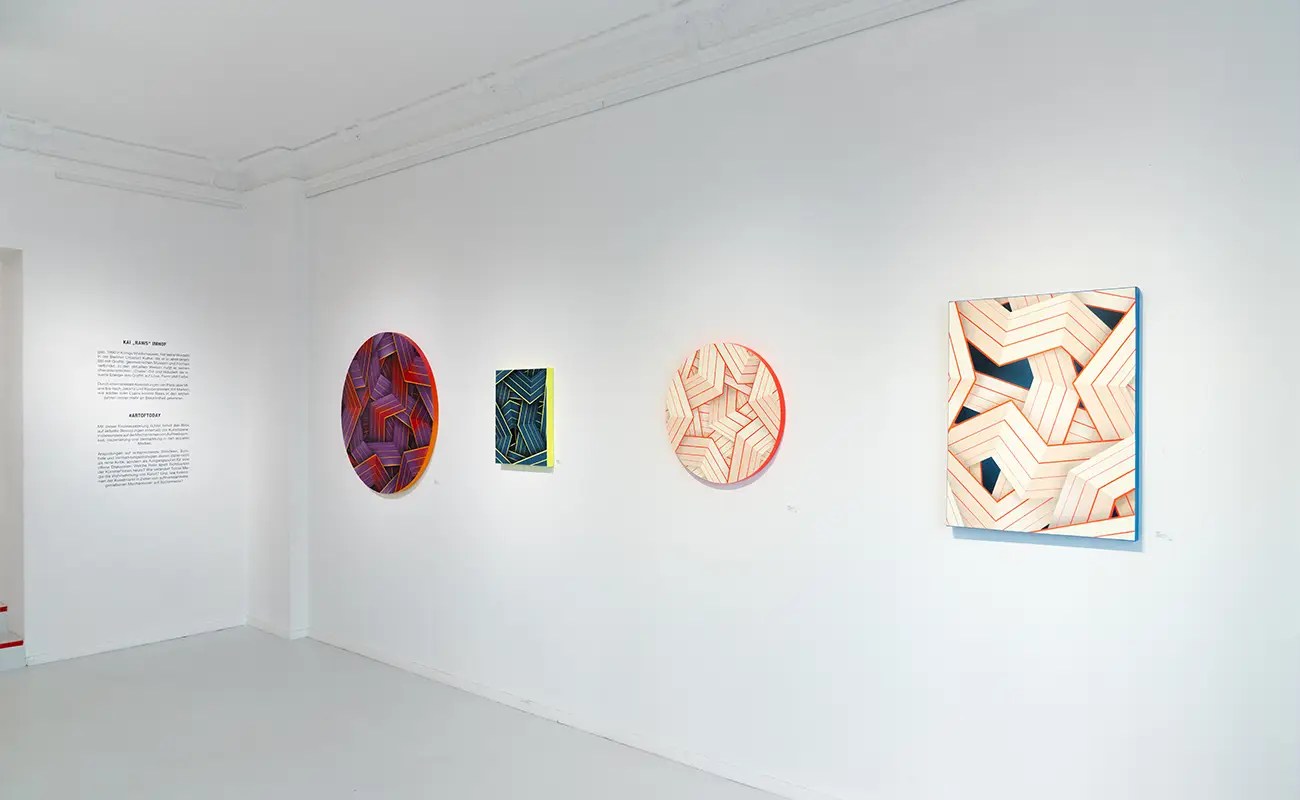
This investigation eventually led to the development of what he describes as his own “chaos” aesthetic. His compositions are built from intuitively arranged networks of lines, overlapping shapes, and optical interactions that appear simultaneously structured and unstable. Rather than presenting visual confusion for its own sake, these works reflect contemporary experiences of fragmentation, information overload, and the constant search for orientation in an increasingly complex society. Spatial depth emerges through layered forms that shift between order and dissolution, encouraging viewers to remain engaged as the composition continually reveals new relationships and perspectives. The visual tension mirrors wider social realities while remaining rooted in a carefully considered design sensibility.
Despite the apparent disorder, optimism remains fundamental to his work. Colour choices, compositional balance, and subtle openings within dense structures create moments of calm that interrupt the surrounding complexity. These quieter passages suggest that beauty can emerge from uncertainty rather than existing in opposition to it. Instead of offering clear answers, his paintings invite viewers to consider larger questions about artistic value, perception, and expectation. He challenges assumptions surrounding whether art must be immediately attractive, easily interpreted, or visually orderly, proposing instead that ambiguity itself can become one of art’s greatest strengths. Through this perspective, his personal history, social observation, and aesthetic exploration become inseparable components of a unified artistic language.

Influence, Dialogue, and Milestone Works
Imhof approaches inspiration as an ongoing exchange rather than a fixed source. Encounters with exhibitions, contemporary artists, and the constant flow of visual culture online continually introduce fresh ideas that influence both his imagery and conceptual thinking. These experiences encourage experimentation without diminishing the individuality of his own practice. Inspiration becomes less about imitation and more about participating in a wider artistic conversation where new perspectives continuously reshape existing ideas. This openness allows his work to remain responsive while preserving the distinctive visual identity he has spent years developing.
Professional ambition also serves as a powerful source of motivation. Watching fellow artists realise significant exhibitions, ambitious commissions, or meaningful careers reinforces the possibilities available through persistence and dedication. Beyond artistic achievements, however, broader social realities play an equally important role in shaping his perspective. Political tensions, environmental concerns, evolving concepts of identity, and questions surrounding human connection all influence his thinking. These issues are not illustrated directly but instead become embedded within the emotional atmosphere and conceptual foundations of his paintings, adding layers of meaning beneath their energetic surfaces.
Among the many works he has produced, two projects stand out as defining milestones. The painting CHAOS represents the moment when his distinctive visual language fully emerged. Dynamic linear structures, graphic precision, optical effects, and controlled disorder combined to establish the artistic vocabulary that continues to guide his practice today. Equally significant is RISING SUN, created with König Galerie in 2021. This series of unique hand painted circular works symbolised warmth, optimism, and renewal. By installing several editions throughout Berlin during the dark month of November, the project extended beyond the gallery environment and invited direct public participation. Residents actively searched for the works, took them home, and became part of the artwork itself, transforming the relationship between artist, audience, and urban space into a shared creative experience.

Kai “Raws” Imhof: Expanding a Global Artistic Vision
Maintaining an international artistic career requires balancing creative production with the practical realities of independent practice. Imhof divides his working week between concentrated studio sessions and the extensive organisational responsibilities that support his projects. Three or four days are devoted entirely to painting, experimentation, and developing new bodies of work. The remaining time is dedicated to communication, project planning, graphic design, client relationships, concept development, and administrative responsibilities. This combination of creative focus and disciplined management enables him to sustain both artistic quality and professional growth while navigating the demands of an expanding international career.
Current projects reflect this continuing momentum. New gallery representation in the United States, collaborations with American partners, and several large scale mural commissions all demonstrate the increasing global reach of his practice. These opportunities allow him to introduce his visual language to new audiences while maintaining the balance between commissioned work and personal artistic development. Rather than treating commercial collaborations as separate from his artistic identity, he integrates them into a broader practice that consistently explores abstraction, visual communication, and the enduring influence of urban culture.
Looking ahead, international expansion remains a central ambition. Among the destinations that hold particular significance, Japan represents a deeply personal aspiration. His long connection with graffiti, typography, and graphic design creates a natural affinity with Japanese visual culture and contemporary design traditions. Exhibiting there would represent more than another international milestone. It would provide an opportunity to engage directly with an audience whose appreciation for craftsmanship, graphic clarity, and visual experimentation aligns closely with many of the ideas that have shaped his artistic evolution. That vision continues to motivate the ongoing development of a practice that remains rooted in Berlin while reaching confidently toward a global cultural dialogue.