Material Devotion and the Weight of the Image
Liisa Viima occupies a distinctive position between contemporary abstraction, devotional imagery and materially assertive relief painting. Based in Siuntio, Finland, she has developed a visual language in which expressive colour and tactile construction support a recurring frontal figure whose stillness contrasts with the activity surrounding it. The Modern Icons collection gives this language a concentrated form. Each work measures 90 by 90 by 4 centimetres, establishing a consistent square format that recalls the self-contained authority of historical icons while remaining firmly connected to contemporary mixed-media practice. Within these boundaries, painted bodies, concentric halos, birds, flowers, stars, inscriptions and wounded hearts form emotionally charged symbolic environments. Although Viima identifies with abstraction, the series depends upon an insistent human presence. Most of its central faces are deliberately androgynous rather than clearly male or female, allowing both qualities to coexist within the same presence. Ani Aya and Lilith are the exceptions, conceived through distinctly female gestures. This openness of identity strengthens the role of the figure as an anchor for questions of suffering, forgiveness, love and hope rather than as a fixed gendered subject. The negotiation between recognisable imagery and sensuous surface gives the collection its particular significance, allowing spiritual concerns to enter contemporary art without relying on doctrinal illustration.
The physical construction of these paintings is central to their meaning. Viima builds relief elements from gypsum using stencils, incorporates fragments of tile, stone or glass, applies acrylic base colour, seals selected areas with resin and completes the principal figure in oil. Shimmering mica pigments introduce another level of optical change, so that the surface responds differently as light moves across it. This twelve-stage process produces objects that possess greater weight than conventional paintings of the same dimensions, and that weight should be understood both literally and conceptually. The raised borders resemble reliquaries, architectural surrounds or embellished frames, yet they remain inseparable from the painted field. Hardened fragments interrupt the continuity of the surface, transforming breakage into ornament and debris into structure. Resin alternately preserves, intensifies and distances what lies beneath it. The result is an image that appears protected but not untouched. Viima’s technique therefore reinforces the collection’s central proposition: suffering cannot simply be erased, but it can be enclosed within a new order shaped by care, endurance and reconstruction.
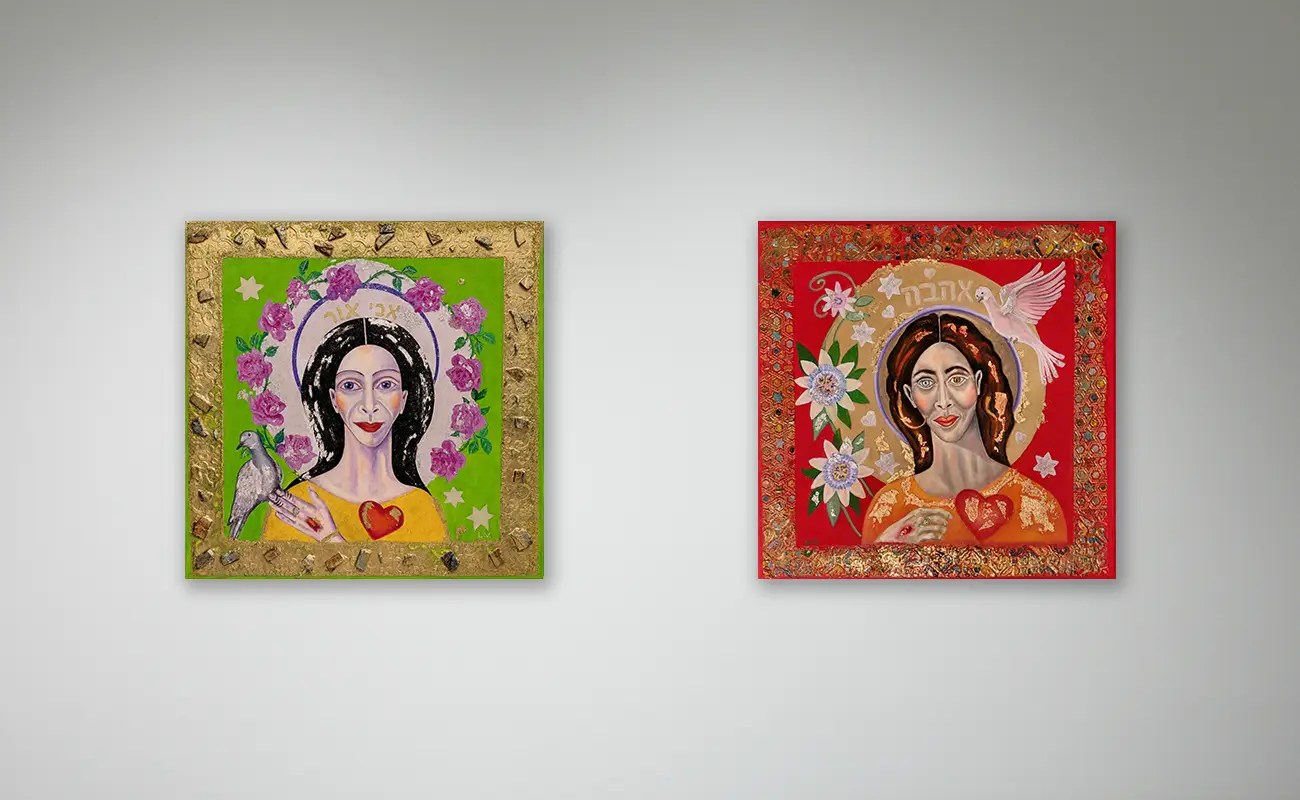
Across the series, consistency emerges through repeated compositional decisions rather than exact duplication. A frontal figure usually occupies the vertical centre, often facing outward with enlarged, attentive eyes. Circular or oval bands surround the head, creating a halo-like architecture that separates the figure from the patterned ground while also binding it to it. Floral stems climb through these zones, birds enter from the sides or upper corners, and stars punctuate areas of metallic colour. Hearts appear on the chest, while wounded hands introduce a more difficult bodily register. The square compositions are frequently contained by thick, highly worked borders whose embedded fragments and metallic surfaces create an almost archaeological density. These elements function as Viima’s visual handwriting. Their recurrence lends the collection coherence, yet shifts in palette, gesture and expression prevent the repeated figure from becoming a fixed emblem.
Within this shared visual system, Lilith occupies a particularly important position. Viima approaches the mythic figure as a she-devil who nevertheless experiences suffering and therefore raises the possibility of mercy. The work complicates the collection’s treatment of compassion by asking whether mercy can extend beyond the innocent or conventionally deserving. Rather than resolving this moral tension, Viima allows vulnerability and darkness to coexist, giving forgiveness a more demanding ethical dimension.

Liisa Viima: Recasting the Icon for a Contemporary Present
Liisa Viima’s use of the term “modern icons” is more than a stylistic label. The collection adopts several structural features associated with sacred images, including frontal presentation, direct gaze, compressed pictorial space, symbolic attributes and luminous metallic fields. Yet these paintings do not reproduce a conventional religious figure or a settled theological narrative. Their central subjects appear as composite presences: wounded bodies, witnesses, protectors and embodiments of inner consciousness. Their predominantly androgynous character further resists a singular identity, allowing masculine and feminine qualities to remain open rather than assigning spiritual or emotional states to one gender. This shift enables Viima to draw on the authority of icon-like representation while opening its meaning to broader human experience. The halos do not establish an unquestionable sanctity; instead, they stage a possibility that vulnerability itself might carry spiritual value. The figures’ large eyes invite encounter rather than passive observation, while their calm expressions complicate the visible evidence of pain. Ancient legends contribute to the imaginative background of the series, but the paintings resist illustration. Mythic and spiritual sources are absorbed into a contemporary symbolic system in which personal identity, bodily suffering and ethical renewal remain inseparable.
Diego Velázquez’s Christ Crucified of 1632 provides an important historical point of orientation for Viima’s treatment of suffering. Velázquez presents anguish through restraint, isolation and bodily gravity, allowing the suspended figure to carry emotional intensity without theatrical excess. Viima does not imitate that composition, nor does she transpose its explicitly masculine crucified body into her own imagery. Instead, the influence becomes evident in the insistence that suffering must remain visible even within an image concerned with transcendence. Her wounded palms, marked hearts and solemn faces preserve physical evidence of injury. At the same time, flowers, birds, metallic light and radiant colour prevent pain from becoming the sole meaning of the image. Where Velázquez’s dark ground intensifies solitude, Viima surrounds the wounded figure with signs of relation and renewal. Her response therefore converts a historical representation of sacrifice into a broader meditation on survival, forgiveness and heart-based consciousness. The crucifixion reference remains present as an ethical and emotional structure rather than as an iconographic quotation.
The titles reinforce this movement between established spiritual language and open contemporary interpretation. Io Sono, meaning “I am,” introduces identity as a declaration rather than a description, while Ani Hu, Ani Haya and Ani Ahu extend the collection’s repeated engagement with naming, being and self-recognition. Their inscriptions appear within the painted fields, sometimes partly integrated into halos or surrounding motifs. Language therefore becomes visual matter rather than a caption placed outside the image. The titles do not resolve the figures into specific portraits; instead, they heighten the sense that each embodies a state of consciousness. Cœur de Courage brings emotional courage directly into the naming of the work, linking the heart motif to endurance rather than sentimentality. Such linguistic variety also broadens the cultural register of the series. Italian, French and transliterated forms coexist within a body of work made in Finland, creating an intentionally mobile spiritual vocabulary. This multilingual dimension supports Viima’s participation in Finnish and European exhibition contexts, where the works can communicate through both symbolic familiarity and interpretive openness.

Wounds, Flowers and the Anatomy of Hope
Io Sono establishes many of the collection’s defining tensions. A pale, elongated face rises against a yellow field, framed by dark hair and several concentric bands. Roses, stars and a descending bird surround the figure, while a red heart placed prominently on the chest carries visible internal disruption. One hand crosses the body, presenting a wound rather than concealing it. The expression is composed, almost ceremonially calm, yet the asymmetrical colour on the cheeks and forehead prevents the face from appearing immaterial or remote. Viima’s handling of the figure combines stylisation with direct emotional address. The narrow neck, symmetrical features and large eyes produce an iconic stillness, while the vivid mouth and wounded hand return the image to bodily experience. The thick gold-toned border amplifies the impression of preciousness, although its uneven, fragment-filled construction complicates decorative luxury. Beauty is not offered as escape. It surrounds injury, giving it a structure through which pain can be acknowledged without becoming visually dominant.
A different emotional register appears in Ani Aya. Here the palette is quieter, with pale pink, cream and muted metallic tones replacing the sharper chromatic contrasts seen elsewhere. The figure crosses both hands over her chest, creating a closed, inward gesture. Her partially exposed body introduces vulnerability without spectacle, while the floral crown and spiralling bands behind the head suggest growth, cyclical movement and contemplative withdrawal. The eyes are lowered or heavily shadowed, reducing the direct confrontation found in several related works. Cœur de Courage restores a more outward gaze. Its black ground sharpens the gold halo, grey bird, orange clothing and blue-centred flowers. The figure again bears a wound on the hand and a heart on the chest, but the saturated orange garment introduces warmth and resilience. Placed beside one another conceptually, these works reveal Viima’s ability to vary emotional temperature within a highly stable visual system. Suffering may appear as inward retreat, guarded endurance or conscious confrontation, rather than as a single dramatic condition.
The surrounding natural symbols are not passive decoration. Birds repeatedly occupy transitional spaces near the head or halo, implying movement between physical and spiritual registers. Roses combine tenderness with the memory of thorns, while star forms introduce guidance, distance and cosmic order. In Ani Haya, the raised hand presents its wound openly, almost as a sign of recognition or blessing. A bird hovers nearby, roses climb along both sides, and the red-brown field intensifies the contrast between pain and vitality. Ani Hu offers a related arrangement, but its pale halo, purple ground and flowering branches produce a more buoyant atmosphere. Mattitja expands metallic silver across the surrounding field, creating a turbulent luminous border around the central figure, heart and bird. These recurring motifs operate like a grammar. Their meaning depends on placement, colour and relation rather than on rigid symbolic definitions. Through such variation, Viima prevents the collection’s spiritual language from hardening into formula.

Liisa Viima: Serial Coherence and Contemporary Position
Liisa Viima’s decision to develop Modern Icons as a twelve-part collection strengthens its conceptual force. Serial practice allows the repeated figure to become an evolving proposition rather than a single definitive image. Each painting shares the same dimensions, comparable relief construction and a recognisable symbolic vocabulary, yet no figure fully replaces another. The collection therefore treats identity as both continuous and changeable. Repetition establishes ritual, while difference introduces psychological movement. The openness of gender across most of the series contributes to this instability of identity, allowing the figures to function as human presences without being confined to a single masculine or feminine role. Seen as a sequence, the works reveal gradations of vulnerability, courage, self-recognition and hope. Their equal square proportions also support a modular exhibition arrangement, whether presented in a line, a grid or a more dispersed installation. The considerable physical weight of the objects distinguishes them from lightweight decorative panels and demands practical attention in transport and display. That material insistence contributes to their institutional presence. These are not simply images of transformation; they are constructed bodies whose mass, thickness and reflective surfaces alter the space around them.
Within contemporary practice, Viima’s work can be positioned at the intersection of mixed-media abstraction, neo-iconic figuration and spiritually oriented art. The paintings resist the austerity often associated with modernist abstraction, favouring symbolic abundance, saturated colour and tactile density. They also differ from conventional religious painting because their meaning is not dependent on a single recognised saint, scripture or institutional doctrine. Instead, Viima brings sacred visual structures into contact with psychological and ethical themes that remain accessible beyond formal belief. Her membership in the Finnish Artists’ Association and participation in solo, curated and international group exhibitions provide an established professional framework for this practice. In gallery and collector contexts, the relief surfaces and metallic pigments offer a strong physical encounter that cannot be fully communicated through reproduction. Their visual immediacy may attract audiences through colour and recognisable symbols, while their more lasting value lies in the tension between ornament, bodily injury and spiritual persistence. That dual accessibility gives the collection relevance across private, public and cross-cultural settings.
The collection’s greatest strength lies in the conviction of its visual language. Viima has developed a technique in which material process, symbolic content and serial structure support one another rather than operating as separate effects. The decorated borders, radiant pigments and floral motifs could easily turn suffering into spectacle or soften it into reassuring sentiment. The repeated wounds, solemn gazes and bodily stillness prevent that resolution. At the same time, the persistent use of hearts, birds, halos and frontal faces creates a challenge: coherence can approach predictability when the symbolic vocabulary remains too stable. The more compelling works answer that risk through pronounced changes in atmosphere, gesture and chromatic pressure, as seen in the contrast between the pale introspection of Ani Aya, the dark intensity of Cœur de Courage and the vivid affirmation of Ani Ahu. Viima’s accomplishment is not the invention of a wholly unprecedented iconography, but the forging of a recognisable contemporary idiom in which broken matter, painted flesh and reflective light become carriers of forgiveness, hope and enduring human consciousness.