“I believe that an abstract painting should evoke emotions and associations that will be different for each recipient, just as people are different.”
A Lifelong Conversation Between Engineering and Abstraction
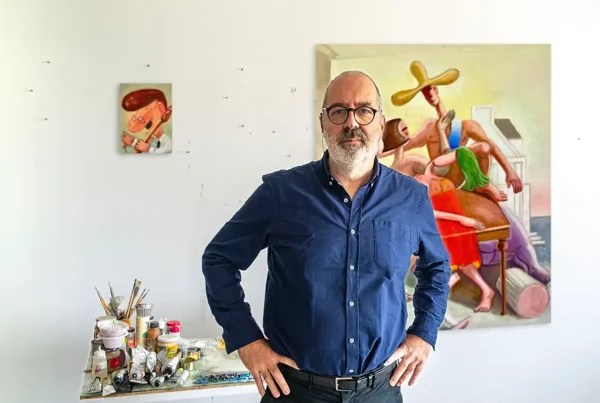
Krzysztof Horała has spent decades balancing two seemingly different worlds, technical precision and artistic exploration. Born in Kraków in 1961 and raised in Poznań from early childhood, he displayed creative interests long before choosing his professional career. During his school years, he directed theatrical productions, attended drawing classes, and originally intended to study architecture. Although he eventually pursued mechanical engineering for practical reasons, artistic ambition never disappeared from his life. Painting remained a constant companion alongside regular visits to galleries, museums, and exhibitions, while conversations with artists, collectors, and dealers deepened his understanding of contemporary art. Personal encounters with distinguished Polish artists including Jan Lebenstein, Eugeniusz Markowski, and Leszek Knaflewski further strengthened his commitment to developing an individual artistic language. Independent study of art history and continuous experimentation with painting techniques gradually prepared the foundation for the mature body of work that would emerge years later, proving that creative development often follows its own timetable regardless of professional obligations.
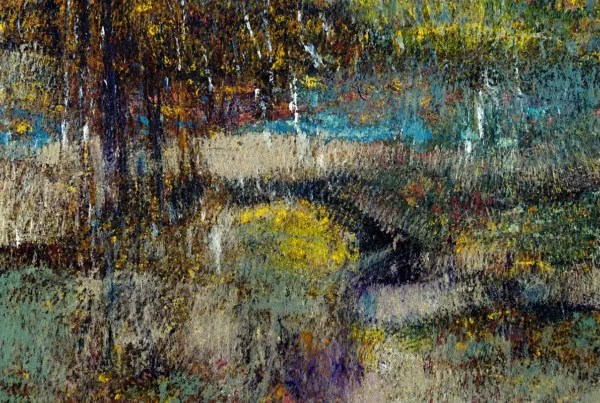
When his personal circumstances became more stable around 2012, Horała finally gained the opportunity to dedicate significantly more time to artistic practice. Early works quickly attracted positive responses from viewers and found collectors, confirming that his distinctive visual approach resonated with audiences. These paintings were created by applying acrylic paint through a drinking straw onto black canvas, producing thousands of raised dots that formed intricate compositions. He titled this first mature cycle “Area” because the resulting images resembled landscapes and topographical maps viewed from high above. Inspiration came in part from the visual traditions of Aboriginal Australian painting, first encountered at Galeria R in Poznań and later reinforced during visits to Australia itself. Rather than adopting cultural narratives associated with Indigenous art, Horała was captivated by the expressive possibilities of the dot technique and by the visual suggestion of terrain, pathways, and expansive landscapes translated into abstract form.
This fascination with abstraction was never driven by the desire to imitate reality directly. Instead, Horała became increasingly interested in constructing images capable of inviting multiple interpretations. Throughout this period he remained convinced that abstraction possesses a unique emotional openness, allowing every viewer to discover different meanings within the same composition. His paintings encourage observation rather than explanation, presenting structures that may resemble landscapes, maps, biological systems, or entirely imagined environments. At the same time, the physical qualities of his technique became an important part of the viewing experience. Because every painted dot remains slightly raised from the surface, changes in lighting and viewing angle transform the appearance of each composition. Light activates the paintings in subtle ways, giving them an optical depth that continually rewards prolonged observation while reinforcing the relationship between material process and visual perception.

Krzysztof Horała: Building Visual Languages Through Series
Horała’s artistic development has unfolded through clearly defined bodies of work, each expanding upon earlier discoveries while introducing fresh conceptual directions. Between 2007 and 2015, the “Area” paintings evolved from compositions featuring pathways, hills, and contour-like formations into increasingly complex arrangements dominated by circles of varying sizes. Although the imagery became less descriptive, the title remained unchanged because the artist continued to imagine these abstract structures as landscapes visible from an extraordinary altitude. During this period he also explored portraiture using the same distinctive dot application method. Beginning in 2014, the “Head” series transformed human faces into highly imaginative compositions, including unusual figures populated by multiple eyes and noses. These paintings demonstrated that the dot technique could move beyond landscape-inspired abstraction while preserving its remarkable visual identity and tactile surface.
Around 2016, Horała sought a broader chromatic vocabulary and introduced a recurring visual element that became central to a new stage of his practice. He named this characteristic form “Triroundness.” Repeated in varying colours and rhythmic arrangements, these shapes generated compositions that recalled DNA strands, genetic structures, and other organic systems. Rather than illustrating scientific concepts directly, the paintings suggested relationships between biological processes, emotional experience, and visual rhythm. This series reflected the artist’s growing interest in connecting intuitive decisions with underlying patterns found in nature. Colour, repetition, and composition worked together to produce images that appeared simultaneously structured and spontaneous, inviting viewers to move freely between scientific associations and emotional responses without settling on a single definitive interpretation.
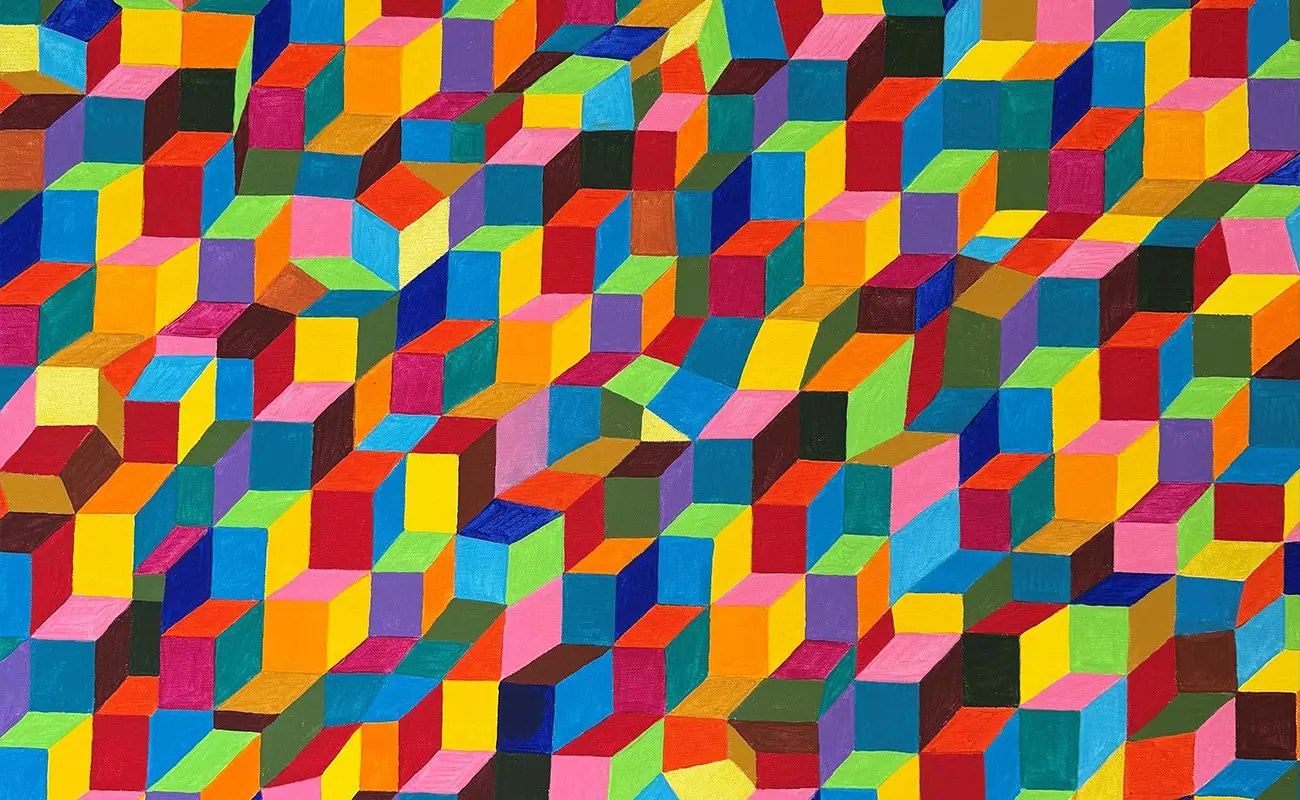
Later, another significant body of work emerged under the title “Zoom.” Here, geometric rectangles and diamond forms replaced the earlier organic vocabulary, creating compositions inspired by the appearance of matter observed under extreme microscopic magnification. These paintings evoke crystal formations, metallic surfaces, and changing structures whose colours shift depending on illumination and perspective. Horała expanded these investigations again in 2025 with the introduction of the “Reflections” series. Returning to the tri curved form developed earlier, he began cutting coloured paper and assembling it onto cardboard, combining painterly sensitivity with relief construction. The resulting works suggest shimmering reflections across moving water while introducing greater physical depth through layered paper elements. Today he continues to develop both the “Zoom” and “Reflections” series, finding sufficient creative possibilities within these established directions rather than seeking another dramatic transformation.

Observation, Material, and the Freedom of Interpretation
The physical process behind Horała’s work plays a crucial role in shaping the viewer’s experience. His dot paintings begin with a black acrylic background before thousands of individual dots are applied using a drinking straw dipped into acrylic paint. Each mark is pressed carefully onto the surface while the canvas lies flat on the floor, remaining in that position until completely dry. This method creates subtle relief because every dot retains its own height depending on the amount of paint applied. As light moves across the surface, shadows and highlights constantly shift, giving the paintings changing visual characteristics that cannot be fully appreciated through reproduction alone. Concentric arrangements of dots often produce an illusion of spatial depth, allowing abstract forms to appear almost sculptural despite remaining firmly rooted within the language of painting.
Although Horała openly acknowledges the influence of Aboriginal Australian art, his practice follows a fundamentally different conceptual path. The visual similarities reside primarily in the application of dots and certain aspects of the colour palette rather than in shared cultural meanings. His own paintings are not intended to communicate inherited stories, ceremonial traditions, or symbolic systems. Instead, abstraction functions as an open field where emotional resonance emerges through colour, rhythm, texture, and composition. This distinction has also been noted by critic Andrzej Haegenbarth, who observes that while Aboriginal painting often serves ritual and narrative purposes, Horała employs related visual strategies to create entirely independent artistic statements rooted in contemporary abstraction.
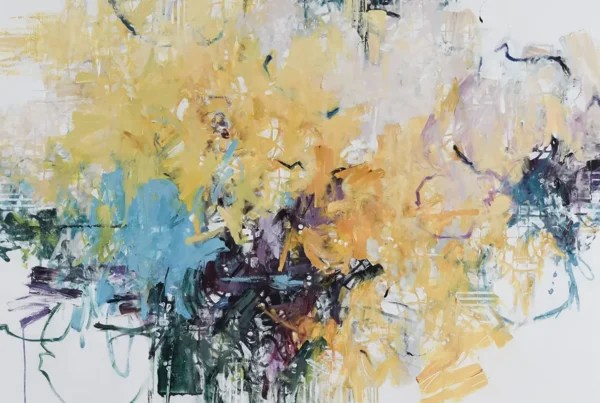
Interpretation therefore remains central to every encounter with Horała’s work. He believes that abstract painting should generate emotional responses unique to each individual viewer because every person brings different experiences and perspectives into the act of looking. During the creative process he relies heavily on intuition, allowing unconscious choices regarding colour relationships, compositional balance, and rhythmic repetition to guide the evolution of each painting. His interest in quantum physics further enriches this perspective, particularly the idea that observation itself may influence perceived reality. Rather than presenting fixed meanings, the paintings encourage audiences to become active participants whose interpretations complete the work. This openness transforms viewing into an ongoing dialogue where perception continually shapes understanding.

Krzysztof Horała: Continuing an Expanding Artistic Journey
Critical responses to Horała’s work frequently emphasise the richness of its interpretative possibilities. Andrzej Haegenbarth has described the paintings as environments that may resemble landscapes viewed from extraordinary heights, where agricultural fields, unfamiliar structures, or even imagined planetary settlements appear within carefully organised compositions. Other works invite microscopic readings, suggesting invisible biological worlds populated by minute organisms or complex material formations. These contrasting scales demonstrate one of the defining strengths of Horała’s abstraction. A single composition can evoke immense aerial distances while simultaneously recalling structures visible only through scientific magnification. Such visual ambiguity encourages sustained observation because the imagery never settles into one stable identity, continually shifting between natural, biological, geological, and imagined references.
Haegenbarth has also pointed to another important characteristic within Horała’s practice. Beneath the apparent precision and order of the compositions lies significant space for intuition, unpredictability, and imaginative invention. The geometric discipline of repeated forms does not eliminate expressive freedom. Instead, rational organisation becomes the framework through which spontaneous artistic decisions can emerge. Sensitive viewers may appreciate the immediate visual qualities of colour, rhythm, and texture while simultaneously constructing highly personal narratives inspired by the abstract imagery. This balance between structural clarity and imaginative openness contributes to the enduring appeal of the work, allowing different audiences to discover new associations with repeated viewing.
Today Horała continues balancing professional responsibilities with an active artistic practice, creating primarily during afternoons and weekends. Completing one painting naturally leads him toward ideas for the next, sustaining an ongoing cycle of experimentation within his established series. Rather than pursuing constant stylistic reinvention, he concentrates on extending the possibilities already present in “Zoom” and “Reflections,” refining visual relationships through continued exploration of colour, geometry, paper construction, and perception. Across more than three decades of artistic activity, his work has developed into a distinctive contribution to contemporary abstract painting, combining technical ingenuity, intuitive decision making, and thoughtful engagement with the endlessly changing relationship between image, light, material, and the individual experience of seeing.