The Human Figure, Unsettled
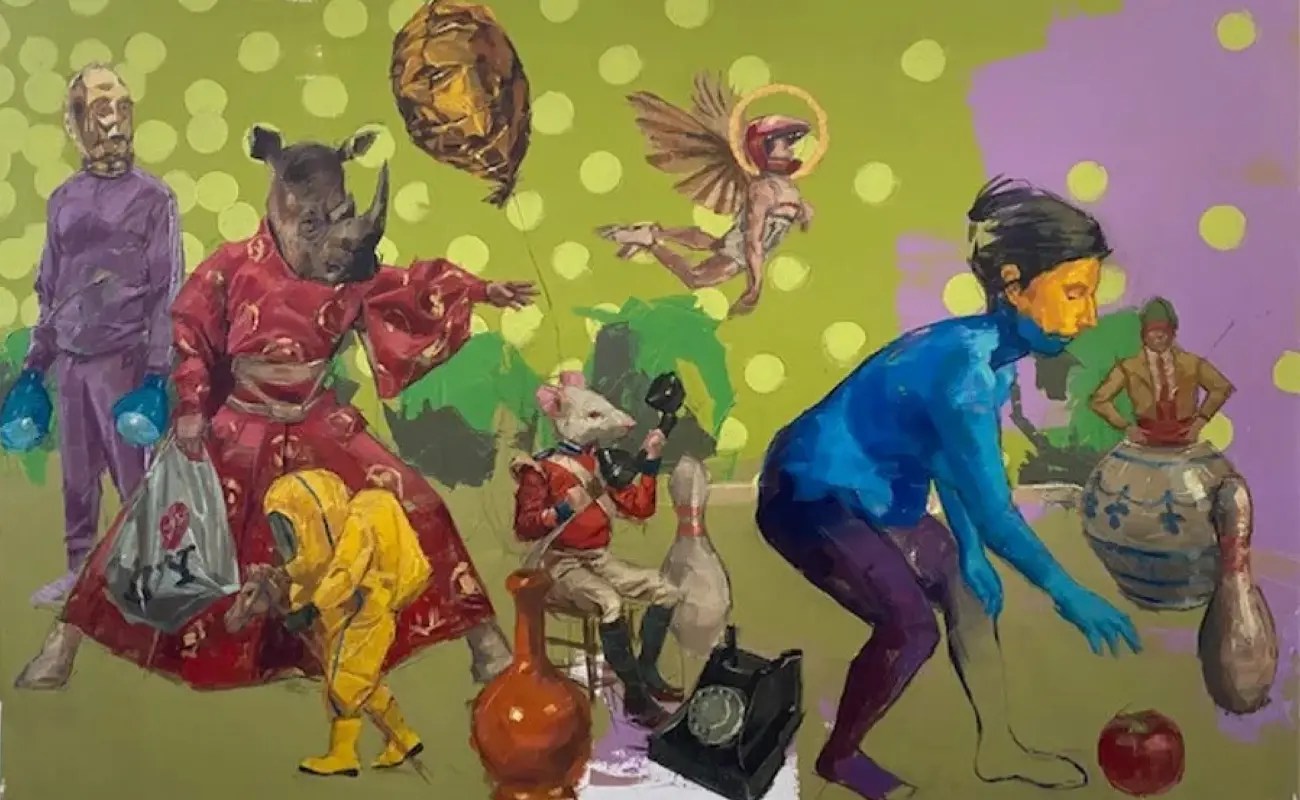
A bull wears a human posture, an astronaut appears among animals, and a machine from another age occupies the same pictorial space as a scene that might belong to a dream. In the paintings of Emanuel De Sousa, improbable encounters are given the weight and texture of ordinary life. His figures have recognizable bodies, clothes, gestures, and expressions, yet the situations surrounding them refuse an obvious explanation. Brightly patterned grounds and shifting scales heighten that uncertainty. The result is figurative painting that uses the familiarity of people and objects to open up worlds that cannot be reduced to a single story.
De Sousa grew up on Porto Santo, a Portuguese island whose memories remain central to his imagination. He studied fine art at the University of Madeira between 1995 and 1998 before continuing at the Faculty of Fine Arts of the University of Porto, where he earned a degree in painting. Now based in Edinburgh, he has developed a practice shaped by that academic education without being confined by it. His exhibitions have taken his work from Portugal to other European countries and the United States, while the island of his childhood continues to offer material for new inventions.
His stated starting point is the human figure and the conventions through which it has historically been represented. Rather than abandon figurative skill, he uses it to question what a painted person can communicate. Earlier work included portraits and investigations of expression, but his later compositions place recognizable figures in increasingly unlikely relationships. He has identified Paula Rego, Lucian Freud, and Eric Fischl among the artists who helped form his visual understanding. Their example matters less as a template to copy than as a foundation for his own movement between observed anatomy, psychological character, and constructed narrative.

Emanuel De Sousa: The Mechanics of a Painted Fiction
Despite the rich, sometimes oil-like handling of his surfaces, De Sousa works primarily with acrylic. He changed medium after an allergic reaction to the solvents associated with oil painting and gradually found ways to give acrylic the depth and flexibility he wanted. Charcoal, watercolour pencils, and water-soluble crayons also enter the process. His technical choices are visible in the contrast between dense passages of colour and lines that remain exposed. He has even modified and reshaped brushes to obtain particular qualities of movement and pressure, treating each tool as something to adapt rather than simply use as supplied.
A finished canvas is only one stage in a much longer sequence. De Sousa describes beginning with a thought that may develop for months through reading, research, writing, and drawing. Sketchbook diaries hold alternative possibilities before he makes studies on paper or canvas, settles questions of composition and scale, and begins a larger painting. He draws first in charcoal, then follows selected marks with a brush and water before introducing colour. This preparatory rhythm helps explain why seemingly spontaneous collisions of characters, props, and settings retain a strong underlying pictorial structure.
The marks themselves are part of the storytelling. Figures can be modeled with convincing volume while other areas remain visibly brushed, rubbed, interrupted, or left open. Circles, grids, floral patterns, and sharply separated colour fields often sit beside flesh, fur, and fabric. These different visual registers stop the painting from pretending to be a seamless window onto reality. De Sousa has also spoken about the demands of working at a smaller scale, where emotional presence must be achieved without the immediate force of a large canvas. Across sizes, the challenge is to make character carry more than outward resemblance.

Nostalgia Without a Time Machine
An important shift came with the series Bruce Lee Shoes. After an extended period of working on portraits and feeling dissatisfied with the results, De Sousa decided to paint subjects that gave him pleasure. He has described the series as a way of examining nostalgia through its fragments and associations. Its imagery brings together recognizable costumes, lively colour, and dislocated objects without resolving them into conventional scenes. The related RetroFuture paintings extend that appetite for invented worlds. The past appears not as something carefully reconstructed, but as a stock of images that can be rearranged and made strange again.
Works presented by Stella Flame Gallery make the visual logic especially clear. In Abduction Logistics, a seated bull shares the picture with other animal-headed characters and a diminutive figure, while draped fabrics and a decorative ground complicate any simple setting. Space Gas Station places a bull-headed figure, an astronaut, a rocket, and a petrol pump within the same brightly patterned composition. Such combinations are playful, but the carefully articulated figures keep them from becoming interchangeable jokes. The eye moves between bodies and accessories, trying to establish relationships that the painting deliberately leaves open.
The series Zed’s Dead brings the source of this imaginative vocabulary into sharper focus. De Sousa has recalled growing up in the 1980s with television and his imagination as close companions, inventing heroes, monsters, and entire fictional worlds after watching programmes. Those childhood adventures became the basis for paintings made decades later. What interests him is not merely the look of an earlier decade, but the freedom with which a child combines images from different stories. The adult painter gives those unstable combinations physical form, using the discipline of drawing and composition to preserve the unpredictable energy of invention.

Emanuel De Sousa: Folklore as a Living Image
Memory also takes a more local and historical form in Quebranto, a project that emerged from an artistic residency at the Madeira Contemporary Art Museum in 2021 and was subsequently shown at MUDAS and on Porto Santo. The paintings address superstitions and practices passed between generations in the islands, particularly beliefs occupying the uncertain ground between pagan traditions and religious observance. Remedies, healing prayers, and stories shared quietly within communities provided material for this examination of popular memory. The subject brought De Sousa back toward a culture he knew personally, while allowing familiar inherited beliefs to become material for visual reconstruction.
Myth provides another structure in Lilith’s Covenant, presented in Lisbon in 2023. The project takes the story of Lilith’s refusal to submit to Adam and develops its own speculative continuation after her departure from Eden. De Sousa imagines her seeking an arrangement with a figure opposed to God, turning a received narrative into the beginning of another drama. The premise fits a broader tendency in his work: established stories are not treated as fixed illustrations, but as situations whose characters can be given new agency, motives, and encounters. The human figure remains the vehicle through which those possibilities become visible.
That interest in inherited stories also appears in his exhibition Fairy Tales: The True Stories at Arp Galerie in Hanau in 2026, and in paintings whose titles invoke mythological figures, including Hades and Persephone, Hera, and Hermes. The movement between island folklore, television memories, and ancient narrative does not erase their differences. Instead, it reveals the range of material De Sousa can bring into figurative painting. A convincing body may stand beside an impossible creature; a decorative pattern may interrupt an otherwise familiar room. The image holds these elements together without insisting that they belong to the same world.