The Scale of Wonder
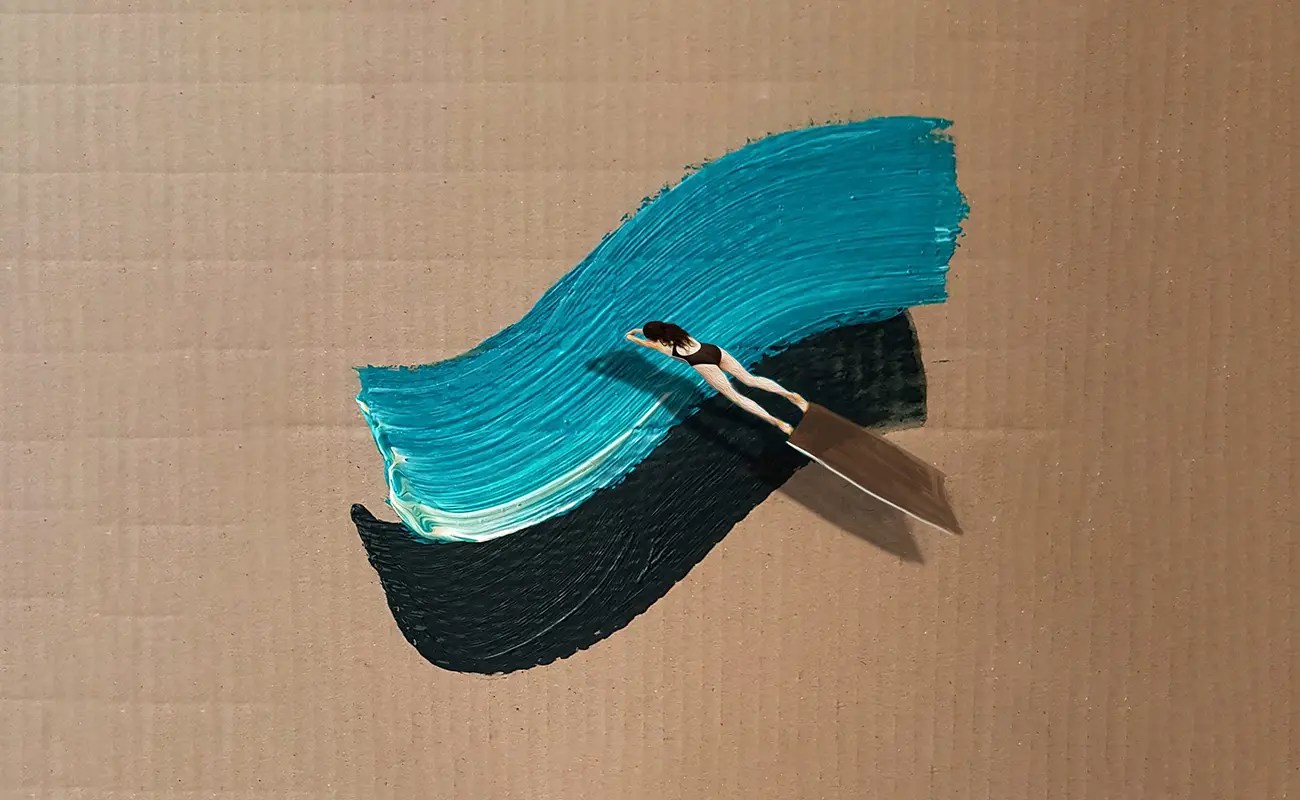
A crest of blue paint can become an ocean when a single swimmer enters the scene. A pale sweep across a surface can turn into a ski slope, complete with a solitary figure moving through the snow. In the work of Golsa Golchini, the physical substance of painting is rarely content to remain a background or a mark. Thick folds of color become places to inhabit. A carefully positioned human figure changes the viewer’s sense of scale, so that a small composition suddenly suggests an expansive world beyond its edges. The initial effect is playful, but the transformation depends on an exact relationship between material, image, and imagination.
Born in Tehran in 1986, Golchini has lived and worked in Milan since 2004. She trained at the Accademia di Belle Arti di Brera, graduating in visual arts in 2010, after an education that encompassed painting, photography, decoration, fresco, sculpture, and other approaches to making images. This breadth remains visible in work that crosses the boundary between flat pictures and constructed objects. Her paintings can begin with a modest piece of cardboard, a conventional canvas, or an already existing object. Whatever she chooses, she looks for ways to make the support itself participate in the image, rather than serve as an invisible surface behind it.
Golchini’s visual language joins two apparently incompatible scales. Broad, tactile gestures occupy much of the composition, while minute people carry out recognizable actions inside them. The contrast makes the brushstroke both monumental and intimately familiar. Her figures are not presented as heroic subjects; they swim, ski, sit, travel, and rest. Their ordinary behavior supplies a human measure to otherwise abstract forms. A viewer can recognize the gesture of a swimmer before noticing how improbable the surrounding sea really is. That movement between recognition and surprise is central to the artist’s approach: she makes the painting immediately legible, then lets its material strangeness change what has been seen.

Golsa Golchini: From Images to Environments
The relationship between photography and drawing was central to Golchini’s earlier practice. She described taking photographs while already imagining, even as she pressed the shutter, what she would later add to them with a graphics tablet. Drawing entered the photographic image as a way of revealing a world not apparent to the camera alone. Works from this period combined photography, digital illustration, and wooden supports. Works such as The Sky Runner and We Share the Same Feelings reveal how a familiar photograph could become the setting for another kind of experience.
Her later mixed-media paintings bring this relationship into a more tangible form. In works centered on water and snow, ridges of acrylic impasto are built up into waves and slopes. Tiny figures, produced through digital painting and ink transfers and then supplemented with details by hand, appear to move across the painted terrain. Deliberate shadows help the figures settle into their surroundings. The illusion is convincing precisely because the viewer can still identify the heavy paint as paint. These are not models concealed inside a realistic landscape. They are encounters between a visibly manufactured surface and an imagined activity taking place upon it.
That dual awareness gives Golchini’s scenes their rhythm. The eye first follows an action and then returns to the marks that make the action possible. A wave is both an ocean and a thick fold of pigment; a snowfield is also the sweep of a tool. Even when the composition appears economical, its effects depend on the direction of a ridge, the placement of a shadow, or the amount of space around a figure. Her work invites close inspection without demanding specialized knowledge. The viewer does not need an explanation to recognize a swimmer, yet looking longer reveals how carefully the artist has arranged the collision of scale, texture, and depth.

Everyday Objects, Unlikely Stages
Over time, Golchini has extended this inventive use of material beyond the conventional picture plane. Her catalogue includes works constructed on books, mirrors, a vintage globe, porcelain plates, brushes, a violin, and even a skateboard. These choices are not interchangeable decorative novelties. Each object brings an established purpose, shape, or history that can become part of the scene. A book already suggests the possibility of entering another world; a mirror changes its relationship to anyone standing in front of it. By working with such supports, Golchini gives familiar things an additional role while keeping their original identities recognizable.
Individual works make the breadth of these experiments clear. What You Seek Is Seeking You uses a framed book, while Art Never Makes Mistakes is made on a framed car side-view mirror. The Lazy Beach takes a skateboard as its support, and A Floating World is constructed on a vintage globe. Elsewhere, At the Lesson, a tribute to Edgar Degas, incorporates a vintage violin. The specificity of these materials matters: Golchini is no longer simply asking what can be painted on a canvas. She is considering how an object’s physical associations and dimensions might produce a new encounter between an image and its viewer.
Art history provides another recurring point of departure. Golchini has made works explicitly identified as tributes to Claude Monet, Pierre-Auguste Renoir, Leonardo da Vinci, Edgar Degas, and Banksy, sometimes incorporating older paintings or unconventional objects into the result. Her dialogue with existing images does not require her to imitate their style. Instead, recognizable artistic references become locations that can accommodate new incidents, gestures, or visual interruptions. A thick addition of paint or an unexpected figure can redirect attention from the inherited composition to what is happening inside it now. This willingness to treat an image as a space available for renewed activity links her historical references to her scenes of everyday recreation.

Golsa Golchini: The Accessible Imagination
The welcoming character of these works reflects a principle Golchini has expressed repeatedly: art should be intelligible and capable of offering pleasure beyond a specialist audience. She emphasizes everyday actions and shared emotions rather than obscure symbolism. Yet she also acknowledges that a simple scene may contain a difficult situation. Her miniature protagonists can appear vulnerable amid the enormous forms that surround them. Their scale makes them easy to overlook, even as their small gestures give the whole composition its meaning. Humor and tenderness coexist with an awareness of how much larger the surrounding world can feel than the person moving through it.
The artist’s capacity to adapt her practice has also been shaped by a personal interruption. An illness that affected her right arm in 2015 and 2016, followed by a period of restricted movement, led her to develop greater skill with her left hand. She subsequently began using both hands in her work. This experience is significant not because it provides a simple explanation for the images, but because it illuminates the practical flexibility behind a career that moves between drawing, photography, painting, and objects. Her varied techniques are not isolated experiments; they belong to a sustained willingness to rethink how an image can be made.
Golchini’s early work received recognition in Italian art and photography exhibitions, including a photography distinction at Premio Arte in 2015. The more durable measure of her artistic direction, however, is the consistency with which she has developed a visual proposition across different materials. She asks viewers to see more than the surface in front of them without asking them to forget that surface exists. A dollop of paint remains a dollop of paint, and a miniature figure remains strikingly small. Somewhere in the meeting of those facts, a scene opens. The image does not conceal its construction; it makes that construction the very condition of its imaginative life.