“Sometimes you have to leave everything behind and start from scratch.”
Stone, Landscape, and a Life Shaped by Place
For more than five decades, Kees Ouwens has built an artistic practice around stone, landscape, and the difficult question of how an artwork belongs to its surroundings. The Dutch-born sculptor, designer of spaces, ceramist, and painter does not treat sculpture as an isolated object. Material, atmosphere, proportion, architecture, and site are brought into the same conversation. This approach grew from an education in landscape architecture, developed through decades in Japan, and continues to change from his current base in rural Mexico. Rather than establishing a signature style and repeating it, Ouwens has allowed different places and materials to challenge the way he works.
Born in the Netherlands in 1958, Ouwens studied Garden Design and Landscape Architecture at the Royal Horticultural College in Utrecht from 1978 to 1981. In 1982, he traveled to Japan to study abstract Japanese garden construction, stone sculpture, art, and culture. Shikoku became especially important to his development. He spent three years apprenticing with garden architect Shoji Miyamoto and another two years working under sculptor Tanaka Tanzo. Through those experiences, garden architecture and sculpture ceased to function as separate disciplines. He became increasingly interested in the relationships between solid forms and open areas, between geological material and human intervention, and between an object and the conditions around it.
His engagement with Japanese culture extended beyond professional training. Ouwens studied Zen and chanoyu, the way of tea, both of which profoundly affected his perception of art and expression. Yet imitation was never his objective. He wanted to absorb what he encountered and give it a personal direction rather than reproduce an established Japanese aesthetic. His encounter with Isamu Noguchi, whose studio was in Mure on Shikoku, also belongs to this formative period. By 1985, Ouwens had created his first monumental sculpture at the Ohtsuki Art Symposium in Kochi Prefecture. A year later, Gallery Balai Budaya in Jakarta presented his first exhibition of stone sculptures.

Kees Ouwens: From Gardens to Spaces
After his initial years in Japan, Ouwens returned to the Netherlands and established Niwa-International, creating abstract gardens and stone sculptures. The distinction between those activities gradually became less useful to him. Instead of thinking in terms of gardens, he began describing his projects as “spaces,” environments in which abstract garden arrangements and sculpture could meet without one becoming subordinate to the other. The shift in terminology was significant. A space could encompass sculpture, vegetation, architecture, empty areas, texture, and movement while remaining open to the character of its location.
Stone became the material through which many of these ideas could be tested most directly. Ouwens works with basalt, granite, green schist, marble, sandstone, and stones discovered locally. His process often starts with searching rather than drawing a predetermined object. Rivers, mountains, and quarries become places of observation and selection. Existing contours, fractures, surfaces, and patinas can determine what follows. Instead of erasing a stone’s geological character, he frequently preserves areas of its natural skin while cutting, carving, splitting, or polishing others. The resulting contrasts reveal changes of color, texture, and reflection already latent within the material.
This balance between acceptance and intervention also informs his experiments with joined and suspended forms. Precision is present, but it works alongside the irregularity of natural matter. Ouwens has described his site-responsive approach in terms of following the “Rules of Nature,” allowing the conditions and available materials of a place to influence artistic decisions. Projects including Nucleos of the Forest in Darmstadt, Stone Forest for the 2009 Echigo-Tsumari Art Triennale in Japan, and Expectation-2 for the Geumgang Nature Art Biennale in South Korea show this thinking on an environmental scale. Sculpture is not simply installed within a landscape. The site itself participates in how the work is understood.

A Studio That Became an Artwork
Ouwens returned permanently to Japan in 1994, settling again on Shikoku. Two years later, he designed and constructed O-Huis in Seiyo, Ehime Prefecture. Over the following 25 years, the studio developed into something more expansive than a place for making objects. Architecture, artworks, landscape, and the spatial composition around them accumulated into an environment that Ouwens regards as perhaps his most meaningful work. For an artist concerned with dissolving distinctions between sculpture and setting, O-Huis offered a chance to work continuously on a single place rather than treating each sculpture as a separate proposition.
The significance of O-Huis continued after Ouwens left Japan. An admirer purchased the property, preserved the environment intact, and transformed it into Atelier O-Huis, a small museum-like art hotel with two rooms surrounded by his works and the space he created. Its preservation gives unusual permanence to a project that developed through years of adjustments and relationships among objects, architecture, and landscape. Ouwens presents the former studio as an example of what became possible through his evolution from garden architect to artist, and of how his concept of “space” could become an artwork in its own right.
O-Huis was also connected to Ouwens’s interest in creating opportunities for other artists. In 2010, he founded the Seiyo Art Initiative, inviting artists to produce and exhibit work at the studio or within the rural landscape of Seiyo City. This collaborative dimension expanded the site beyond his individual practice. His own work was already concerned with responding to location, and the initiative allowed other artists to negotiate the same environment through their own methods. The studio therefore operated simultaneously as home base, artwork, exhibition setting, and meeting point, extending his interest in spatial relationships into the social conditions surrounding artistic production.

Kees Ouwens: Beginning Again in Mexico
Leaving Japan meant abandoning the familiarity of a place that had shaped Ouwens for roughly 35 years. He relocated to rural Mexico, where he has lived for almost 15 years, and began constructing La Coyotera Taller-Estudio in Umécuaro, Michoacán, in 2014. Completed in 2016, the studio became a base for sculpture, ceramics, painting, printmaking, exhibitions, and residencies. Mexico, in his view, is profoundly different from Japan, and that difference is productive. Rather than protecting the artistic language he had already established, Ouwens expects the new environment to alter it. Starting again has become part of the work itself.
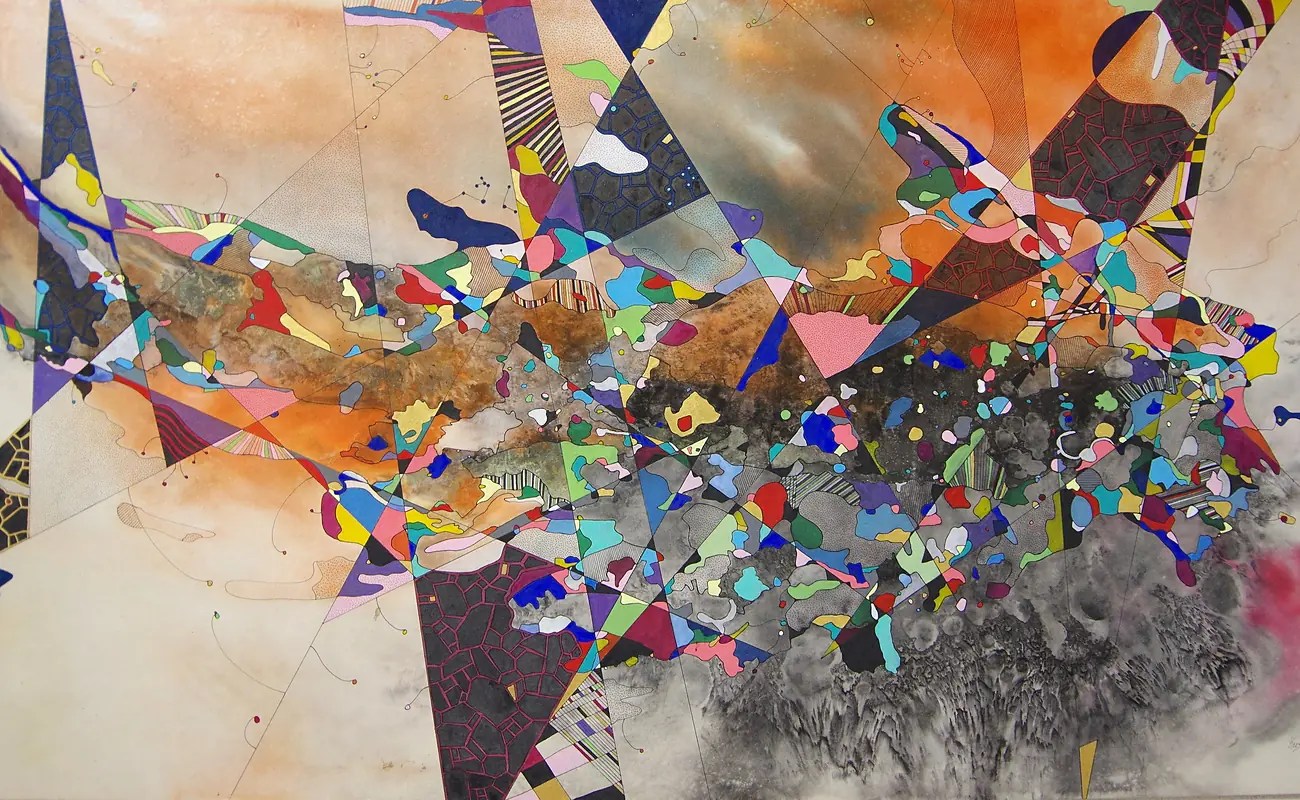
His practice has also expanded beyond stone while retaining the principles that shaped his sculpture. Drawings can begin with uncontrolled areas of ink, followed by lines, patterns, and enclosed forms that establish relationships around the initial marks. In ceramics, Ouwens works with mixed clays, reduction firing, charcoal, sawdust, volcanic sand, and locally sourced substances. Heat and process are allowed to leave visible evidence on the surfaces, much as natural patina remains present on stone. These methods reflect a consistent interest in what happens when deliberate decisions meet processes that cannot be entirely controlled.
At La Coyotera, that philosophy extends once again to other artists and the surrounding landscape. Ouwens initiated the annual Proyecto en Sitio, inviting artists to create artworks and installations for selected locations around the studio. Meanwhile, he continues pursuing residencies and commissions abroad while working daily in Mexico. He describes this period as a search for what kind of artist he is, making something meaningful each day, whether large or small, and judging it against his own standards. The uncertainty is intentional. After decades of experience, Ouwens is not trying to settle into a final identity. He is testing how far a practice built through Japan, landscape architecture, stone, and spatial composition can change when its maker chooses to begin again.