“Art does not necessarily give answers, but creates a space where something deeply human can exist without being fully resolved.”
Between Domestic Space and Emotional Terrain
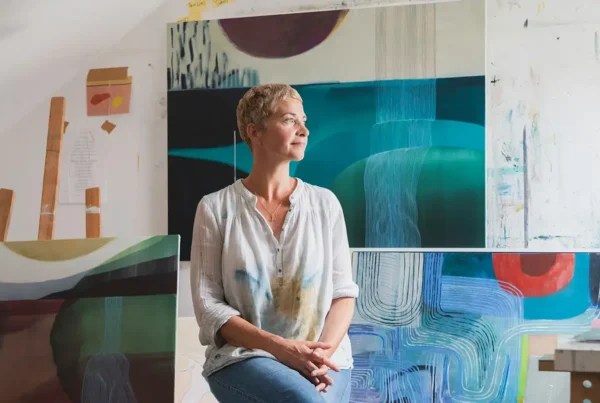
Katharina Grodzki builds paintings that carry the density of lived experience, where memory, atmosphere, and physical material merge into emotionally charged surfaces. Born into a German Polish working class family and now based in Norway, she arrived at painting through an unconventional route shaped by theatre, motherhood, exhaustion, and persistence. Before committing fully to her own practice, she spent many years working as a theatrical scenic painter at the State Theatre Mainz in Germany and later at the National Theatre in Bergen. Those years immersed her in a world of constructed illusion, light rehearsals, layered textures, and shifting emotional environments. The influence remains deeply visible in her paintings today, where surfaces behave almost like psychological stages and every object appears charged with quiet tension. Rather than separating art from ordinary life, Grodzki folds domestic rhythms, vulnerability, and personal history directly into the work itself.
Her relationship with art began long before she considered it a viable path. During adolescence, periods of bullying and social exclusion pushed her toward the public library, where she found refuge in the art section. Discovering the work of Egon Schiele became a formative moment that permanently altered her understanding of visual language. His ability to expose emotional discomfort without resolving it opened a space she would continue searching for throughout her own life. Drawing became a private method of translation, allowing difficult emotions and experiences to exist outside conventional speech. Even then, her artistic development resisted traditional structures. Although she briefly applied to art school, the academic environment felt disconnected from her instincts and experiences. Instead, her education unfolded through observation, labor, improvisation, literature, theatre production, and the accumulation of lived encounters.
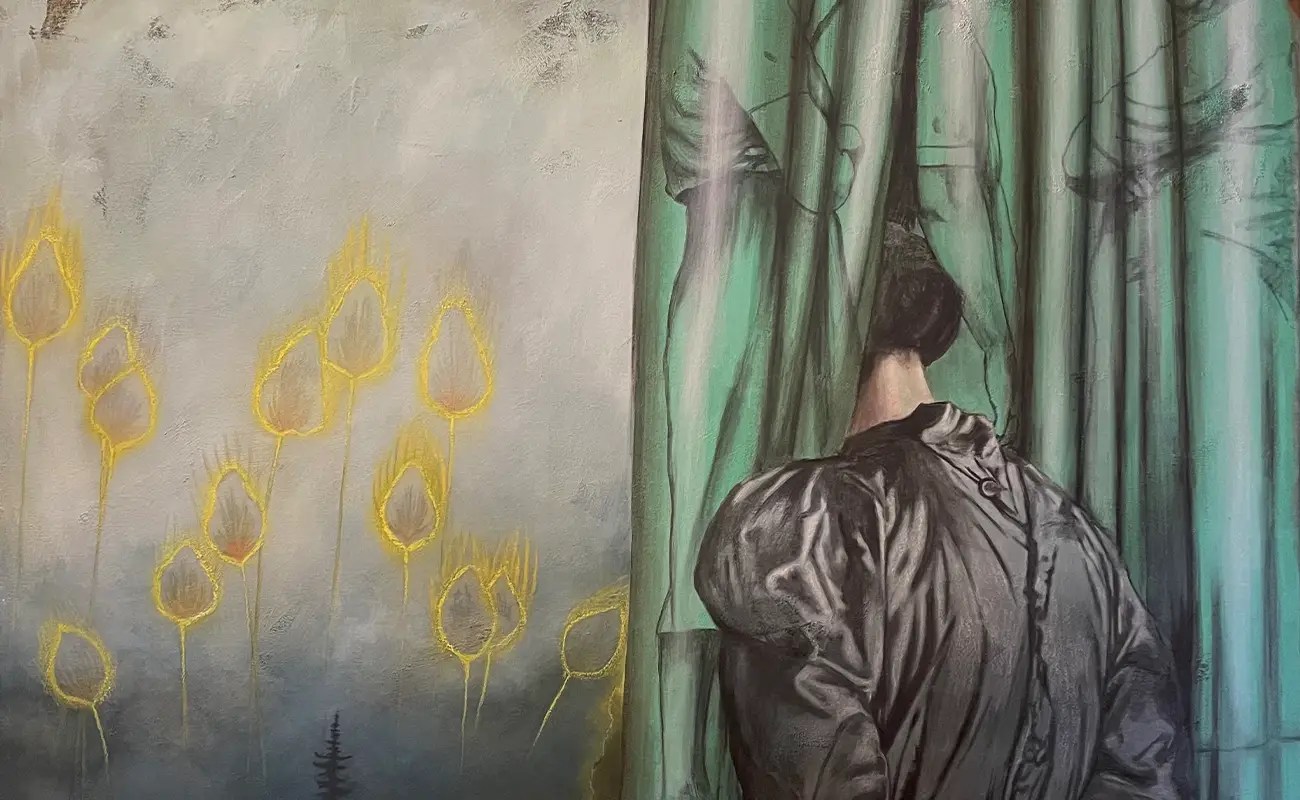
That layered background gives Grodzki’s paintings their unusual emotional weight. Her work frequently exists between figuration and abstraction while incorporating found textiles such as linen, velour, embroidered tablecloths, and chenille. These materials already contain traces of former lives, carrying marks of use, touch, intimacy, and domestic history. Instead of treating the fabric as a neutral support, she allows its previous existence to remain active within the painting. This approach reflects a broader interest in transformation and emotional survival. Her surfaces become places where private memory, collective experience, and physical material coexist without hierarchy. The paintings are not polished escapes from reality but porous objects shaped by motherhood, illness, fatigue, tenderness, and uncertainty. Through this openness, Grodzki constructs a body of work that feels deeply human precisely because it resists complete resolution.

Katharina Grodzki: Theatre Shadows and the Language of Surfaces
The theatre continues to shape nearly every aspect of Grodzki’s visual thinking. Fifteen years spent inside performance institutions across Europe trained her to observe how environments influence emotion and how surfaces can communicate psychological states before a single word is spoken. Scenic painting demanded constant adaptation, technical experimentation, and collaboration across departments, exposing her to changing materials and spatial strategies every day. Older theatre buildings fascinated her especially because they functioned as both hidden worlds and reflections of society itself. Behind thick walls existed elaborate systems of illusion, labor, vulnerability, and spectacle. Those experiences taught her to examine spaces slowly and attentively, noticing how light, texture, staging, and silence alter perception. In her studio practice today, paintings retain this theatrical sensitivity, often feeling suspended between narrative fragments and emotional atmospheres.
Her approach to making art remains highly intuitive and resistant to rigid planning. A painting may begin with a found image, a sentence from literature, a texture, or an indistinct emotional sensation before gradually shifting into something entirely unexpected. Grodzki often describes the process as a dialogue in which the painting eventually dictates its own direction. This openness allows accident and instability to become active collaborators rather than obstacles. Everyday conditions also enter directly into her work. Financial limitations have sometimes led her to purchase leftover paint mixtures from hardware stores, turning unwanted colors into the foundation for entire series. Similarly, fleeting moments from family life, conversations, books, or physical exhaustion frequently become embedded in the visual atmosphere of the paintings. Nothing exists outside potential transformation.
The boundaries between studio and domestic life are equally fluid. Grodzki works from home, describing the situation less as having a studio in her house and more as living inside the studio itself. Paintings remain hanging on walls throughout the family home for weeks or months while she observes them during ordinary routines such as reading with her children or playing cards. Distance and repetition become essential parts of the editing process. Rather than waiting for uninterrupted solitude or ideal working conditions, she has learned to construct her practice within the unpredictability of motherhood and daily responsibilities. Morning school preparations, practical tasks, after school schedules, and household interruptions exist alongside painting rather than opposing it. This integration gives her work a particular honesty because the paintings emerge directly from the unstable conditions of contemporary life instead of from protected artistic isolation.

The Weight of Touch, Memory, and Material
Material carries emotional significance throughout Grodzki’s practice, especially in her ongoing body of work titled Greetings from the Other Side. The series reflects periods of irreversible transformation connected to motherhood, illness, psychological change, relationships, and loss. Rather than presenting transformation as redemptive or simplified, the work acknowledges how experience complicates identity and exposes vulnerability. Grodzki is especially interested in the fragile structures people build around themselves, including social roles, personal narratives, and emotional facades. Beneath those constructions lies instability that can surface unexpectedly even during ordinary moments. Her paintings capture that uneasy coexistence between beauty and collapse, intimacy and distance, tenderness and fear. The domestic fabrics she paints on reinforce these themes because they already contain histories of use, care, touch, and time.
One particularly meaningful work within this evolving direction is Superior Whispers, painted in 2023 during a difficult period marked by illness within her family. Much of her daily life revolved around caring for her children, while nights became occupied by reading literature including The Jungle, Moby Dick, and poetry by William Carlos Williams and Wisława Szymborska. Long walks through the Norwegian countryside also shaped the emotional atmosphere of the piece, with her daughter carried on her back, her son on her chest, and her dog Neo accompanying them. These experiences filtered slowly into the painting, creating a work defined less by direct representation and more by emotional residue. For Grodzki, the piece marked a profound artistic shift toward atmosphere, physical presence, memory, and vulnerability. Looking back, she recognizes it as a turning point where her paintings began moving more decisively beyond representation alone.
Touch plays a crucial role in this exploration of emotional and material presence. Unlike many artists who protect their works from physical contact, Grodzki openly allows viewers to touch her paintings. She accepts that fingerprints, stains, grease marks, and wear may accumulate over time because she views these traces as extensions of the work’s life rather than damage. Many surfaces contain dense textures and physical structures that invite tactile interaction. This openness reflects her broader understanding of touch itself as something deeply ambivalent. Touch can comfort, connect, and create understanding, yet it can also wound or violate. The fabrics she uses already contain evidence of both realities through years of domestic use and human contact. A linen tablecloth employed in her painting The worst of the cases, for instance, came from an elderly woman and carried decades of tea gatherings, conversations, laughter, stains, and shared presence. Painting onto such material becomes less an act of replacement than a continuation of accumulated human experience.

Katharina Grodzki: Painting Beyond Resolution
The emotional atmosphere of Grodzki’s work is shaped not only by visual influences but also by literature, observation, and the unpredictable rhythms of daily life. She continuously gathers images from books, magazines, newspapers, films, internet archives, and second hand materials, building an expanding internal archive of references and impressions. During certain periods, she photographs women from her immediate environment and later uses those fragments as emotional entry points within paintings. These references rarely remain literal. Instead, they become absorbed into layered compositions where atmosphere matters more than narrative clarity. This sensitivity to ambiguity connects strongly with the artists she repeatedly returns to, including Paula Rego, Mamma Andersson, Serban Savu, Magdalena Abakanowicz, and Rinus Van de Velde. Their work resonates with her because it sustains emotional complexity without forcing complete explanation.
That refusal of fixed interpretation appears central to her philosophy of art itself. Grodzki often speaks about the importance of experiences that resist full understanding yet leave lasting emotional impact. She recalls encountering Kim Hankyul’s installation Shore and feeling profoundly affected without being able to articulate precisely why. For her, this uncertainty is not a weakness but an essential quality of meaningful art. The goal is not always resolution or clarity. Instead, art can create a space where emotional contradictions remain active and visible. This perspective connects directly to her own paintings, which rarely provide singular narratives or definitive emotional conclusions. Figures emerge partially obscured, materials hold traces of prior histories, and domestic objects become carriers of unresolved psychological tension. Viewers are invited to remain inside uncertainty rather than escape from it.
Motherhood ultimately became the force that pushed Grodzki fully into her own artistic identity after years spent supporting the visions of others within theatre production. Following the births of her daughter and son, she recognized an increasing urgency to create work that belonged entirely to her own voice. What initially appeared to threaten artistic possibility instead opened a new direction grounded in honesty, transformation, and emotional endurance. Her paintings now exist as records of ongoing negotiation between care and autonomy, fragility and resilience, intimacy and distance. Through layered fabrics, theatrical sensitivity, and emotionally charged surfaces, Grodzki constructs works that acknowledge the instability of contemporary existence while still insisting on connection. The result is a body of work that feels physically grounded yet psychologically open, shaped by the understanding that life rarely resolves neatly even after profound change.